
How to Get a Job in the PMO: Eligibility, Recruitment Routes, Salary and Career Options Explained
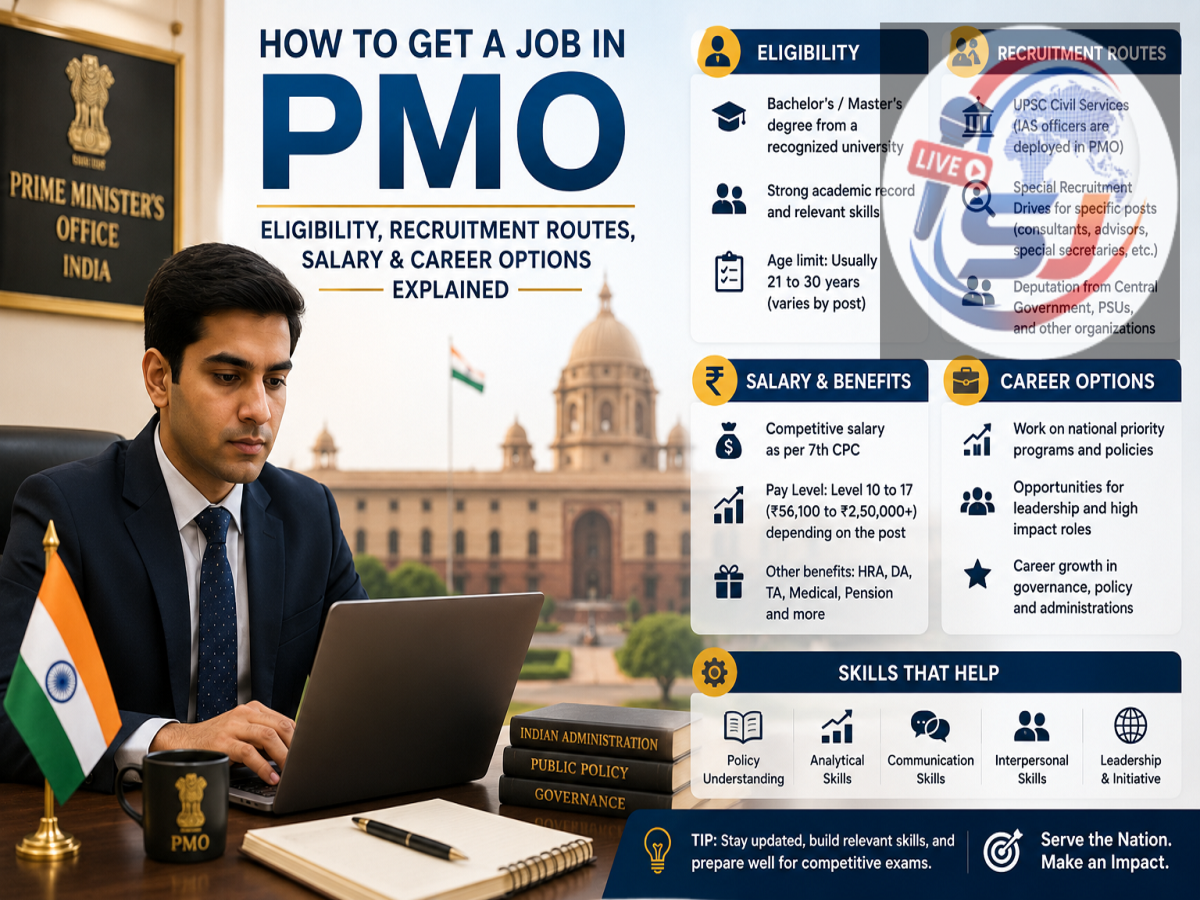
PMO Jobs and Eligibility: Working at the Prime Minister's Office (PMO) is a career aspiration for many government job seekers in India. As one of the country's most important administrative offices, the PMO is involved in coordinating key government matters, monitoring major initiatives and supporting the Prime Minister in the discharge of official responsibilities.
However, getting a job in the PMO is different from applying for a typical government vacancy. There is no single examination through which every employee enters the office. Many officers serving in the PMO come from established government services and are appointed or deputed after gaining relevant experience.
So, what qualifications are required to work in the PMO, which examinations can provide a pathway, and how much can employees earn? Here is an overview.
Can You Get a Job in the PMO Directly?
Direct recruitment specifically for the Prime Minister's Office is relatively limited compared with recruitment across larger government departments.
A significant number of officers working in the PMO are drawn from different ministries, departments, civil services and other government organisations.
Appointments depend on the position, experience, service record and requirements of the office. Consequently, candidates interested in eventually working in the PMO generally first need to enter an appropriate government service and build relevant professional experience.
For some specialised requirements, professionals with expertise in fields such as economics, public policy or technology may also be considered through applicable government recruitment or engagement mechanisms.
UPSC Civil Services Can Provide a Route to the PMO
One of the prominent career routes is the UPSC Civil Services Examination (CSE).
Candidates who clear the examination and meet the applicable service-allocation requirements may enter services such as the Indian Administrative Service (IAS), Indian Police Service (IPS) and other participating civil services.
Clearing UPSC, however, does not automatically guarantee a posting in the PMO.
Civil servants typically work in various field assignments, ministries or departments and build administrative experience. Depending on their service record, expertise, seniority and the government's requirements, some may later be considered for postings or deputation to the PMO.
Therefore, candidates should view the Civil Services Examination as one possible pathway into government administration rather than a direct PMO recruitment examination.
Experienced Central Government Officers May Also Be Posted in PMO
Civil services are not the only potential route.
Officers already working in ministries and departments of the central government may also be appointed to positions in the PMO according to applicable staffing arrangements.
Posts can include administrative roles at different levels, such as Section Officer, Under Secretary, Deputy Secretary, Director and Joint Secretary, depending on the organisational structure and vacancies.
Selection for such positions can involve factors such as professional experience, performance record, domain expertise and suitability for the responsibilities concerned.
This means government employees who build strong careers in relevant ministries may potentially have opportunities to work in the PMO without necessarily beginning their careers there.
Specialists and Advisers May Also Be Required
Modern government administration requires expertise extending beyond traditional administrative roles.
Depending on requirements, professionals with backgrounds in areas such as economics, finance, technology, data, public policy, infrastructure or strategic affairs may be engaged in specialised capacities.
Educational qualifications for such positions depend on the job profile. A role involving economic policy, for instance, may require advanced qualifications and substantial experience in economics or finance, while technology-related work may require relevant technical education and professional expertise.
Strong analytical abilities, communication skills and an understanding of government processes can also be important.
Candidates interested in specialist opportunities should rely on official vacancy notifications for the exact eligibility requirements rather than assuming that one qualification applies to every PMO position.
What Is the Salary of an IAS Officer?
Government salaries are determined primarily by the employee's post, service, seniority and pay level, rather than simply by the fact that the person works in the PMO.
Under the existing central government pay structure, the entry-level basic pay commonly associated with an IAS officer begins at ₹56,100 per month at the applicable level of the pay matrix.
As officers gain seniority and move to higher administrative positions, their basic pay increases according to the prescribed government pay structure.
At senior levels, basic monthly pay can exceed ₹1 lakh and reach approximately ₹2.5 lakh at the highest levels of the government pay hierarchy, subject to the position and applicable rules.
These figures generally refer to basic pay rather than the employee's final take-home salary.
How Much Can Other PMO Employees Earn?
Pay for other officials similarly depends on the post and corresponding level in the government pay matrix.
For example, some administrative positions may have basic pay beginning around ₹44,900, while higher positions can carry substantially greater basic salaries.
The source report cites a range extending to around ₹1,42,400 for certain posts, depending on level and progression.
Specialists, consultants and advisers may have different compensation structures. The report indicates that remuneration for some such roles could range from around ₹80,000 to ₹2 lakh per month or more, depending on experience and the terms of engagement.
However, these amounts should not be treated as a universal PMO salary scale. Candidates should check the official notification for the specific position to determine the applicable pay level, remuneration and benefits.
Government Allowances Can Increase Overall Compensation
Eligible government officials may receive allowances and benefits in addition to basic pay.
Depending on the employee's service conditions, posting and entitlement, these may include Dearness Allowance (DA), House Rent Allowance (HRA), transport-related benefits, medical facilities and other government benefits.
Government accommodation may also be available to eligible officers according to entitlement and availability.
The final monthly salary can therefore differ considerably between two employees even if their basic pay appears similar.
What Skills Are Important for Working in the PMO?
Academic qualifications and government experience are only part of the requirements for sensitive administrative assignments.
Officials working in high-level government offices may need strong communication, analytical, administrative and coordination skills. They may also handle sensitive information and work on matters requiring accuracy, confidentiality and timely decision-making.
An understanding of government procedures, policy implementation and inter-ministerial coordination can be particularly valuable for senior administrative roles.
The nature of the work can also involve significant responsibility and demanding schedules.
How Should Aspirants Prepare for a PMO Career?
Candidates hoping to work in the PMO should first identify which career route best matches their qualifications.
Those interested in senior administrative careers may consider preparing for the UPSC Civil Services Examination or other appropriate government recruitment processes. Candidates already working in government can focus on building relevant experience and a strong professional record.
Specialists should develop expertise in their chosen domain and monitor official government recruitment channels for suitable opportunities.
Most importantly, aspirants should remember that there is no guaranteed shortcut to a PMO posting. Clearing a government examination may provide entry into public service, but subsequent PMO appointments depend on the position, eligibility conditions, experience and staffing requirements.
Where Should You Check for Genuine PMO Vacancies?
Job seekers should rely only on official government recruitment notices and authorised portals when looking for PMO-related vacancies.
Advertisements claiming to guarantee direct jobs in the Prime Minister's Office in exchange for money should be treated with caution.
Before submitting an application, candidates should verify the recruiting authority, eligibility criteria, pay level, application procedure and deadline from the official notification.
For most aspirants, a career in the PMO is best understood as a longer-term opportunity that may follow entry into government service, professional development and relevant administrative experience—not as a single recruitment examination with guaranteed placement.