
Education Loan for Students: Should the Borrower Be the Student or Parent? Know What Works Better
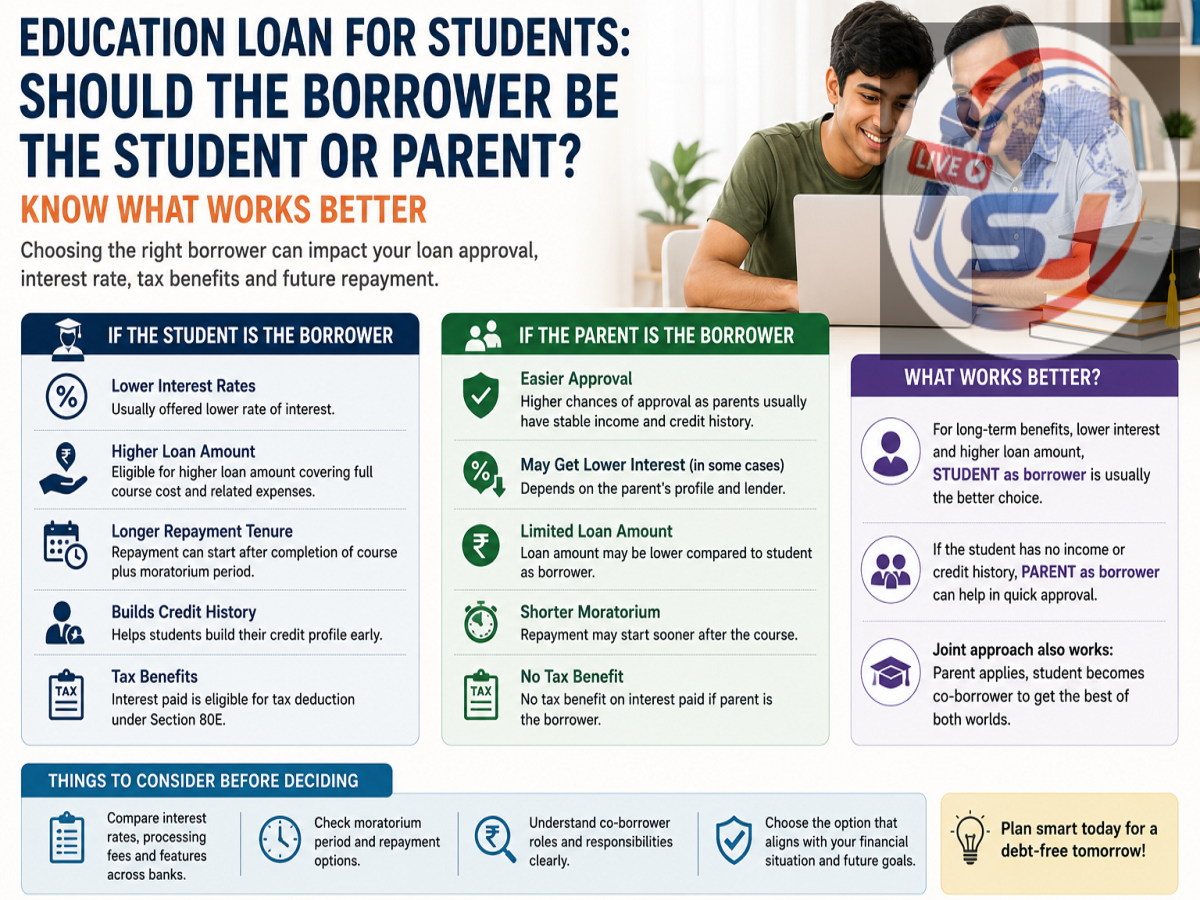
Higher education can be expensive, particularly when a student is admitted to a private university, professional programme or an overseas institution. Tuition fees, accommodation, books, travel and other expenses can place a substantial financial burden on a family. Education loans are designed to bridge this funding gap, but one question often creates confusion: should the loan be taken in the student's name or the parent's name?
In a typical education loan structure, the student is the primary borrower, while a parent or guardian joins the application as a co-applicant or co-borrower. Since most students do not have a regular income or established credit history when they begin college, the parent's financial profile can play an important role in the lender's assessment.
However, loan structures and eligibility requirements can differ between banks and schemes. Families should therefore evaluate repayment capacity, interest costs, moratorium rules and future financial commitments before borrowing.
How Does an Education Loan Usually Work?
Unlike a regular personal loan taken by a salaried individual, an education loan is linked to the student's academic programme and future earning potential.
Banks generally consider several factors before approving an application. These may include the course, educational institution, expected employment prospects, loan amount and the financial profile of the co-applicant.
Where a parent is included as a co-applicant, their income, existing debts, credit score and repayment capacity may also be assessed.
For larger loan amounts, additional documentation or collateral may be required depending on the lender's policy and applicable scheme.
What Are the Benefits of Keeping the Student as the Primary Borrower?
Making the student the primary applicant reflects the fundamental purpose of an education loan—the money is being borrowed to finance that student's education.
After completing the course and the applicable moratorium period, the student can begin repaying the loan once they start earning, subject to the repayment terms.
Regular and timely repayments can also help the student establish a credit history. A good repayment record may become useful later when applying for other forms of credit, such as a vehicle loan, credit card or home loan.
This structure can also prevent parents from taking the entire education debt solely in their own name.
However, a student without income will generally find it difficult to qualify independently for a substantial loan. This is why lenders commonly require a financially capable parent or guardian to participate in the application.
Why Does the Parent's Financial Profile Matter?
Even when the student is listed as the main borrower, the lender may rely heavily on the co-applicant's financial strength while evaluating the loan.
A parent with stable income, manageable existing debt and a healthy credit profile can strengthen the application.
The lender may examine salary or business income, bank statements, existing EMIs and credit history to determine whether the household can meet its obligations if required.
Parents should remember that becoming a co-borrower is not merely a formality. Depending on the loan agreement, a co-borrower can have legal responsibility for repayment.
Therefore, the terms should be read carefully before signing.
When Can Greater Parental Involvement Make Sense?
Some families prefer to begin servicing the loan while the student is still studying rather than waiting until graduation.
This may be practical when the parents have sufficient and stable income.
For example, paying interest during the study period can potentially prevent unpaid interest from accumulating and increasing the overall outstanding amount. The exact benefit will depend on the loan's interest calculation and repayment terms.
Starting payments early can also reduce the debt burden the student faces when entering the workforce.
But parents should avoid sacrificing essential financial goals simply to repay the education loan faster.
If additional EMIs substantially reduce retirement savings, emergency funds, insurance coverage or money required for another child's education, the repayment strategy may need to be reconsidered.
Understand the Moratorium Before Taking the Loan
The moratorium period is one of the most important features of an education loan.
Depending on the lender and scheme, borrowers may not be required to begin regular EMI payments immediately after the loan is disbursed. Repayment can generally start after the course and an additional specified period.
However, a moratorium does not necessarily mean that the loan remains interest-free.
Interest may continue to accrue during the study and moratorium periods according to the loan terms. If this interest is not paid, it can increase the amount that eventually needs to be repaid.
Borrowers should specifically ask the lender how interest will be treated during this period.
Don't Choose an Education Loan Based Only on Interest Rate
A lower advertised interest rate can be attractive, but it should not be the only factor used to select a lender.
Before signing an education loan agreement, compare:
-
The total loan amount and applicable interest rate
-
Whether the rate is fixed or floating
-
How interest is calculated during the study period
-
Duration of the moratorium
-
When regular EMIs will begin
-
Maximum repayment tenure
-
Processing fees and other charges
-
Collateral or security requirements
-
Co-applicant eligibility conditions
-
Prepayment or foreclosure terms
-
Availability of eligible government subsidies or support schemes
Comparing the total cost of borrowing is more useful than looking only at the headline interest rate.
Check Whether Collateral Is Required
Security requirements can vary according to the size of the education loan, lender and applicable lending programme.
Smaller education loans may be available without tangible collateral under certain policies or government-supported frameworks. Higher-value loans, particularly for expensive courses, may require additional security.
Banks may accept eligible assets according to their lending rules.
Families should understand these requirements before paying large non-refundable admission deposits, especially when they are relying heavily on an education loan to finance the course.
Consider the Student's Expected Income After Graduation
Future earning potential is another important consideration.
A large education loan can appear manageable while the student is studying, but the real financial impact becomes apparent when repayments begin.
Families should estimate the EMI and compare it with a realistic starting salary for graduates of the selected course rather than assuming an exceptionally high package.
If the expected EMI would consume a very large portion of the student's likely monthly income, taking a smaller loan or increasing the family's upfront contribution may be safer.
The objective should be to fund education without creating an unmanageable financial burden immediately after graduation.
Student or Parent: Which Option Is Better?
For most students who do not have an independent income, a practical structure is often to have the student as the primary borrower and a parent or guardian as the co-applicant, subject to the lender's rules.
The student's education and future career remain central to the loan, while the parent's financial standing can support eligibility and approval.
Families with sufficient income may choose to service some or all of the interest during the study period to reduce the eventual burden. Alternatively, they may wait until the repayment schedule formally begins if cash flow is limited.
Ultimately, the name on the loan is only one part of the decision. What matters more is whether the family understands the total borrowing cost, repayment obligations, moratorium conditions and risks involved.
A well-planned education loan should help a student pursue higher education without placing excessive pressure on either the student's future income or the parents' long-term financial security.