
₹50 Lakh EPF at Retirement? See How It Could Generate ₹16,700–₹20,800 Monthly Cash Flow
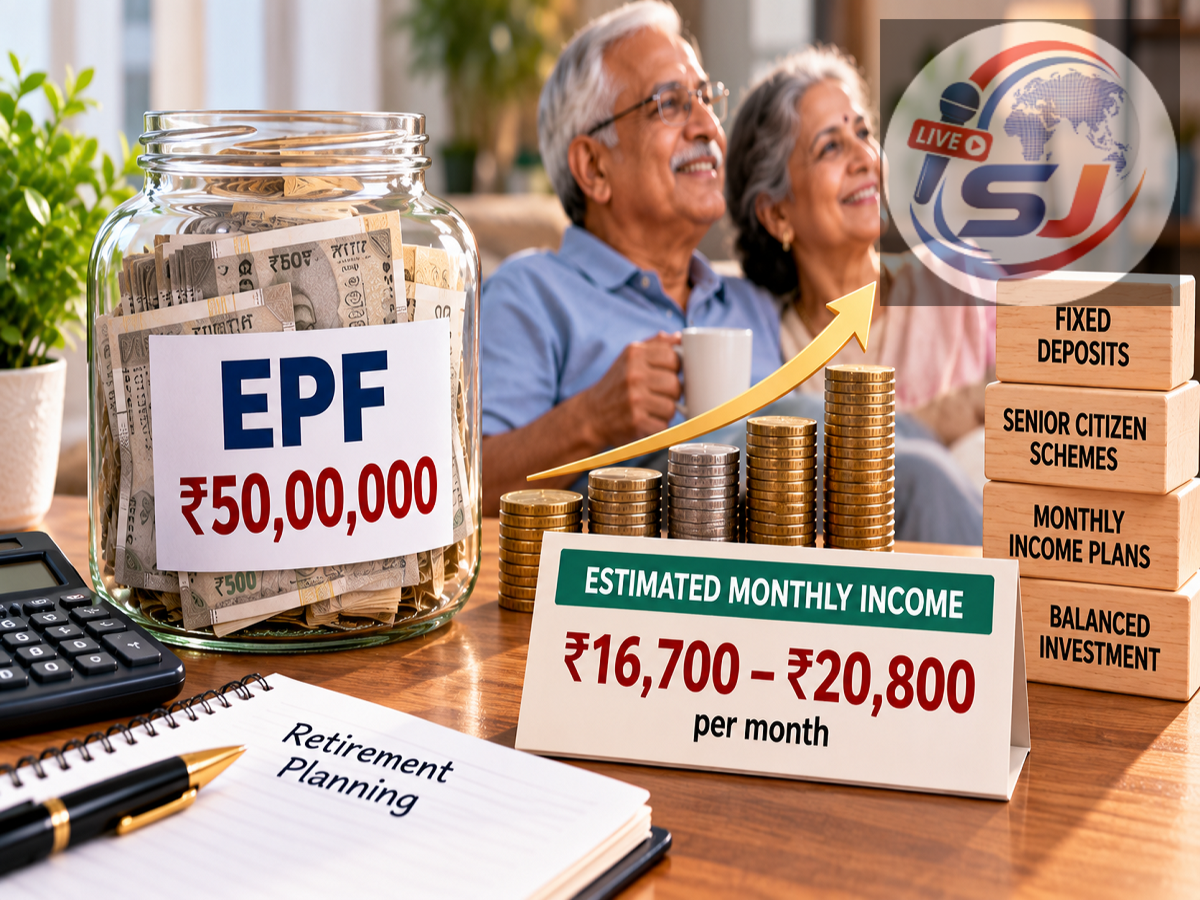
EPF Retirement Planning: Building a ₹50 lakh EPF corpus by retirement is a major milestone, but accumulating the money is only one part of retirement planning. Once regular salary stops, the bigger question is how that corpus can be managed to support monthly expenses without being exhausted too quickly.
Instead of keeping the entire amount in one place, retirees may consider dividing their savings among fixed-income products, debt investments, growth-oriented assets and a readily accessible emergency reserve, depending on their age, expenses, pension income, tax position and tolerance for market risk.
One illustrative strategy discussed by financial professionals divides a ₹50 lakh retirement corpus into four separate buckets. Here is how the calculation works.
How Could a ₹50 Lakh Retirement Corpus Be Divided?
An example allocation could place the largest share in relatively stable fixed-income investments, followed by debt, a smaller allocation to equity and a separate emergency fund.
| Investment Category | Allocation | Amount |
|---|---|---|
| Fixed Income | 45% | ₹22.50 lakh |
| Debt Investments | 32.50% | ₹16.25 lakh |
| Equity | 17.50% | ₹8.75 lakh |
| Emergency Fund | 5% | ₹2.50 lakh |
| Total | 100% | ₹50 lakh |
This is only an illustration. A 60-year-old retiree with a substantial pension and limited monthly expenses could have very different requirements from someone with no pension, significant medical expenses or financial dependants.
Therefore, asset allocation should not be copied simply because the total EPF corpus is ₹50 lakh.
₹22.50 Lakh in Fixed Income: How Much Could It Generate?
Under this illustrative allocation, ₹22.50 lakh, or 45% of the corpus, is assigned to fixed-income investments.
Depending on eligibility and prevailing rates, this bucket could include options such as the Senior Citizens' Savings Scheme (SCSS), bank fixed deposits and other suitable fixed-income products.
Suppose this ₹22.50 lakh earns an average 7% annually.
The approximate annual income would be:
₹22,50,000 × 7% = ₹1,57,500
That works out to roughly:
₹1,57,500 ÷ 12 = ₹13,125 per month
This does not necessarily mean the retiree will literally receive ₹13,125 every month. Different products pay interest monthly, quarterly, annually or at maturity.
Taxation can also reduce the amount available for spending.
Why Put ₹16.25 Lakh in Debt Investments?
The example assigns another 32.5%, or ₹16.25 lakh, to debt-oriented investments.
The objective of this portion is to provide diversification and potentially lower volatility than an equity-heavy portfolio.
If this portion generated an assumed average return of 6.5% a year, the mathematical annual growth would be:
₹16,25,000 × 6.5% = ₹1,05,625
However, this should not be described as guaranteed interest.
Debt mutual funds and similar market-linked products can fluctuate because of interest-rate movements, credit events and other risks. Their tax treatment can also differ from that of traditional bank deposits.
A retiree should therefore distinguish between a guaranteed fixed-income product and a market-linked debt investment.
Why Keep Some Retirement Money in Equity?
It may seem counterintuitive to invest in equity after retirement, but a retirement period can potentially last for decades.
Inflation is one of the biggest long-term challenges.
If every rupee is held in instruments that barely keep pace with rising living costs, the retiree's purchasing power may decline over time.
The illustrative strategy therefore assigns 17.5%, or ₹8.75 lakh, to equity-oriented investments.
Depending on the retiree's risk profile, such exposure could potentially be taken through diversified equity, index-oriented or suitable hybrid strategies.
If ₹8.75 lakh generated an assumed long-term return of 10%, the mathematical annual growth would be approximately:
₹8,75,000 × 10% = ₹87,500
But this ₹87,500 is not guaranteed income.
Equity can produce negative returns over shorter periods, and even long-term returns cannot be promised in advance.
Don't Treat a 10% Equity Return as Guaranteed
This distinction is particularly important in retirement.
A projection may assume 10% annual growth to demonstrate how a portfolio could behave, but actual equity returns can be significantly higher or lower.
A retiree should not plan essential monthly expenses on the assumption that the stock market will deliver 10% every year.
The role of equity in a retirement portfolio is generally longer-term growth rather than guaranteed monthly income.
How Much Can You Withdraw Monthly From ₹50 Lakh?
The next question is how much of the ₹50 lakh corpus can be used each year.
The source discusses an illustrative annual withdrawal range of 4% to 5%.
At a 4% initial withdrawal rate:
₹50,00,000 × 4% = ₹2,00,000 a year
That equals approximately:
₹16,667 per month
Rounded off, the retiree would have an initial monthly cash-flow target of around ₹16,700.
At a 5% withdrawal rate:
₹50,00,000 × 5% = ₹2,50,000 a year
That equals approximately:
₹20,833 per month
So the illustrative starting monthly withdrawal range becomes approximately ₹16,700 to ₹20,800.
Does a 4% Withdrawal Mean the Money Will Never Run Out?
No.
A 4% or 5% withdrawal rate is a planning assumption, not a guarantee that the corpus will last for life.
How long ₹50 lakh lasts depends on many variables, including investment returns, inflation, taxes, medical costs, longevity and whether withdrawals increase every year.
For example, a retiree withdrawing ₹20,000 per month today may need considerably more for the same lifestyle 10 or 20 years later because of inflation.
Market returns are also uneven. A portfolio could perform strongly for several years and then experience a major decline.
This is why retirement planning should consider the sequence in which investment returns occur, not merely the long-term average.
Keep One to Two Years of Expenses Accessible
One way to manage market volatility is to maintain a separate pool of readily accessible money.
Suppose household expenses are ₹20,000 per month.
One year of expenses would be:
₹20,000 × 12 = ₹2.40 lakh
Two years would require:
₹20,000 × 24 = ₹4.80 lakh
Keeping an appropriate liquidity reserve can help a retiree avoid selling equity investments during a major market decline merely to pay routine household bills.
The amount needed depends on other sources of regular income, such as pension, rent, annuity or family income.
Why an Emergency Fund Is Different
The illustrative ₹50 lakh allocation separately keeps ₹2.50 lakh, or 5%, as an emergency reserve.
This money has a different purpose from the regular monthly-expense bucket.
An emergency reserve could be required for unexpected medical expenses, urgent home repairs, family emergencies or other unplanned costs.
It should generally be held where it can be accessed easily rather than being locked away solely to earn the highest possible return.
For retirees, liquidity can be just as important as investment performance.
Inflation Can Quietly Reduce Purchasing Power
Consider someone spending ₹30,000 a month at the beginning of retirement.
If living costs rise over time, ₹30,000 may no longer buy the same goods and services 10 years later.
This is why focusing only on nominal returns can be misleading.
A retirement plan should consider real returns, meaning the investment return after accounting for inflation.
For instance, earning 7% when inflation is 6% provides a much smaller improvement in purchasing power than the headline 7% figure suggests.
Should the Entire EPF Corpus Be Put Into FDs?
Fixed deposits can be useful in retirement because they offer predictable returns and are relatively easy to understand.
However, placing the entire retirement corpus in a single product can create concentration and reinvestment risks.
FD interest is also generally taxable according to applicable income-tax rules, which can reduce post-tax returns.
Another consideration is that interest rates available when an FD matures may be lower than those available when it was originally opened.
Retirees should therefore evaluate returns after tax and inflation rather than looking only at the advertised FD rate.
SCSS Can Be Part of the Fixed-Income Bucket
Eligible senior citizens may also evaluate the Senior Citizens' Savings Scheme as part of their fixed-income planning.
SCSS is government-backed and provides periodic interest according to the rate applicable to the investment.
However, the scheme has its own eligibility conditions, deposit limits, tenure, premature-closure rules and tax treatment.
The applicable interest rate can also be revised for new investments from time to time.
Therefore, retirees should check the prevailing rules before allocating money.
Retirement Planning Changes the Purpose of Your Money
During working years, the primary goal may be accumulation.
After retirement, the objective changes.
The portfolio may now need to perform several jobs simultaneously:
It must provide cash for monthly expenses, maintain sufficient liquidity for emergencies, protect part of the capital, and potentially grow enough to help offset inflation over a retirement that could last decades.
That is why a retirement portfolio often requires a different structure from an accumulation portfolio.
Don't Ignore Other Sources of Retirement Income
A ₹50 lakh EPF corpus should not always be analysed in isolation.
A retiree may also receive EPS pension, NPS pension, rental income, annuity payments, interest income or another pension.
Suppose monthly household expenses are ₹40,000 but a pension already provides ₹25,000.
In that case, the investment portfolio only needs to cover the remaining gap initially, rather than generating the full ₹40,000.
This can substantially change the required withdrawal rate and asset allocation.
Medical Expenses Need Separate Attention
Healthcare expenses can rise significantly with age.
A retirement plan based only on routine monthly household expenditure may therefore underestimate future cash requirements.
Retirees should separately assess health-insurance coverage and potential out-of-pocket medical expenses.
Using the entire emergency fund for ordinary monthly spending can leave the household financially vulnerable when a genuine emergency occurs.
Rebalance the Portfolio Periodically
A portfolio that starts with 17.5% equity will not necessarily remain at that level.
If equity markets rise sharply, its share of the total portfolio can increase. If markets fall, it can decrease.
Periodic rebalancing can help bring the portfolio back toward the retiree's chosen risk level.
Rebalancing should be based on financial needs and risk tolerance rather than attempts to predict short-term market movements.
₹50 Lakh Can Generate Cash Flow, but Planning Matters
A ₹50 lakh EPF corpus can provide an important financial foundation after retirement, but there is no universal formula for investing it.
In the illustrative allocation above, ₹22.50 lakh goes to fixed income, ₹16.25 lakh to debt investments, ₹8.75 lakh to equity and ₹2.50 lakh to an emergency fund.
An initial withdrawal of 4% to 5% of the ₹50 lakh corpus translates to approximately ₹16,700 to ₹20,800 per month.
But these figures should not be mistaken for guaranteed lifelong income.
Actual sustainability will depend on investment performance, inflation, taxes, healthcare costs, other pension income, future withdrawals and the retiree's lifespan.
For someone approaching retirement, the key objective is not simply earning the highest return. It is creating a structure that can provide income, liquidity, stability and long-term purchasing power while keeping investment risk at a level the retiree can manage.
Disclaimer: The allocations, returns and withdrawal calculations in this article are illustrative examples only and do not constitute investment advice. Returns from equity, debt funds and other market-linked products are not guaranteed. Interest rates, tax rules and government-scheme conditions can change. Retirees should consider their expenses, liabilities, pension income, health needs, tax position and risk tolerance and consult an appropriately qualified financial professional before making investment decisions.