
₹10 Lakh FD Monthly Income: How Much Interest Can You Earn Every Month at 6% to 8%?
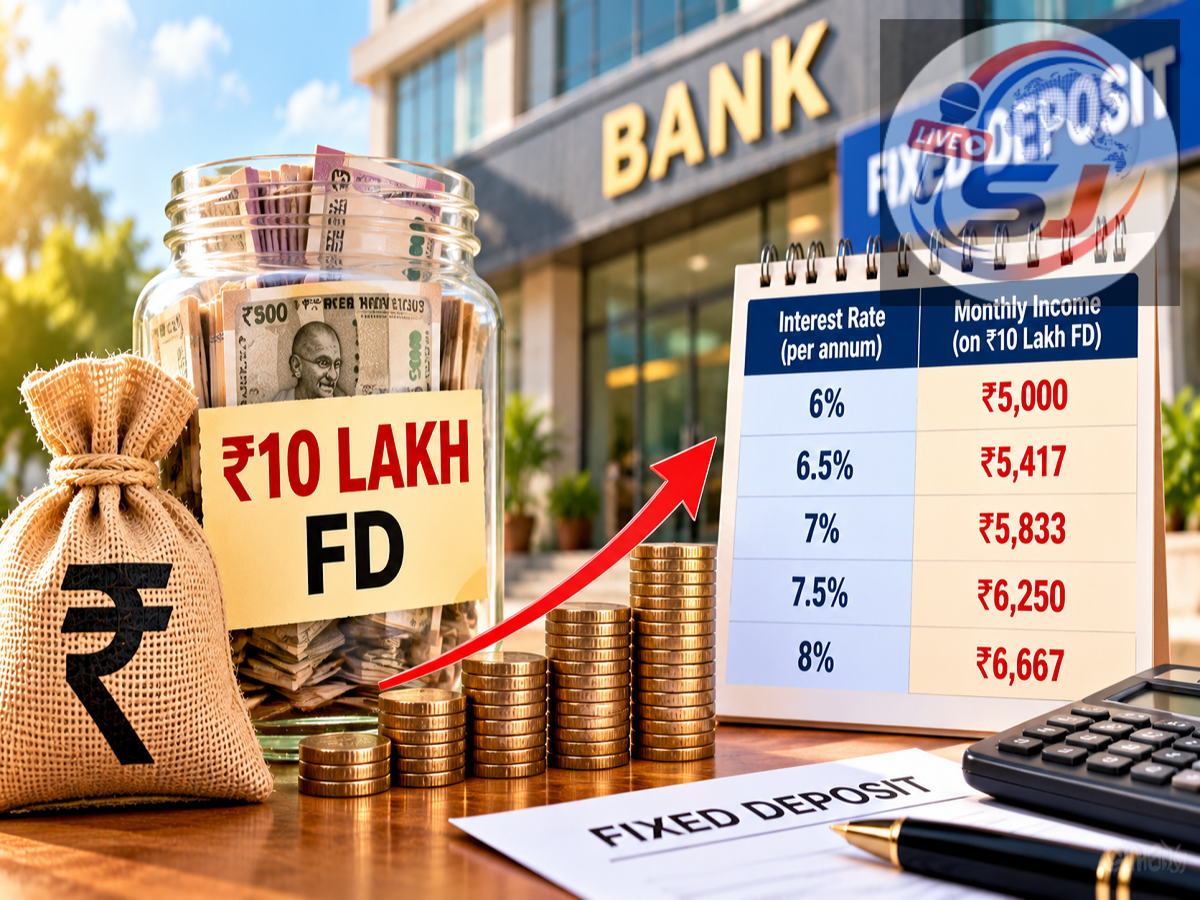
FD Monthly Income Calculation: A fixed deposit can be an option for people who have a lump sum of money and want to generate a predictable stream of interest income without immediately using the principal. If you invest ₹10 lakh in an FD, the amount you can receive every month will largely depend on the interest rate offered by the bank and the interest payout option you select.
For instance, a ₹10 lakh deposit earning 6% annually generates roughly ₹60,000 in interest over a year on a simple annual calculation. At 8%, the corresponding annual interest rises to around ₹80,000.
However, the actual monthly amount credited by a bank can differ because FD interest calculations and payout conventions vary across products.
How Does a Monthly Income FD Work?
Banks generally offer two broad ways of receiving interest from fixed deposits: cumulative and non-cumulative.
In a cumulative FD, the interest is added back to the deposit and compounds during the tenure. The investor normally receives the principal along with accumulated interest when the FD matures.
A non-cumulative FD, on the other hand, is designed for investors who want regular cash flow. Depending on the bank and product, interest may be paid monthly, quarterly, half-yearly or annually.
Therefore, someone investing ₹10 lakh primarily to generate monthly income should check whether the FD offers a monthly interest payout facility.
How Much Can ₹10 Lakh Generate at 6% Interest?
Suppose ₹10 lakh is invested at an annual interest rate of 6%.
A simple calculation gives:
₹10,00,000 × 6% = ₹60,000 a year
Dividing ₹60,000 by 12 gives an indicative monthly income of:
₹60,000 ÷ 12 = ₹5,000
So, at a 6% annual rate, ₹10 lakh could generate approximately ₹5,000 per month before tax, based on a simple annual interest calculation.
What If the FD Rate Is 7%?
If the same ₹10 lakh deposit earns 7% per annum, the calculation becomes:
₹10,00,000 × 7% = ₹70,000 a year
The indicative monthly equivalent would be:
₹70,000 ÷ 12 = approximately ₹5,833
This means a one-percentage-point increase from 6% to 7% increases the simple annual interest by ₹10,000.
₹10 Lakh FD at 8%: Monthly Income Calculation
At an annual interest rate of 8%, a ₹10 lakh deposit would generate approximately:
₹10,00,000 × 8% = ₹80,000 annually
Dividing this by 12 gives:
₹80,000 ÷ 12 = approximately ₹6,667 per month
Therefore, the difference between a 6% and 8% interest rate on ₹10 lakh is around ₹20,000 in annual interest, based on this simple calculation.
₹10 Lakh FD Income at Different Interest Rates
Here is an easy comparison of the indicative returns:
| FD Interest Rate | Approx. Annual Interest | Approx. Monthly Equivalent |
|---|---|---|
| 6.00% | ₹60,000 | ₹5,000 |
| 6.50% | ₹65,000 | ₹5,417 |
| 7.00% | ₹70,000 | ₹5,833 |
| 7.50% | ₹75,000 | ₹6,250 |
| 8.00% | ₹80,000 | ₹6,667 |
These figures are illustrative calculations based on ₹10 lakh and the stated annual rates. The actual monthly payout offered by a bank may be different depending on its interest-calculation method, payout frequency and FD terms.
FD Rates Can Differ From One Bank to Another
Fixed deposit interest rates are not identical across banks. They can vary according to the deposit tenure, deposit amount and customer category.
Many large banks may offer different rates across their FD tenures, while some small finance banks may offer comparatively higher rates on selected maturity periods.
Senior citizens may also receive an additional interest-rate benefit on eligible deposits at many banks.
Therefore, investors should compare not only the headline interest rate but also the tenure, premature withdrawal conditions, payout frequency and other applicable terms before opening an FD.
What Happens to the Original ₹10 Lakh?
In a regular non-cumulative FD where only the interest is periodically withdrawn, the ₹10 lakh principal generally remains invested until maturity, subject to the terms of the deposit.
For example, if the FD provides a monthly interest payout, the investor receives the applicable interest while the principal remains deposited with the bank.
At maturity, the principal is returned according to the FD terms.
However, if an investor closes the deposit before maturity, the bank's premature withdrawal rules may apply. This can include a lower applicable interest rate and/or a premature closure penalty.
Checking these conditions before investing is especially important for anyone who may need access to the principal during the FD tenure.
Remember the Tax on FD Interest
The monthly figures mentioned above represent pre-tax indicative interest, not necessarily the amount an investor will ultimately retain after taxes.
Interest earned from bank fixed deposits is generally taxable according to applicable income-tax rules. The actual tax liability depends on factors including the investor's total taxable income and the tax provisions applicable to them.
TDS provisions may also apply when interest crosses the relevant threshold, subject to prevailing rules and eligibility.
For this reason, investors comparing two FDs should consider the post-tax return, not just the advertised interest rate.
Is a Monthly Payout FD Suitable for Regular Income?
A monthly interest payout FD can provide predictable cash flow for investors who prefer regular income while keeping the principal invested. It may be particularly useful for people looking to supplement monthly household expenses.
However, investors should understand the trade-off between receiving interest regularly and allowing it to compound.
With a cumulative FD, interest remains invested and can earn additional interest over time. With a monthly payout option, the interest is distributed instead, which can reduce the benefit of compounding.
For a ₹10 lakh FD, an indicative monthly equivalent can range from around ₹5,000 at 6% to ₹6,667 at 8%, before tax. The final amount received will depend on the bank's actual FD rate, payout methodology, tenure and applicable tax treatment.
Disclaimer: This article is intended only for general information and financial awareness. Interest rates, tax provisions and FD terms can change. Investors should verify the latest terms with the relevant bank and consider professional financial or tax advice before making investment decisions.