
Yearly SIP vs Monthly SIP: 5 Things to Check Before Investing a Lump Sum Every Year
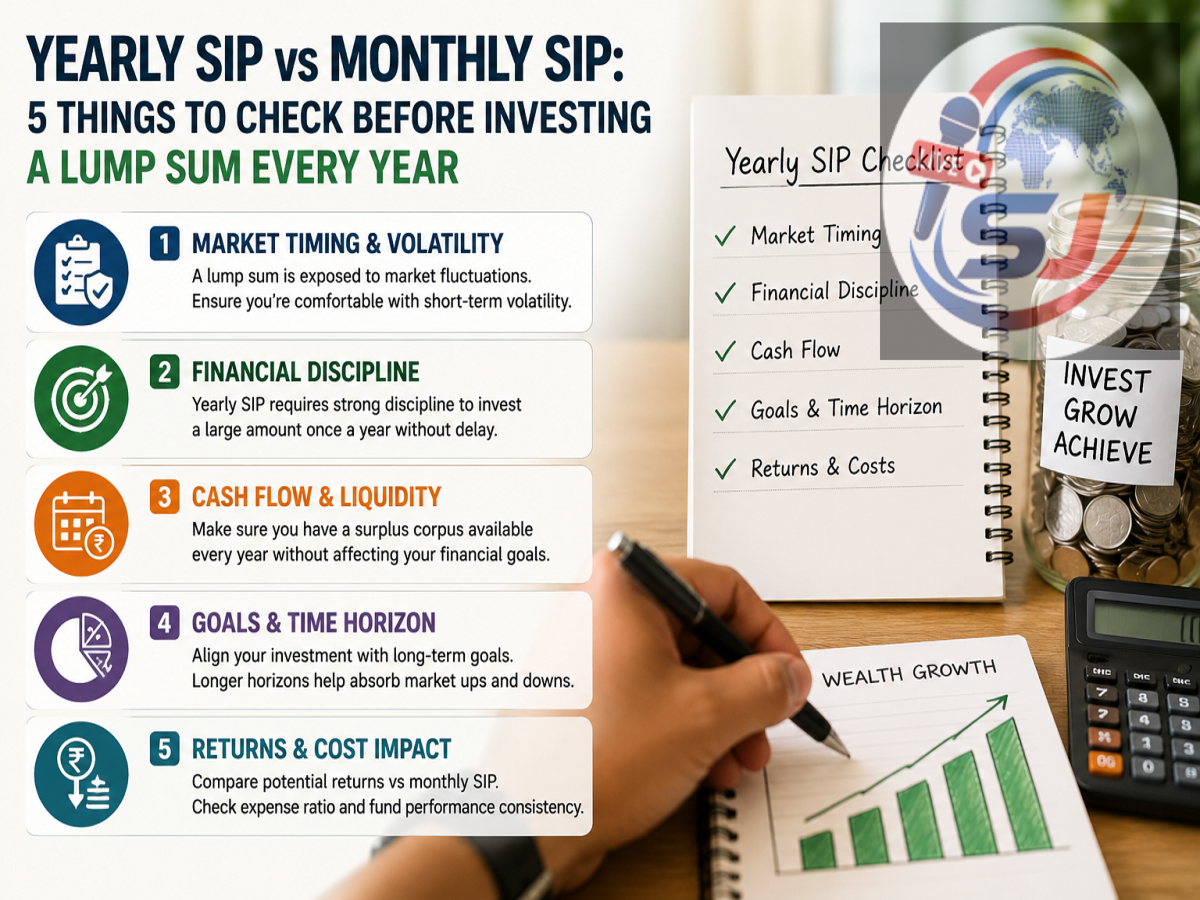
Systematic Investment Plans (SIPs) have become a popular way to invest in mutual funds because they allow investors to build a portfolio through regular contributions instead of committing a large amount at once. While monthly SIPs are the most common choice, some investors may prefer investing a larger amount once a year.
An annual investment approach can be particularly convenient for people who receive yearly bonuses, incentives or other lump-sum income. Instead of committing to a monthly deduction, they can earmark part of this annual cash flow for their investment goals.
However, investing once a year works differently from spreading the same amount across 12 monthly instalments. Market timing, cash flow, risk tolerance and financial goals can all affect the outcome. Before choosing an annual investment strategy, investors should understand these differences.
1. Understand the Timing Risk of Investing Once a Year
One of the biggest differences between monthly and annual investing is how frequently money enters the market.
Suppose an investor wants to invest ₹60,000 annually. With a monthly SIP, ₹5,000 would be invested every month across the year.
With an annual approach, the entire ₹60,000 may be invested at one time.
If the market happens to be at a relatively high level when the lump sum is invested and falls sharply soon afterwards, the portfolio could show a noticeable short-term decline.
A monthly SIP spreads purchases across different market levels. When markets fall, the same SIP amount can purchase more mutual fund units, while fewer units are purchased when prices are higher.
This process is commonly associated with rupee-cost averaging. It does not eliminate market risk or guarantee better returns, but it reduces dependence on a single entry point.
2. Make Sure the Annual Investment Doesn't Hurt Your Cash Flow
Investors should also consider whether they can comfortably invest a large amount at once.
For example, someone who can manage a ₹5,000 monthly SIP would invest ₹60,000 over 12 months.
Paying ₹5,000 each month may be manageable within a regular salary budget. Taking ₹60,000 out of a bank account in one transaction, however, can feel very different.
Before investing the annual amount, consider upcoming expenses such as insurance premiums, school fees, loan EMIs, medical costs, taxes and household requirements.
Investment discipline is useful, but it should not create a situation where you need to borrow money a few weeks later to meet essential expenses.
3. Don't Wait for the 'Perfect' Market Level
Choosing an annual investment strategy does not mean trying to identify the lowest point of the stock market every year.
Predicting short-term market movements consistently is extremely difficult.
An investor may postpone investing because the market appears expensive, only to see prices continue rising. Alternatively, someone may invest because the market appears cheap and then experience a further decline.
Rather than attempting to identify the perfect entry date, investors can base decisions on factors they can control: financial goals, investment horizon, asset allocation and risk tolerance.
If the money is intended for a long-term goal, short-term market movements may be less important than maintaining a disciplined investment strategy over many years.
4. Define the Goal Before Choosing the Investment
Before deciding between monthly and annual investing, ask a simple question: What is this money for?
An investment intended for retirement 20 years away should not necessarily be structured the same way as money required for a house purchase in three years.
Common long-term goals include:
-
Children's higher education
-
Retirement planning
-
Buying a house
-
Building long-term wealth
-
Creating a future financial corpus
For longer investment horizons, investors with suitable risk tolerance may consider equity-oriented mutual funds. However, equity investments are exposed to market fluctuations, and returns are neither fixed nor guaranteed.
For shorter-term goals, taking excessive equity risk can be inappropriate because the investor may not have enough time to recover from a major market decline.
The investment product should therefore be selected according to the goal and time horizon rather than simply because a particular fund has recently delivered high returns.
5. Keep Your Emergency Fund Separate
One of the most important rules is to avoid investing money that may be required for emergencies.
Before committing a large annual amount to a mutual fund, maintain sufficient liquid savings for unexpected expenses.
An emergency fund can help manage situations such as a temporary loss of income, urgent home repairs or other unplanned financial needs.
Without adequate emergency savings, an investor may be forced to redeem mutual fund investments during an unfavourable market period.
For example, investing your entire annual bonus into an equity fund and then needing the money three months later could expose you to losses if markets have declined.
Emergency savings and investments serve different purposes and should ideally be treated separately.
Monthly SIP vs Annual Investment: What's the Difference?
Consider an investor who wants to invest ₹60,000 every year.
| Investment Method | Amount | Frequency | Number of Investments a Year |
|---|---|---|---|
| Monthly SIP | ₹5,000 | Every month | 12 |
| Annual investment | ₹60,000 | Once a year | 1 |
Both approaches result in ₹60,000 being invested over the year, but the timing is significantly different.
With a monthly SIP, each instalment gets a different purchase price depending on the fund's NAV on the investment date. With a single annual investment, the entire amount is exposed to the NAV available at that particular entry point.
The eventual returns can therefore differ even when the total annual contribution is identical.
Who May Find Annual Investing Convenient?
Investing once a year may suit people whose income is not distributed evenly throughout the year.
For instance, professionals who receive substantial annual bonuses, business owners with seasonal cash flows or people receiving periodic incentives may find it convenient to invest when surplus money becomes available.
However, convenience should not be confused with guaranteed financial advantage.
If a salaried employee has predictable monthly cash flow, a monthly SIP may make investing easier by automating the process and spreading investments throughout the year.
Should You Choose Monthly or Annual Investing?
There is no single investment frequency that is automatically best for everyone.
Monthly SIPs can offer convenience, disciplined investing and diversification across different market entry points. Investing a larger amount annually may be suitable for someone who receives most of their investible surplus as a bonus or another lump-sum payment.
The better approach is the one that matches your cash flow and helps you remain invested without compromising essential expenses.
Before investing, decide your financial goal, assess how much market risk you can tolerate, keep an adequate emergency reserve and choose a realistic investment horizon.
Most importantly, do not select an annual investment strategy simply because you believe you can predict the market's lowest point. Long-term financial planning generally depends more on consistency, suitable asset allocation and disciplined investing than on successfully timing a single investment every year.
Disclaimer: Mutual fund investments are subject to market risks. Returns are not guaranteed. Investors should read scheme-related documents carefully and consider professional financial advice where necessary.