
UPI Payment Rules May Change From October 15: 0.4% MDR Planned on Select Transactions Above ₹2,000
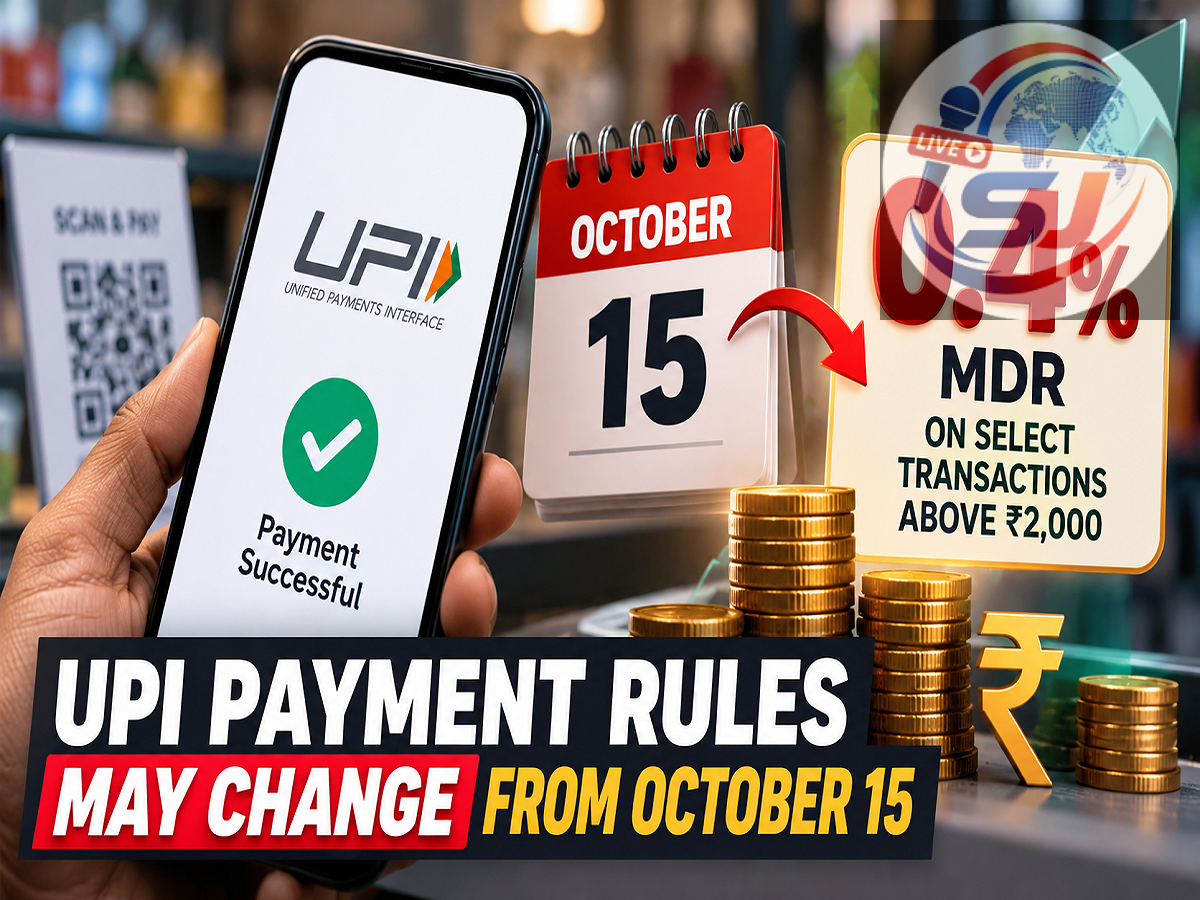
A significant change in India's Unified Payments Interface (UPI) payment ecosystem could take effect from October 15, 2026. According to the report, the government is not considering an extension of the proposed deadline for introducing Merchant Discount Rate (MDR) on certain UPI merchant payments. However, the 18% Goods and Services Tax (GST) applicable to MDR could come under review.
The reported development is particularly important for merchants and businesses that accept UPI payments. Consumers, however, are not expected to pay any additional fee for making UPI payments under the proposed arrangement.
What Could Change From October 15?
Under the reported framework, a 0.4% MDR may apply to select UPI merchant transactions exceeding ₹2,000. The MDR amount would also be subject to a maximum ceiling of ₹300 per transaction.
This does not mean every UPI transaction above ₹2,000 will automatically become chargeable for consumers. MDR is a merchant-side payment processing charge, and the proposed change is reportedly intended for selected merchant transactions rather than regular person-to-person transfers.
Government sources cited in the report indicate that authorities are not currently planning to push back the October 15 implementation date.
The MDR rates have reportedly been determined by the Indian Banks' Association (IBA) after consultations with relevant stakeholders.
Will Customers Have to Pay for UPI Transactions?
For ordinary UPI users, the key point is that the government has reportedly clarified that customers will not be charged for making UPI payments.
Therefore, an individual using UPI to pay an eligible merchant is not expected to see a separate MDR fee added to the payment simply because the transaction crosses ₹2,000.
Similarly, person-to-person (P2P) UPI transfers are expected to remain free. These include common transactions such as sending money to a family member, friend or another individual through UPI.
The proposed MDR framework is instead focused on specified merchant transactions.
Why Is MDR Being Considered for UPI?
The rapid expansion of UPI has transformed digital payments across India, allowing consumers to transfer money and pay businesses almost instantly. However, operating such a large digital payment network involves substantial infrastructure and processing costs.
According to the report, the government's position is that a sustainable revenue mechanism is necessary to support the UPI ecosystem as transaction volumes continue to grow.
Government sources have reportedly argued that even the proposed MDR would not recover 100% of the cost involved in maintaining the UPI payment infrastructure.
This is one of the key arguments being cited in support of introducing MDR on selected merchant payments.
Merchants Raise Concerns Over Additional Costs
The proposed change has also triggered concerns among businesses and merchants. An MDR charge could increase the cost of accepting digital payments, particularly for businesses handling a large number of higher-value UPI transactions.
The financial impact would depend on factors such as transaction value, the category of merchant covered under the framework and how the final MDR rules are implemented.
Questions are also being raised about the broader cost structure of the UPI ecosystem if MDR becomes applicable to more merchant payments.
18% GST on MDR Could Be Reviewed
While the October 15 deadline is reportedly unlikely to change, another component of the proposal could receive attention: 18% GST on MDR.
The GST Council is scheduled to meet on October 7, 2026. According to the report, GST on MDR is currently not formally listed on the meeting's agenda.
However, government sources suggest the matter could still be discussed during the meeting.
This means businesses should not assume that the GST treatment has already been changed. As of the information cited in the report, no final decision on reviewing or changing the 18% GST has been announced.
Any change would depend on deliberations and an official decision by the GST Council.
What UPI Users and Merchants Should Know
For consumers, UPI payments are expected to continue without a direct MDR charge, while P2P transfers are also expected to remain free. The proposed 0.4% MDR, capped at ₹300 per transaction, would apply only to specified merchant transactions above ₹2,000, according to the reported framework.
For merchants, October 15 could therefore become an important date, particularly for businesses processing higher-value UPI payments.
At the same time, attention will be on the GST Council meeting scheduled for October 7. Any review of the 18% GST applicable to MDR could influence the overall cost borne by businesses.
Until an official notification or final government clarification is issued, details regarding the exact scope, merchant categories, exemptions and GST treatment should be treated as subject to the final rules.