
UPI Growth Slows as MDR Debate Heats Up, But Will Users Have to Pay Charges?
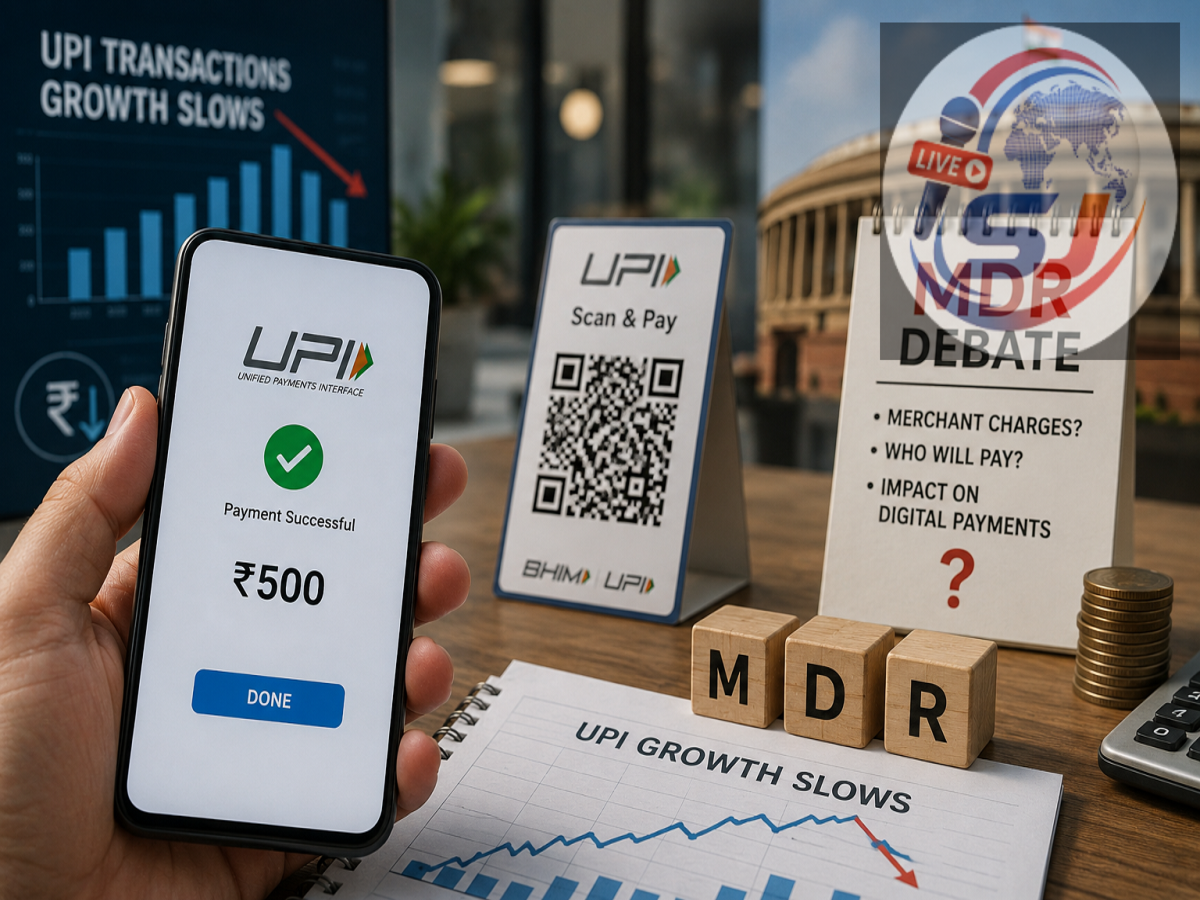
UPI Transaction Update 2026: India's Unified Payments Interface (UPI) continues to process record numbers of digital payments, but the pace at which transaction volumes are expanding has slowed during the first four months of the current financial year. The development has attracted attention at a time when the possibility of introducing Merchant Discount Rate (MDR) on certain UPI payments is being widely discussed.
Between April and July of FY 2026-27, UPI transaction volumes increased by around 23.5% compared with the corresponding period of the previous year. However, growth during the same four-month period a year earlier was about 33.5%.
This means UPI usage itself has not declined. Instead, the year-on-year rate of expansion has moderated by roughly 10 percentage points.
The trend is significant because UPI has become the backbone of India's retail digital payment ecosystem, handling billions of transactions every month.
UPI Volume Growth Loses Some Momentum
UPI has witnessed extraordinary expansion over the past several years as consumers increasingly use mobile payments for everything from grocery purchases and utility bills to money transfers and online shopping.
That growth continues, but at a slower rate.
During April-July FY27, UPI processed approximately 92 billion transactions, representing growth of about 23.5% from roughly 74.5 billion transactions during the corresponding period of the previous financial year.
In comparison, transaction volume had expanded by approximately 33.5% during the same period a year earlier.
Interestingly, the slowdown is more visible in transaction volume than in value. The growth in the total value of payments has remained relatively stable at around 20%.
The numbers indicate that Indians are still using UPI extensively, even though the rapid pace of transaction-count expansion seen in earlier years is beginning to moderate.
July 2026 Still Sets a New UPI Record
A slowdown in the growth rate should not be mistaken for an outright decline in UPI usage.
July 2026 was another record-breaking month for the payment platform.
UPI handled approximately 23.66 billion transactions during the month, while the total value of transactions reached around ₹29.88 lakh crore.
These figures underline the enormous scale UPI has achieved across India.
Therefore, the latest data presents two trends simultaneously: UPI is reaching new absolute records, but the percentage rate at which transaction volumes are growing compared with the previous year has cooled.
MDR Discussion Adds a New Dimension
The moderation in growth has emerged at an important time for India's digital payments industry.
On August 6, 2026, the Lok Sabha passed the Taxation and Other Laws (Amendment) Bill, 2026. The legislative change has triggered discussion over whether Merchant Discount Rate could eventually return for some UPI transactions.
MDR is essentially a fee associated with payment processing that can be charged to merchants for accepting certain forms of digital payments.
The issue is particularly important for banks, payment companies and fintech firms because maintaining the massive UPI infrastructure involves technology, cybersecurity, server capacity, fraud prevention and operational costs.
At the same time, policymakers have to ensure that any change in the payment model does not discourage consumers or small businesses from using digital payments.
Will Ordinary UPI Users Have to Pay?
For consumers, the government's clarification is particularly important.
The government has stated that person-to-person UPI transactions will continue to remain free. This means ordinary users transferring money to friends, relatives or other individuals are not expected to pay a transaction fee.
The government has also indicated that the vast majority of merchant transactions will remain free.
Any possible MDR framework would primarily concern certain merchant payments rather than imposing a direct charge on ordinary consumers every time they use UPI.
Therefore, claims suggesting that every UPI transaction is about to become chargeable can be misleading.
No universal fee has been announced for UPI users.
Small Merchants Could Also Remain Protected
The MDR debate is also important for India's millions of small shopkeepers, street vendors and micro businesses that have adopted QR-code payments.
The zero-cost nature of UPI has played an important role in encouraging merchants to accept digital payments, including very small transactions.
Any widespread fee could potentially discourage smaller businesses from accepting UPI or encourage them to prefer cash.
For this reason, the policy discussion has focused on designing a framework that could support the financial sustainability of the payment ecosystem without creating an unnecessary burden on consumers and small merchants.
Why Is UPI Growth Slowing?
A moderation in percentage growth does not necessarily indicate weakening consumer interest.
UPI has already reached an enormous user and transaction base. As any service becomes widely adopted, maintaining exceptionally high percentage growth becomes progressively more difficult.
For example, adding the same number of new transactions produces a much smaller percentage increase when the existing base is already extremely large.
UPI has also become deeply integrated into everyday payments, meaning future expansion may increasingly depend on new users, new use cases, international acceptance and deeper adoption among merchants.
What Happens Next?
The coming months will be closely watched by consumers, banks, fintech companies and merchants.
The key question is not whether UPI will suddenly become chargeable for everyone. The more relevant issue is how the government eventually structures any MDR mechanism for merchant payments while protecting ordinary users and smaller businesses.
For now, consumers can continue making regular UPI payments without a newly announced universal transaction fee.
Meanwhile, the latest numbers show that UPI remains firmly on a growth trajectory despite a moderation in its year-on-year expansion rate. With 23.66 billion transactions recorded in July alone, India's instant payment network continues to operate at an unprecedented scale.
The challenge ahead will be balancing three priorities: keeping digital payments affordable, maintaining UPI's rapid adoption and ensuring that banks and payment companies have a sustainable framework for operating the infrastructure behind one of India's most widely used financial technologies.