
UPI Charges From October 15: Will Debit or Credit Cards Be Cheaper? Here’s What NPCI Says
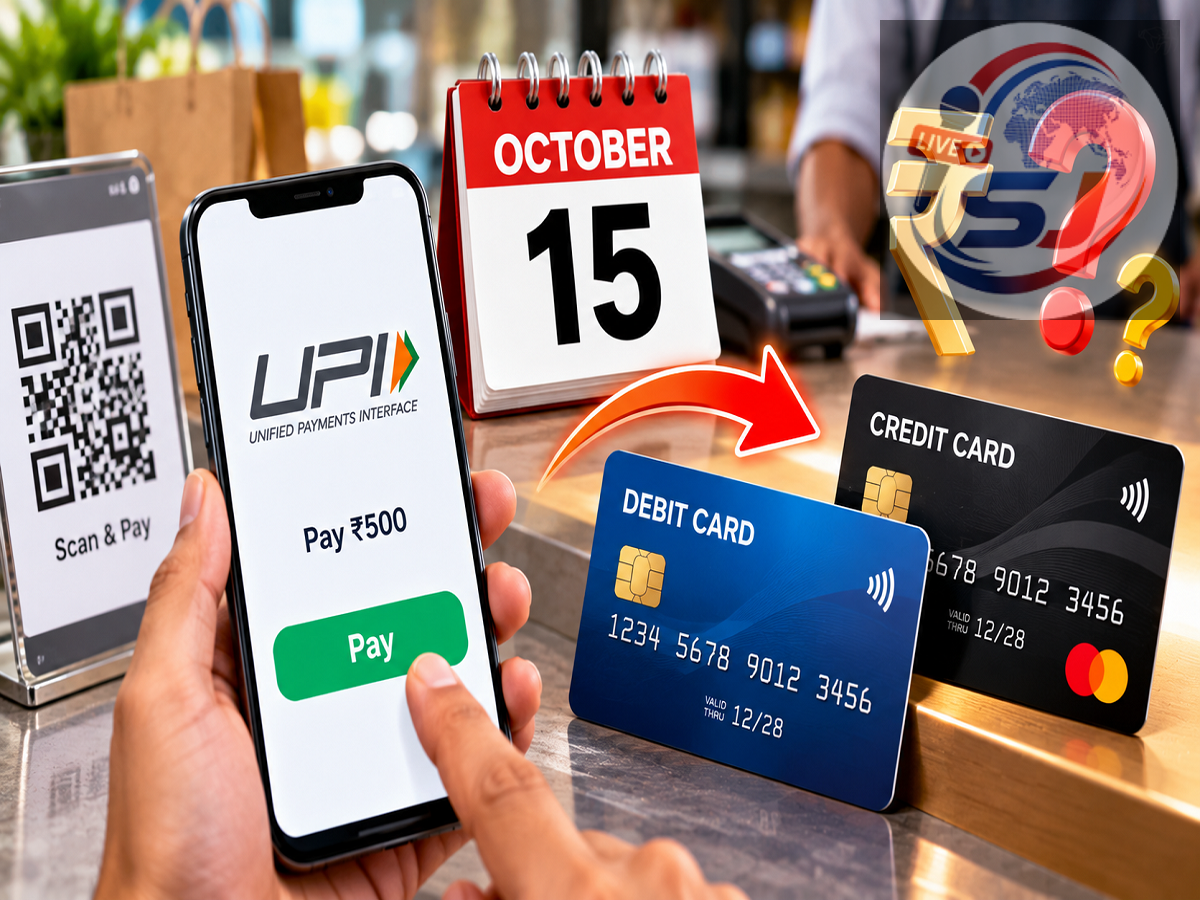
A major change in India's digital payments ecosystem is scheduled to take effect from October 15, 2026, when a Merchant Discount Rate (MDR) will apply to certain high-value UPI payments made to businesses. The announcement has raised an obvious question among millions of users: will paying through UPI now become more expensive than using a debit or credit card?
For ordinary consumers, the change is less dramatic than it may initially appear. The new MDR is a merchant-side processing fee, rather than a charge that customers are supposed to pay for making an eligible UPI transaction.
Under the revised framework, Person-to-Person (P2P) transfers will continue without MDR, while eligible Person-to-Merchant (P2M) payments of up to ₹2,000 will also remain outside the MDR charge. For certain merchant payments above ₹2,000, the standard MDR will be 0.4%, subject to a maximum of ₹300 per transaction.
What Is a P2M UPI Transaction?
P2M stands for Person-to-Merchant.
Whenever a customer uses UPI to pay a business, retailer or other merchant, the transaction generally falls into the P2M category. This is different from a P2P transfer, where money is sent from one individual to another.
The distinction matters because the new MDR framework does not apply to ordinary person-to-person UPI transfers.
For eligible P2M transactions, the standard structure from October 15 is broadly as follows:
-
P2P transfers: No MDR
-
Eligible P2M transactions up to ₹2,000: No MDR
-
Eligible P2M payments above ₹2,000: 0.4% MDR
-
Transactions of ₹75,000 or more: MDR capped at ₹300 per transaction
-
Eligible small merchants under the prescribed framework: Zero MDR
Certain specified merchant categories, including railways, telecom, insurance and fuel, have a separate flat MDR structure for qualifying payments above ₹2,000.
Will Customers Have to Pay the 0.4% UPI Charge?
This is perhaps the most important point for UPI users.
The 0.4% MDR is not intended to be charged directly to the customer making the payment. It is a processing cost applicable to eligible merchants receiving payments.
For example, suppose you buy goods worth ₹10,000 from an eligible merchant and pay through UPI. At an MDR rate of 0.4%, the applicable merchant fee would work out to:
₹10,000 × 0.4% = ₹40
That ₹40 is the MDR associated with processing the payment. Under the announced framework, it is the merchant-side cost rather than an additional ₹40 that the customer is supposed to pay on top of a ₹10,000 purchase. NPCI has said the MDR should not be passed on to consumers.
Is UPI Still Cheaper Than Debit and Credit Cards?
NPCI's comparison indicates that UPI remains a relatively low-cost payment mechanism for merchants even after the new MDR is introduced.
Using the example cited in the source material, an eligible ₹10,000 UPI merchant transaction at 0.4% would generate an MDR of ₹40.
By comparison, if a hypothetical credit-card merchant charge were 2%, the processing cost on ₹10,000 would be ₹200. At a hypothetical debit-card rate of 0.9%, it would work out to ₹90.
These comparisons illustrate the difference in processing costs; actual card MDR arrangements can vary by merchant, payment network, transaction category and commercial agreement.
For consumers, however, the more relevant point is that they are not expected to switch payment methods simply because UPI MDR is being introduced for eligible merchants.
What Happens on a ₹1 Lakh UPI Payment?
The ₹300 cap becomes particularly important for high-value transactions.
At the standard 0.4% rate, a payment of ₹75,000 works out to exactly ₹300:
₹75,000 × 0.4% = ₹300
For payments at or above this threshold under the standard structure, the MDR is capped at ₹300 per transaction. Therefore, a ₹1 lakh qualifying transaction would not generate a ₹400 MDR under this structure; the applicable MDR would remain capped at ₹300.
Again, this is the merchant-side processing fee and not an additional amount that the customer is expected to pay.
Small Merchants Get Protection Under the New Framework
The MDR change has also been structured to protect smaller businesses.
Under the framework, small merchants falling within the specified P2PM category continue to receive zero-MDR treatment. Recent explanations of the framework define small merchants for this purpose around UPI QR receipts of up to ₹1 lakh per month.
This means the change is primarily targeted at qualifying transactions involving larger merchants rather than every roadside vendor or small business accepting UPI.
Will Everyday UPI Payments Become More Expensive?
For most consumers, there is no reason to assume that buying groceries, paying a local shop or transferring money to another person will suddenly attract a direct UPI fee.
P2P transactions remain outside the MDR framework, and P2M transactions up to ₹2,000 remain free from MDR. Reports on the new structure indicate that the vast majority of UPI transactions by volume are expected to remain unaffected.
The significant change is that certain larger merchant payments will now carry a processing cost for the merchant receiving the money.
Should You Switch Back to Debit or Credit Cards?
For consumers, the introduction of UPI MDR does not by itself create a financial reason to abandon UPI.
If you make a qualifying ₹10,000 purchase through UPI, you are expected to pay the purchase amount—not the purchase amount plus the merchant's 0.4% MDR. The same principle applies to larger eligible transactions, subject to the rules governing the payment.
From October 15, 2026, the important distinction is therefore not simply whether a UPI transaction exceeds ₹2,000. Consumers should understand who is paying whom, whether it is a P2P or P2M transaction, what type of merchant is receiving the payment, and whether the transaction falls within an exempt category.
For everyday UPI users, the central takeaway is simple: the new MDR changes the economics of processing some merchant payments, but it does not turn every UPI payment above ₹2,000 into a direct fee for the customer.
Clarify the October 15 fee rulesAdd a quick UPI fee comparison table