
Update on ₹25,000 wage limit: Find out whose pension will be affected.
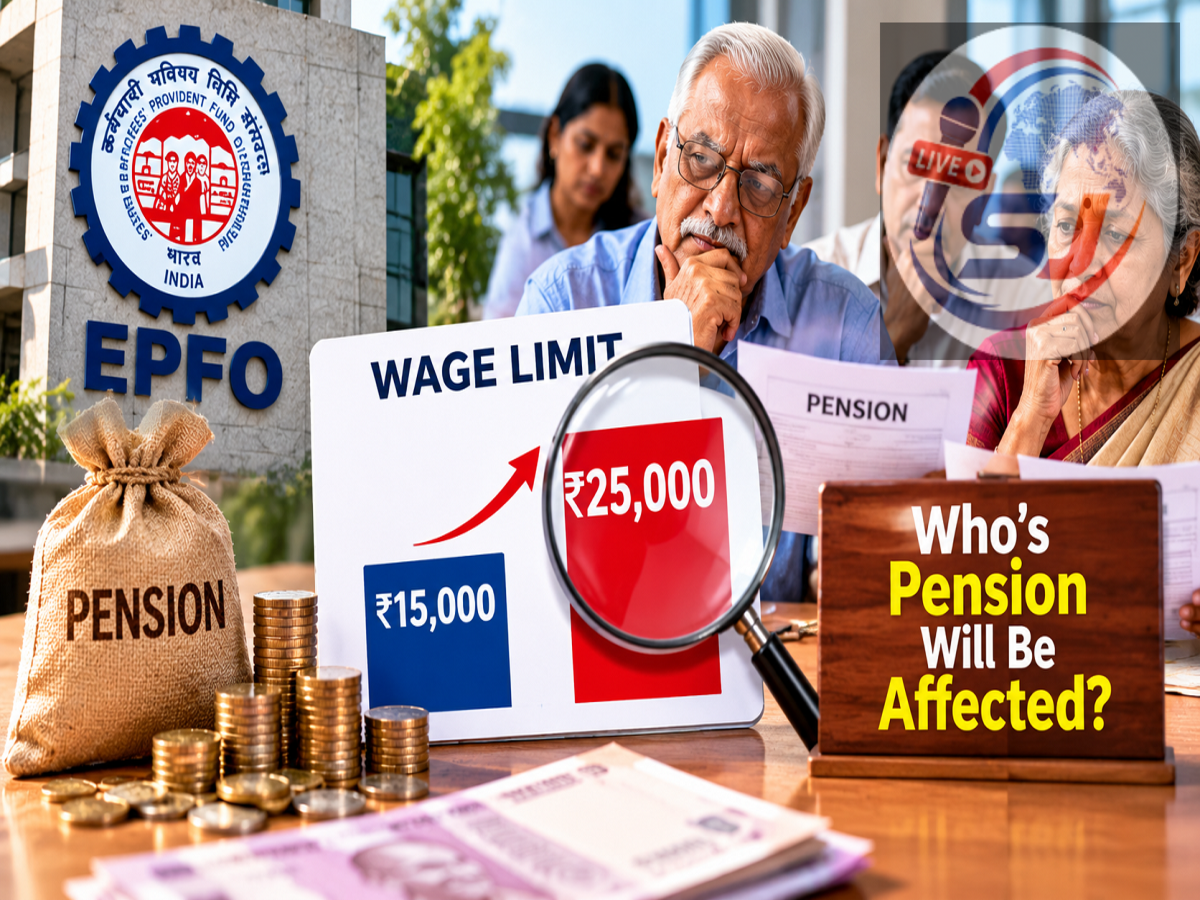
EPFO Wage Limit 2026: A reported increase in the Employees' Provident Fund Organisation (EPFO) wage ceiling from ₹15,000 to ₹25,000 has raised important questions among salaried employees, particularly about eligibility for the Employees' Pension Scheme (EPS).
According to a report dated October 13, 2026, the revised wage ceiling is intended to expand mandatory provident fund coverage. However, employees should not assume that becoming eligible for PF coverage automatically makes them eligible for pension contributions.
The report highlights that an employee's previous EPS membership can play an important role in determining whether pension contributions are applicable.
This distinction matters because the Employees' Provident Fund (EPF) and Employees' Pension Scheme serve different purposes and are governed by separate eligibility provisions.
Here is what employees should know about the reported ₹25,000 wage ceiling, PF deductions, EPS membership, and the impact on retirement benefits.
EPFO Wage Ceiling: What Is the Latest Update?
The supplied report states that the mandatory PF coverage wage ceiling has been increased from ₹15,000 to ₹25,000.
If implemented under the applicable statutory provisions, such a revision would affect the coverage assessment of employees whose relevant wages fall within the revised limit.
However, the supplied excerpt does not include the official notification, effective date, or complete implementation rules.
Employees and employers should therefore verify the revised ceiling through an official EPFO or Ministry of Labour notification before changing payroll deductions.
The distinction between PF coverage and pension eligibility is especially important when assessing the effect of any wage ceiling revision.
Does a ₹25,000 Salary Automatically Mean EPS Pension Deduction?
No. PF coverage and EPS membership should not be treated as identical.
According to the report, an employee's salary alone does not determine whether pension contributions will apply.
Previous pension membership is also relevant.
This means two employees earning the same salary may have different EPS contribution arrangements depending on their membership history and the applicable scheme rules.
An employee who is already an EPS member may be treated differently from someone entering covered employment for the first time.
The final position must be determined using the rules in force, including any official amendments accompanying the reported wage ceiling revision.
Why Does Previous EPS Membership Matter?
The Employees' Pension Scheme is linked to eligible provident fund membership, but it has separate entry and continuation conditions.
Under the established EPS framework, pension membership history is particularly relevant when a worker changes jobs.
An employee who previously joined EPS may continue to have pension-related rights and obligations, subject to the applicable rules.
On the other hand, a new employee who has never been an EPS member may be subject to different entry restrictions.
Therefore, an employer should not determine EPS eligibility solely by checking whether the employee's salary is below ₹25,000.
The employee's earlier EPF and EPS records must also be considered.
EPF vs EPS: What Is the Difference?
EPF is primarily a retirement savings arrangement in which eligible employee and employer contributions build a provident fund balance.
EPS, meanwhile, is intended to provide pension benefits to eligible members under its prescribed conditions.
| Feature | EPF | EPS |
|---|---|---|
| Main purpose | Retirement savings | Pension benefits |
| Employee contribution | Generally 12% of applicable PF wages | No separate direct employee contribution under the standard arrangement |
| Employer contribution | Allocated according to applicable rules | Eligible portion directed toward pension |
| Benefit | Provident fund accumulation | Pension benefits subject to scheme conditions |
| Eligibility | Governed by EPF coverage rules | Governed by separate EPS membership rules |
This difference explains why a change in mandatory PF coverage does not automatically establish identical pension benefits for every worker.
How Are EPFO Contributions Calculated?
Under the standard contribution arrangement, an eligible employee contributes 12% of applicable PF wages.
The employer also contributes at the prescribed rate.
For employees eligible for EPS, part of the employer's contribution is directed toward the pension scheme according to the applicable pensionable wage ceiling and contribution rules.
For example, if PF contributions were calculated on ₹25,000, the employee's 12% contribution would be ₹3,000.
The employer's corresponding 12% contribution would also be ₹3,000 before the applicable allocation.
However, it would be incorrect to assume that EPS contributions must automatically be calculated on the entire ₹25,000.
The pensionable wage ceiling and EPS eligibility requirements must be verified separately.
Who Should Check Their EPS Membership Status?
Employees who have worked for multiple employers should review their provident fund and pension records.
This is particularly important for workers who changed jobs after joining EPS.
Employees entering formal employment for the first time should also understand whether they qualify for pension membership under the current rules.
Workers can review relevant information through official EPFO member services and contact their employer's payroll department if clarification is needed.
Will the Reported Wage Ceiling Increase Monthly Pension?
A higher mandatory PF coverage ceiling does not automatically guarantee a higher EPS pension.
Pension benefits depend on the applicable EPS formula, pensionable salary rules, eligible service period, and other conditions.
Even if a PF wage ceiling is increased, the pension calculation provisions may remain different unless separately amended.
Therefore, employees should be cautious about claims that the reported ₹25,000 PF ceiling automatically guarantees a particular monthly pension amount.
Any such claim must be supported by the applicable official pension rules.
What Should Employers Do?
Employers should review official notifications before implementing changes to PF or EPS deductions.
Payroll teams may need to assess the applicable wage definition, employee coverage, previous EPS membership, and contribution allocation rules.
Incorrectly treating every newly covered employee as an EPS member could lead to contribution errors.
Similarly, excluding an eligible continuing pension member without reviewing their records could create complications.
Employers should follow the official EPFO instructions and obtain appropriate compliance guidance where necessary.
EPFO Wage Limit 2026: What Employees Should Remember
The October 13 report highlights a claimed increase in the mandatory EPF wage ceiling from ₹15,000 to ₹25,000.
More importantly, it explains that PF coverage and EPS pension membership are not necessarily the same.
An employee's previous pension membership can influence whether pension contributions apply.
The key point is that a ₹25,000 wage ceiling, even if officially implemented, does not mean every employee earning up to ₹25,000 will automatically receive EPS pension contributions.
Employees should verify their membership records and consult official EPFO notifications for the precise rules.
Disclaimer: This article is based on a brief news excerpt dated October 13, 2026. The reported wage ceiling increase and its effective date have not been independently verified through an official government notification. EPF and EPS eligibility should be determined according to the applicable statutory provisions.