
Sukanya Samriddhi Yojana 2026: Invest ₹12,500 Monthly to Build a ₹72 Lakh Fund for Your Daughter
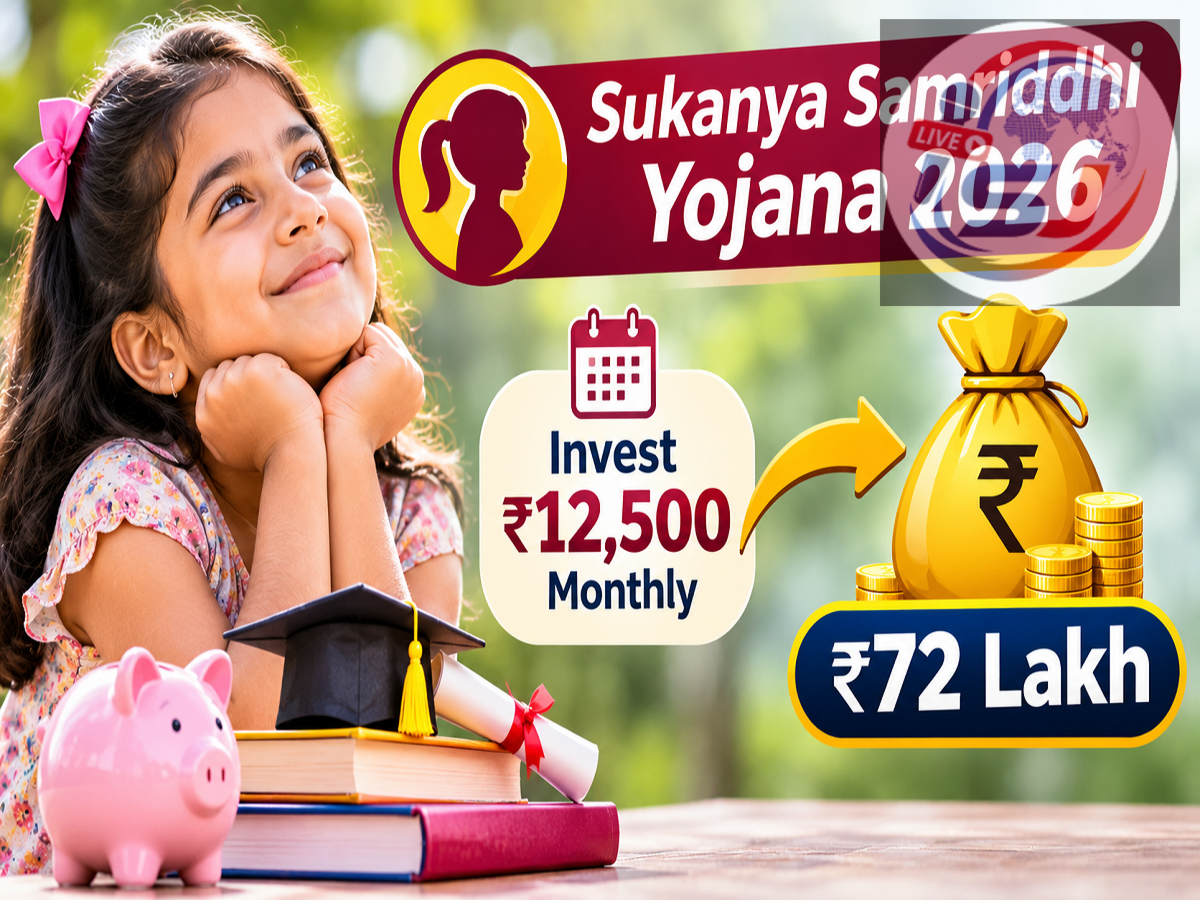
Sukanya Samriddhi Yojana 2026: Parents looking to create a substantial financial reserve for their daughter's higher education or marriage can consider the government-backed Sukanya Samriddhi Yojana (SSY). The savings scheme offers an annual interest rate of 8.2% for the October–December 2026 quarter and allows families to accumulate wealth through long-term compounding. According to an illustrative calculation, investing ₹1.5 lakh annually for 15 years could generate a maturity corpus of approximately ₹71.82 lakh after 21 years, assuming the current interest rate remains unchanged.
The scheme is particularly attractive to families seeking a government-supported investment option with tax benefits and a long-term savings structure. However, the final maturity amount depends on future interest rates and the timing of deposits.
Sukanya Samriddhi Yojana 2026: How ₹12,500 Monthly Can Grow Into ₹72 Lakh
The Sukanya Samriddhi Yojana permits a maximum annual investment of ₹1.5 lakh, equivalent to an average monthly saving of ₹12,500.
If parents contribute the maximum permitted amount every year for 15 years, their total investment will reach ₹22.50 lakh.
The remaining growth comes from compound interest accumulated over the scheme's 21-year maturity period.
According to the calculation presented in the original report, an annual investment of ₹1.5 lakh made at the beginning of each contribution year could potentially grow to approximately ₹71.82 lakh, assuming a constant annual interest rate of 8.2%.
Of this estimated maturity amount, around ₹49.32 lakh would represent interest earnings.
SSY Investment Calculator: ₹1.5 Lakh Annual Deposit
| Investment Details |
Amount |
|---|---|
| Monthly Savings Equivalent |
₹12,500 |
| Annual Investment |
₹1,50,000 |
| Investment Duration |
15 years |
| Total Investment |
₹22,50,000 |
| Assumed Annual Interest Rate |
8.2% |
| Account Maturity Period |
21 years |
| Estimated Maturity Amount |
₹71,82,000 |
| Estimated Interest Earnings |
₹49,32,000 |
Important: The ₹71.82 lakh estimate assumes that the full annual contribution is deposited near the beginning of each contribution year and that the 8.2% interest rate continues throughout the calculation period. Monthly deposits of ₹12,500 would produce a different maturity amount because the timing of contributions affects interest earnings.
The estimate is not a guaranteed return, as the government reviews small savings interest rates periodically.
How Does Compound Interest Help Build a Large Fund?
The main advantage of Sukanya Samriddhi Yojana is the power of long-term compounding.
Under this system, interest is earned not only on the money deposited by parents but also on interest accumulated during previous years.
For example, when a family makes its first contribution, interest begins accumulating according to the scheme's prescribed calculation method.
At the end of the financial year, the applicable interest is credited to the account.
In subsequent years, the balance includes earlier contributions and credited interest, allowing the overall investment to grow further.
This process continues throughout the account's eligible interest-earning period.
The longer the money remains invested, the greater the potential impact of compounding, assuming favourable interest rates.
This explains why an investment of ₹22.50 lakh could potentially generate a substantially larger maturity corpus over 21 years.
What Is Sukanya Samriddhi Yojana and Who Can Open an Account?
Sukanya Samriddhi Yojana is a government-backed small savings scheme designed exclusively for girl children.
The initiative encourages parents and legal guardians to save regularly for their daughters' future financial requirements, particularly education and marriage-related expenses.
The scheme is also known as the Selva Magal Savings Scheme in Tamil Nadu.
Parents or legal guardians can open an account in the name of an eligible girl child through an authorised bank or post office.
The account must generally be opened before the girl reaches 10 years of age.
Only one Sukanya Samriddhi account is ordinarily permitted for each girl child.
A family can generally open accounts for up to two daughters, although special provisions apply in certain cases involving twins or multiple births.
Minimum and Maximum Investment Limits in SSY
One of the useful features of the scheme is its flexible contribution structure.
Parents do not need to invest ₹12,500 every month to maintain an account.
The minimum annual contribution is ₹250, while the maximum permissible deposit is ₹1.5 lakh per financial year.
This means families can begin with smaller amounts and increase their savings according to their financial capacity.
For example, a household may choose to deposit ₹1,000 or ₹2,000 every month instead of contributing the maximum amount.
However, investing smaller sums will naturally result in a lower maturity corpus than the ₹71.82 lakh illustration.
The scheme does not require a compulsory monthly deposit schedule, provided the minimum annual contribution requirement is satisfied during the prescribed deposit period.
Why Do Parents Need to Invest for Only 15 Years?
Although the Sukanya Samriddhi account ordinarily matures 21 years after opening, contributions are permitted for only the first 15 years.
This distinction is important for understanding how the scheme works.
Suppose parents open an SSY account when their daughter is born.
They can contribute money during the next 15 years, subject to the annual deposit limits.
After completing the contribution period, they are not required to make further deposits.
However, the account continues earning interest at the applicable rates until maturity.
Therefore, the accumulated balance can keep growing for another six years without additional contributions.
This extended interest-earning period plays an important role in building the final maturity amount.
Sukanya Samriddhi Yojana Interest Rate for October–December 2026
For the October to December 2026 quarter, the annual interest rate on Sukanya Samriddhi Yojana is 8.2%, according to the rate information cited in the original report.
The Ministry of Finance periodically reviews interest rates on government small savings schemes.
As a result, the rate applicable today may change during the account's 21-year duration.
For comparison, the reported interest rates for selected government savings schemes are:
| Government Savings Scheme |
Annual Interest Rate |
|---|---|
| Sukanya Samriddhi Yojana |
8.2% |
| Senior Citizens Savings Scheme |
8.2% |
| Public Provident Fund |
7.1% |
These schemes have different eligibility requirements, investment limits, withdrawal rules and maturity periods.
Therefore, their interest rates should not be the only consideration when comparing them.
Why Does Deposit Timing Matter in SSY Calculations?
The timing of deposits can influence the total interest earned in a Sukanya Samriddhi account.
Under the scheme's interest calculation rules, monthly interest is calculated using the lowest account balance between the close of the fifth day and the end of the month.
Interest is credited annually.
Consequently, depositing money before the fifth day of a month can help maximise the eligible interest for that month.
The ₹71.82 lakh illustration assumes that the full annual amount of ₹1.5 lakh is contributed near the beginning of each investment year.
If parents instead deposit ₹12,500 every month, some contributions will enter the account later and earn interest for fewer months.
Therefore, the final maturity amount may be lower than the annual upfront-deposit illustration, even though the total principal invested remains ₹22.50 lakh.
Is Sukanya Samriddhi Yojana a Safe Investment?
Sukanya Samriddhi Yojana is a government-backed small savings scheme.
Unlike equity mutual funds or other market-linked investments, SSY returns are not directly determined by daily stock market movements.
This makes it a relatively predictable savings option for families seeking to build a long-term financial reserve.
However, investors should distinguish between the security of the government-backed scheme and the certainty of a projected maturity amount.
While the scheme operates under government rules, future interest rates can change.
Therefore, the projected ₹71.82 lakh maturity value should be viewed as an illustration rather than a fixed promise.
Tax Benefits Available Under Sukanya Samriddhi Yojana
SSY offers tax advantages under the applicable income tax provisions.
Eligible contributions can qualify for deductions within the overall annual limit of ₹1.5 lakh under Section 80C of the Income-tax Act, 1961, for taxpayers using the old tax regime.
The corresponding deduction provision under the Income-tax Act, 2025, is Section 123, subject to its commencement and applicable conditions.
However, the contribution-related deduction is not available to taxpayers choosing the new tax regime.
Interest earned on the Sukanya Samriddhi account is generally exempt from income tax, and eligible maturity proceeds are also tax-free under the applicable rules.
These tax benefits can improve the scheme's overall attractiveness for eligible families.
Nevertheless, taxpayers should confirm the applicable provisions for the relevant financial year before claiming deductions.
Can Parents Withdraw Money Before 21 Years?
Although Sukanya Samriddhi Yojana is designed as a long-term savings product, certain withdrawals are permitted under specified conditions.
Partial withdrawals may be allowed for the account holder's education after she meets the prescribed age or educational requirements.
Generally, eligible withdrawals can be made up to 50% of the balance determined under the scheme's rules, subject to documentation and other conditions.
The scheme also contains provisions relating to closure in eligible marriage-related circumstances.
However, parents should not treat the SSY account as an ordinary savings account from which money can be withdrawn freely at any time.
Understanding the withdrawal restrictions is essential before committing funds for the long term.
How to Open a Sukanya Samriddhi Account in 2026
Parents or legal guardians can apply for an SSY account through participating post offices and authorised banks.
The general process involves completing the prescribed account opening form and submitting the required identity and eligibility documents.
Applicants typically need the girl's birth certificate, the guardian's identification documents and other information requested by the institution.
Once the application is approved, the guardian can make the initial deposit and begin contributing according to the scheme's rules.
Families should verify the current documentation requirements and available digital deposit facilities with their chosen bank or post office.
Is Saving ₹12,500 Every Month Enough for Your Daughter's Future?
A monthly savings target of ₹12,500 represents an annual contribution of ₹1.5 lakh, which is the maximum permitted under Sukanya Samriddhi Yojana.
Over 15 years, this would amount to a total investment of ₹22.50 lakh.
Under the illustrative calculation provided in the original report, the corpus could grow to approximately ₹71.82 lakh after 21 years, assuming a constant 8.2% annual interest rate and early annual deposits.
However, families should also consider inflation and the rising cost of higher education when planning long-term financial goals.
An amount that appears substantial today may have different purchasing power after two decades.
Therefore, the savings target should be evaluated in relation to expected future expenses, household income and other financial commitments.
Final Takeaway: Can SSY Really Create a ₹72 Lakh Fund?
Sukanya Samriddhi Yojana provides a structured way for parents to build savings for their daughters through regular contributions and long-term compounding.
By investing the maximum ₹1.5 lakh annually for 15 years, parents would contribute ₹22.50 lakh from their own funds.
If the annual interest rate remained at 8.2% throughout the relevant period and deposits were made early each year, the original report estimates a maturity value of approximately ₹71.82 lakh.
The actual amount could be higher or lower depending on future interest rates and contribution timing.
For families seeking a government-backed, tax-efficient savings option dedicated to a daughter's future, SSY can form part of a broader financial plan.
Disclaimer: This article is for informational purposes only and does not constitute personalised financial or tax advice. The maturity estimate assumes an unchanged 8.2% annual interest rate and specified deposit timing. Actual returns will depend on government-notified interest rates and applicable scheme rules.