
Sugar Stock Limit Cut to 1,000 Quintals From October 15: What the New Rules Mean for Prices
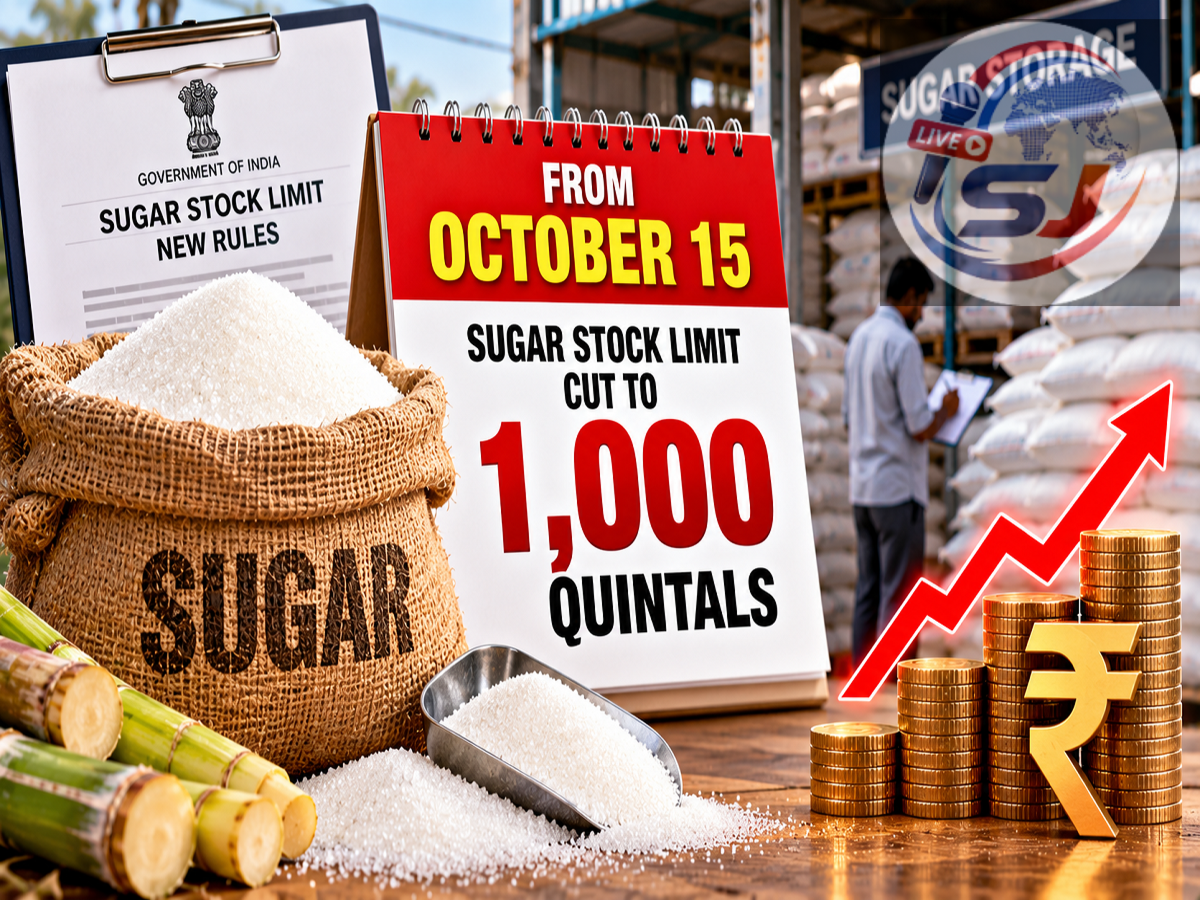
With the festive season increasing demand for sweets and other sugar-based products, the government has moved to tighten sugar stock limits in an effort to maintain adequate supplies and curb excessive stockpiling.
Under the revised arrangement cited in the report, dealers in most parts of the country will be permitted to keep a maximum of 1,000 quintals of sugar from October 15 to November 30, 2026. The permitted holding period will also be restricted to 15 days.
The decision comes at an important time for consumers because sugar demand typically rises during the festive period. By restricting how much stock can remain with dealers and how long it can be held, the government aims to improve the movement of sugar through the supply chain and keep the commodity available in retail markets.
However, consumers should not interpret the measure as a guarantee that retail sugar prices will immediately fall everywhere. Actual prices can vary according to location, supply, transportation costs and other market conditions.
Sugar Stock Limit Reduced to 1,000 Quintals
The biggest change concerns the quantity of sugar dealers can hold.
According to the supplied information, the general stock limit will be reduced to 1,000 quintals from October 15.
One quintal equals 100 kilograms, meaning 1,000 quintals is equivalent to 100,000 kilograms or 100 tonnes of sugar.
The measure is intended to prevent excessive accumulation of stocks with individual dealers during a period of high consumer demand.
In addition to the quantity restriction, dealers will reportedly be allowed to hold the stock for no more than 15 days.
Together, the two restrictions are designed to keep sugar moving from mills and wholesale channels toward retailers and consumers.
Kolkata and Assam Get Higher Limit
The same 1,000-quintal limit will not apply uniformly in every location.
According to the report, Kolkata and surrounding areas, along with Assam, will have a higher limit of 2,000 quintals.
The differential limit reflects regional consumption patterns and logistical considerations involved in supplying sugar to these markets.
This means eligible dealers in these specified areas can hold up to 2,000 quintals under the revised framework, compared with the general 1,000-quintal ceiling cited for most other areas.
Sugar Stock Limits Have Been Tightened Gradually
The latest restriction follows previous reductions in the amount dealers were permitted to keep.
The supplied report states that the limit was 4,000 quintals in August with a holding period of as much as 30 days.
It was subsequently reduced to 2,000 quintals from September 15.
From October 15, the general limit is set to fall further to 1,000 quintals, while the holding period is restricted to 15 days.
The progression can be summarised as follows:
| Period | Reported Stock Limit | Holding Period |
|---|---|---|
| August 2026 | 4,000 quintals | Up to 30 days |
| From September 15 | 2,000 quintals | As applicable |
| October 15-November 30 | 1,000 quintals in most areas | Maximum 15 days |
| Kolkata/surrounding areas and Assam | 2,000 quintals | As per applicable order |
The changes indicate a progressively tighter approach to sugar inventory management during the high-demand period.
Why Has the Government Reduced the Stock Limit?
Festival demand is one of the major factors behind the decision.
Sugar consumption can rise significantly when households, sweet shops, restaurants and food manufacturers increase production of sweets and festive foods.
When demand rises sharply, excessive stock accumulation at one level of the supply chain can reduce the quantity immediately available elsewhere.
This can potentially create temporary shortages and put upward pressure on market prices.
By lowering the stock ceiling and reducing the holding period, authorities aim to discourage unnecessary hoarding and encourage faster circulation of available sugar.
How Could the New Rule Affect Consumers?
For consumers, the objective is relatively straightforward: maintain availability and reduce the possibility of artificial shortages.
If sugar moves more quickly from mills to wholesalers, dealers and retail shops, consumers may have better access during the festive period.
The policy could also reduce the ability of market participants to hold unusually large quantities while waiting for prices to increase.
However, stock limits are only one factor affecting prices.
Sugar prices can also be influenced by production, sugarcane availability, weather, transport expenses, demand and broader commodity-market conditions.
Therefore, a tighter stock limit does not necessarily mean every retailer will immediately cut prices.
Government Reports Decline in Sugar Prices
The supplied information states that sugar prices had risen sharply in August but subsequently declined.
According to figures cited in the report, retail sugar prices have fallen by around 15% from the relevant earlier level, while prices at the sugar-mill level have declined by approximately 28%.
These percentages should be understood as reported movements from the government's referenced comparison period rather than as a promise of an additional 15% or 28% reduction after October 15.
The government's focus is now on ensuring that lower upstream prices and sufficient supply translate into reasonable availability for consumers.
Why Mill Prices and Retail Prices Can Move Differently
Consumers may wonder why a large fall in prices at the mill level does not always result in an equally large decline at retail shops.
The reason is that the final retail price includes several stages of the supply chain.
Transportation, storage, wholesale margins, retail margins, existing inventory purchased at earlier prices and local demand can all influence what consumers ultimately pay.
Therefore, even if ex-mill prices decline significantly, the reduction may reach retail consumers gradually rather than immediately.
Government Focuses on Preventing Hoarding
The stock-limit measure is also aimed at discouraging hoarding.
Dealers holding more sugar than permitted under the applicable order may face action under relevant rules.
Sugar mills, wholesalers and dealers are therefore expected to comply with inventory and supply requirements and avoid unnecessary accumulation of stocks.
Authorities want available sugar to continue flowing through the distribution system rather than remaining concentrated with a small number of market participants.
Weather Could Remain an Important Factor
The report also highlights concerns surrounding the sugarcane crop because of deficient rainfall in some areas.
Sugar production ultimately depends heavily on sugarcane availability.
Weather conditions affecting the crop can therefore influence future production estimates and market expectations.
If supply or pricing conditions change materially, the government could review its policy and take additional measures as considered necessary.
For consumers, this means the current stock-limit decision should be viewed as one part of a broader effort to manage sugar availability rather than as a permanent guarantee of lower prices.
Why the October 15 Date Matters
The revised general stock limit becomes particularly relevant from October 15, 2026.
From that date through November 30, the supplied report says dealers in most areas will face the 1,000-quintal ceiling and 15-day holding restriction.
This period overlaps with an important part of India's festive season, when household and commercial demand for sugar can remain elevated.
The timing is therefore intended to ensure that adequate quantities continue reaching the market when demand is high.
What Consumers Should Know
Consumers do not need to make any application or registration because of the stock-limit change.
The restriction is aimed at dealers and other covered participants in the sugar supply chain rather than ordinary households purchasing sugar for personal consumption.
People should also avoid panic buying based on rumours of a possible shortage. Large-scale consumer stockpiling can itself temporarily increase demand and put pressure on local supplies.
Sugar Price Outlook During the Festive Season
The government's immediate objective is to maintain adequate sugar availability while preventing excessive stock accumulation.
The reported reduction from 4,000 quintals in August to 2,000 quintals from September 15 and then 1,000 quintals from October 15 shows that stock restrictions have been progressively tightened.
For most areas, the latest 1,000-quintal limit is expected to remain applicable through November 30, according to the supplied information, while Kolkata and surrounding areas and Assam have been given a higher limit because of their specific requirements.
Whether retail sugar becomes cheaper will ultimately depend on how production, supply and demand evolve.
The stock-limit decision is intended to improve market availability and limit hoarding—not to guarantee a specific retail price. Consumers should therefore watch actual local market rates rather than assuming that the October 15 rule will automatically produce an immediate or uniform price cut across the country.