
SSY vs PPF: Which Government Savings Scheme Is Better for Your Child’s Future? Check Returns and Rules
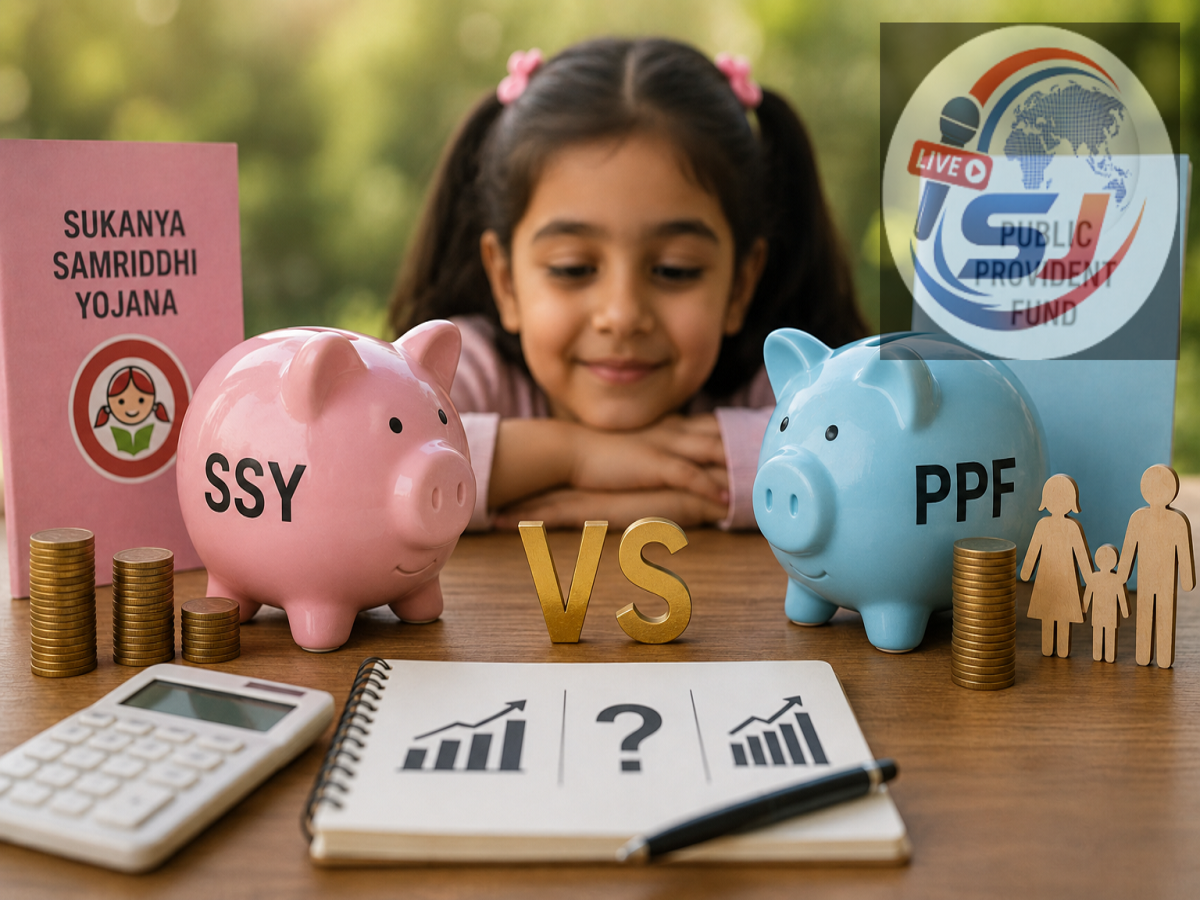
Planning early for a child's education, marriage and other major financial goals can reduce the burden on parents later. With higher education costs continuing to rise, building a dedicated fund through regular long-term investments can make a significant difference.
For parents looking for relatively stable, government-backed savings options, Sukanya Samriddhi Yojana (SSY) and the Public Provident Fund (PPF) are two popular choices. Both encourage long-term saving and offer tax-related benefits, but they are designed differently and cannot necessarily be used for the same financial goals.
One of the biggest differences is eligibility. SSY is specifically designed for a girl child, while PPF can be used for long-term savings irrespective of whether the child is a boy or a girl.
There is also a difference in returns. Based on the rates considered here, SSY offers an interest rate that is 1.1 percentage points higher than PPF. However, choosing a scheme solely on the basis of the interest rate may not be the right approach. Investment period, withdrawal rules, eligibility and the purpose of the accumulated money should also be considered.
What Is Sukanya Samriddhi Yojana?
Sukanya Samriddhi Yojana is a government-backed small savings scheme created specifically to help families build a financial corpus for a girl child's future.
An SSY account can be opened for an eligible girl child subject to the scheme's prescribed conditions. Parents or guardians can contribute regularly and use the accumulated amount for major future requirements such as higher education and marriage.
Because the scheme is designed around long-term goals, it can be particularly useful for parents who begin saving when their daughter is young.
Another attraction is its comparatively higher interest rate. A difference of even one percentage point can have a noticeable effect on the final corpus when money remains invested and compounds over many years.
How Is PPF Different From SSY?
The Public Provident Fund is a broader long-term savings scheme and is not restricted to a girl child.
Parents looking to create a future corpus for either a son or daughter can consider PPF as part of their financial planning. Adults can also use the scheme for their own long-term savings goals.
PPF has traditionally been viewed as an option for people who want disciplined long-term saving along with government backing.
The scheme has a 15-year tenure, making it suitable for goals that are several years away. It can therefore be aligned with a child's higher education or other long-term financial requirements, depending on when the investment is started.
SSY vs PPF: Interest Rate Makes a Difference
Returns are naturally one of the first things investors compare.
In the comparison considered here, SSY's interest rate is 1.1 percentage points higher than PPF's rate.
While 1.1 percentage points may initially appear to be a relatively small difference, compounding can magnify its impact over a long investment period. When contributions continue for years and the returns are reinvested, a higher rate can potentially create a significantly larger maturity corpus.
For parents eligible to invest in SSY for their daughter, this higher interest rate can therefore be an important advantage.
However, the return should not be considered in isolation.
A Simple Example Shows Why Compounding Matters
Suppose parents regularly invest the same amount toward a child's future in two long-term instruments but receive different rates of return.
During the initial years, the difference in the accumulated corpus may not appear substantial. As the investment period becomes longer, however, returns begin generating additional returns.
This is the power of compounding.
As a result, the investment earning the higher rate can gradually build a larger corpus, provided other factors such as the amount invested and timing of contributions remain comparable.
This is why beginning early can be just as important as selecting the investment itself. Parents who start saving when their child is young get more years for compounding to work.
SSY Is Specifically Meant for a Daughter
Eligibility is perhaps the biggest practical difference between these two schemes.
SSY is meant specifically for a girl child. Therefore, parents planning for their son's higher education or another future requirement cannot simply choose SSY because it offers a higher interest rate.
PPF, on the other hand, provides greater flexibility in terms of who can use it for long-term savings.
This makes the decision relatively straightforward in some cases. For a daughter, parents may compare SSY and PPF based on their goals and liquidity requirements. For a son, PPF may be considered because SSY is not available for that purpose.
Don't Ignore Lock-In and Withdrawal Conditions
Parents should also consider when they are likely to need the money.
A higher maturity value may look attractive, but a scheme should match the timeline of the financial goal. If money is likely to be required for college admission at a particular age, for example, the withdrawal conditions of the chosen investment become extremely important.
SSY has rules connected to the girl child's age, education and maturity of the account. PPF follows its own tenure and withdrawal framework.
Therefore, parents should understand the applicable rules rather than simply choosing whichever scheme currently offers the higher interest rate.
Which One Should Parents Choose?
There is no single answer that will suit every family.
For parents specifically building a long-term fund for their daughter, SSY can be attractive because it is designed for that purpose and offers a comparatively higher interest rate under the rates considered here.
For parents saving for a son, or those looking for a more general long-term savings option, PPF can be useful.
Some families may also use more than one investment instrument rather than depending entirely on a single scheme.
The key is to first determine the goal: how much money will be required, how many years are available to build it and when the funds will need to become accessible.
Once these questions are clear, comparing SSY and PPF becomes easier.
For long-term child planning, starting early and investing consistently can matter as much as the choice of scheme itself. A disciplined investment made over many years can help parents build a substantial corpus for education and other important milestones while reducing the need to arrange a large amount of money at the last minute.