
Small Savings Rates Unchanged From October: PPF at 7.1%, Sukanya at 8.2% and NSC at 7.7%
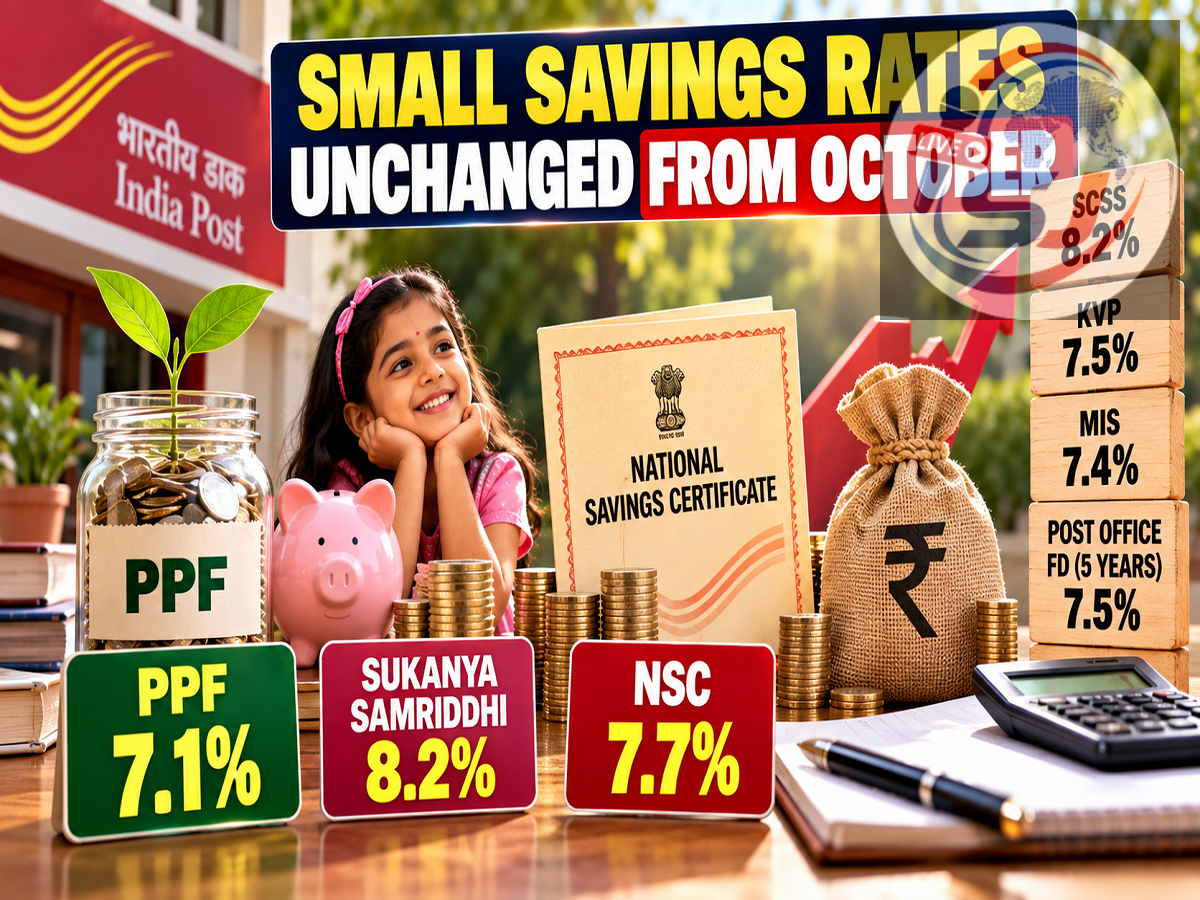
Investors in government-backed small savings schemes will see no change in interest rates from October 1, 2026. The Finance Ministry has decided to retain the existing rates for the October-December 2026 quarter, providing continuity for people investing in schemes such as the Public Provident Fund (PPF), Sukanya Samriddhi Yojana (SSY) and National Savings Certificate (NSC).
The government announced the rates on September 30, 2026, ahead of the beginning of the new quarter.
The decision means that the rates applicable during the July-September 2026 quarter will continue from October 1 to December 31, 2026.
Therefore, unlike several banking, LPG and other rule changes taking effect around the beginning of October, small savings investors will not face either an interest-rate cut or an increase during the new quarter.
Finance Ministry Keeps Small Savings Rates Unchanged
Small savings interest rates are reviewed periodically by the government, making every quarterly announcement important for millions of depositors.
For the October-December quarter, however, the Finance Ministry has opted for stability.
The rates applicable during the previous July-September quarter will continue without modification.
This means existing and eligible new investments will continue to earn interest according to the applicable scheme rules and the rates notified for the quarter.
For investors using these schemes for long-term savings, retirement planning, children's future expenses or eligible tax-saving purposes, the latest announcement removes uncertainty over a possible rate revision at the start of October.
PPF Interest Rate Remains at 7.1%
The Public Provident Fund (PPF) will continue to offer an annual interest rate of 7.1% during the October-December 2026 quarter.
PPF is widely used as a long-term savings option because of its government backing and tax-related features under the applicable rules.
The scheme has a long investment horizon and is often used by individuals building a retirement corpus or saving for other long-term financial objectives.
With the government leaving the rate unchanged, there will be no increase or reduction in the 7.1% rate for the October-December quarter.
Sukanya Samriddhi Continues to Offer 8.2%
The Sukanya Samriddhi Yojana (SSY) will continue with an annual interest rate of 8.2%.
The scheme is specifically designed to encourage parents and guardians to save for the future financial needs of a girl child.
At 8.2%, Sukanya Samriddhi remains among the higher-interest government small savings schemes currently available to eligible investors.
The October announcement does not increase this rate further, but it also avoids a reduction.
Investors will therefore continue under the existing 8.2% rate for the new quarter, subject to the scheme's interest-calculation rules.
NSC Interest Rate Stays at 7.7%
There is also no change for the National Savings Certificate (NSC).
The annual interest rate will remain 7.7% during the October-December quarter.
NSC is a government-backed savings instrument available through the post office network and is commonly considered by investors seeking a fixed-term small savings product.
The government's latest decision means the rate continues at the same level as in the preceding quarter.
SCSS Continues at 8.2%
The Senior Citizens Savings Scheme (SCSS) will also continue to offer an annual interest rate of 8.2%.
SCSS is designed for eligible senior citizens and is frequently used to generate regular income after retirement.
Its rate remains unchanged alongside the other major small savings schemes.
With SSY and SCSS both carrying an 8.2% rate, they remain among the higher-paying schemes in the current small savings basket, although they serve very different groups and have separate eligibility conditions.
Post Office Schemes Also Retain Existing Rates
The unchanged-rate decision covers other notified small savings products as well.
For example, the Post Office Monthly Income Scheme (MIS) continues at 7.4%, while the five-year Post Office Recurring Deposit (RD) remains at 6.7%.
The five-year Post Office Time Deposit continues at 7.5%, while Kisan Vikas Patra remains at 7.5% under the rates applicable for the quarter.
Investors should remember that interest-payment and compounding rules are not identical across these schemes, so comparing only the headline percentage may not provide a complete picture.
Small Savings Interest Rates for October-December 2026
Here are some of the major rates applicable during the quarter:
| Small Savings Scheme | Interest Rate |
|---|---|
| Sukanya Samriddhi Yojana | 8.2% |
| Senior Citizens Savings Scheme | 8.2% |
| National Savings Certificate | 7.7% |
| 5-Year Post Office Time Deposit | 7.5% |
| Kisan Vikas Patra | 7.5% |
| Post Office Monthly Income Scheme | 7.4% |
| Public Provident Fund | 7.1% |
| 3-Year Post Office Time Deposit | 7.1% |
| 2-Year Post Office Time Deposit | 7.0% |
| 1-Year Post Office Time Deposit | 6.9% |
| 5-Year Post Office Recurring Deposit | 6.7% |
| Post Office Savings Account | 4.0% |
These rates apply according to the individual terms and conditions of each scheme.
What Does the Decision Mean for Existing Investors?
For existing investors, the biggest takeaway is that there is no fresh rate cut to worry about for the October-December quarter.
PPF investors will continue with the notified 7.1% annual rate, while Sukanya Samriddhi account holders will continue at 8.2%.
Similarly, NSC remains at 7.7% and SCSS at 8.2%.
However, investors should understand that the way an interest-rate announcement affects their money can differ depending on the product.
Some schemes have rates that are periodically notified and applied according to their own rules, while certain certificates and time deposits may lock in the applicable rate based on when the investment is made.
Therefore, investors should examine the specific terms of their chosen scheme rather than assuming every small savings product calculates returns in exactly the same manner.
Why Are Small Savings Rates Reviewed?
The government reviews small savings rates periodically.
The framework broadly considers yields on comparable government securities along with the spreads applicable to individual savings products. However, the final rates are those formally notified by the government.
This is why investors closely watch the Finance Ministry's announcement at the end of every quarter.
A rate increase can improve prospective returns for eligible investments, while a reduction can make some schemes relatively less attractive compared with bank deposits or other fixed-income alternatives.
For October-December 2026, the government has chosen not to change the rates.
PPF vs Sukanya vs NSC: Different Schemes for Different Goals
Although these products are often grouped under the broad category of small savings schemes, they are not interchangeable.
PPF is designed primarily as a long-term savings product available to eligible individuals.
Sukanya Samriddhi is specifically meant for savings for an eligible girl child.
NSC is a fixed-term savings certificate, while SCSS targets eligible senior citizens.
Therefore, investors should not select a scheme solely because it offers the highest interest rate.
Eligibility, investment tenure, liquidity, withdrawal conditions, taxation and the purpose of the investment should also be considered.
Does 8.2% Make Sukanya or SCSS Better Than PPF?
A higher headline rate does not automatically make one scheme universally better than another.
Sukanya Samriddhi and SCSS both offer 8.2%, compared with PPF's 7.1%, but the eligibility requirements and financial objectives are completely different.
A person cannot simply choose SSY unless the eligibility conditions related to a girl child are satisfied. Similarly, SCSS is intended for eligible senior citizens.
PPF has its own rules relating to tenure, deposits and withdrawals.
The appropriate option therefore depends on the investor's eligibility and financial objective rather than the interest rate alone.
Will the Rates Change in January 2027?
The October-December rates are applicable only for the notified quarter.
The government will review small savings interest rates again for the next quarter covering January-March 2027.
That review could result in rates being retained, increased or reduced.
Investors should therefore wait for the government's next official notification rather than assuming today's rates will automatically continue beyond December 31.
What Investors Should Do Now
People already investing in these schemes do not need to make changes simply because October has started, since the interest rates have been retained.
Those planning a new investment should compare the available schemes based on their requirements.
For example, a parent saving specifically for a daughter's future may consider the eligibility and features of Sukanya Samriddhi, while an eligible senior citizen looking for regular income may examine SCSS.
A long-term saver may evaluate PPF, while NSC and Post Office Time Deposits may suit different fixed-income requirements.
The decision should take into account the investment period, withdrawal restrictions, taxation and expected cash-flow needs.
Bottom Line
The Finance Ministry's September 30 announcement brings stability for small savings investors.
There will be no change in the interest rates of major small savings schemes for the October-December 2026 quarter.
PPF will continue at 7.1%, Sukanya Samriddhi and SCSS at 8.2%, NSC at 7.7%, Kisan Vikas Patra at 7.5%, Monthly Income Scheme at 7.4%, and the five-year Post Office RD at 6.7%.
The rates applicable from July to September will therefore continue from October 1 through December 31, 2026.
Investors should note that the government will review the rates again for the January-March 2027 quarter, so the current rates should not automatically be assumed to continue beyond December.
Disclaimer: Interest rates and scheme rules are subject to government notifications. Investors should check the latest official terms, eligibility conditions, tax treatment and withdrawal rules before making an investment decision.