
SIP Rule of 60 Explained: How a ₹1,150 Monthly Investment Could Target ₹1 Crore
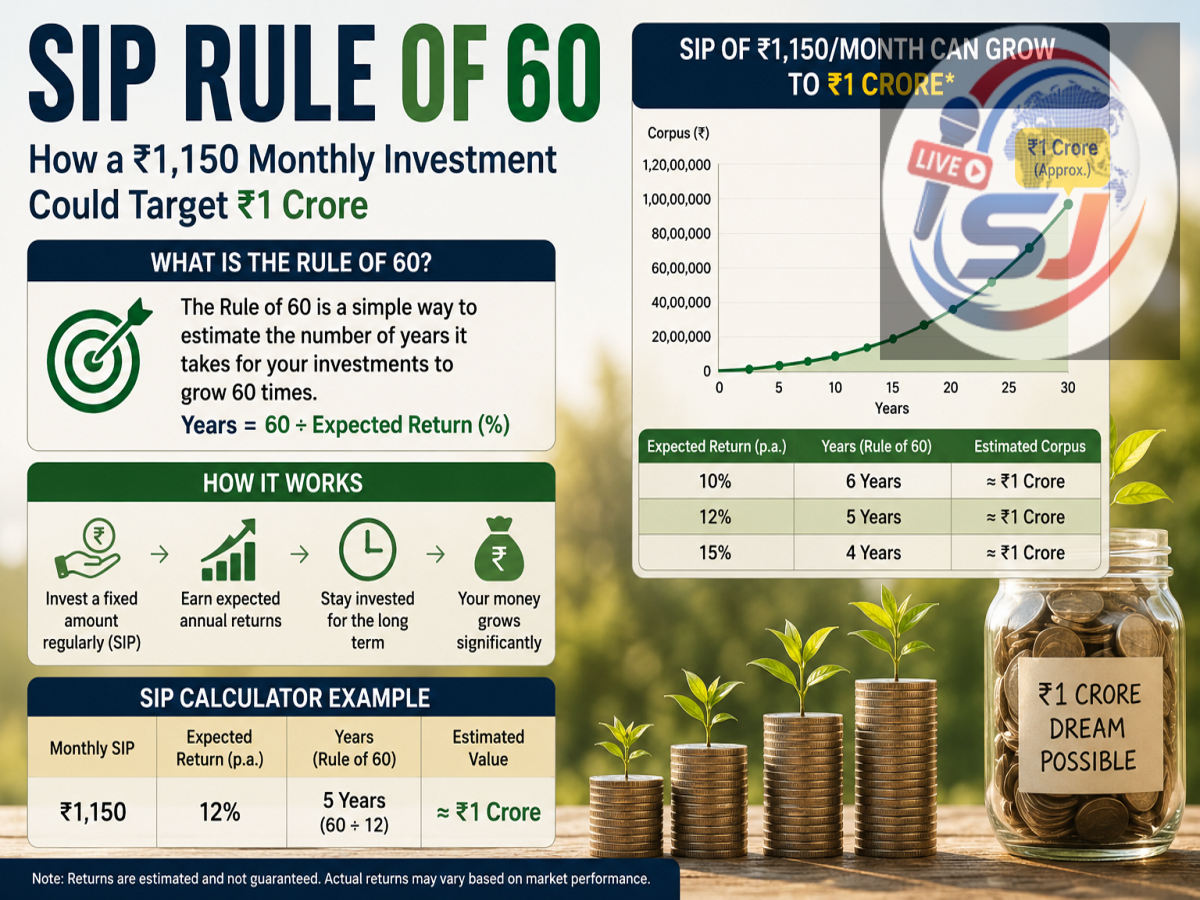
SIP Investment Rule of 60: Building a retirement corpus of ₹1 crore may appear difficult when you are starting with a small monthly investment. However, a long investment horizon, regular contributions and gradually increasing your SIP can make the target more achievable. This idea is behind the so-called "Rule of 60" currently being discussed among mutual fund investors.
The Rule of 60 is not an official investment scheme, government programme or guaranteed wealth formula. Instead, it is a simple illustration of how someone starting around age 30 could use the next 30 years to build wealth through a step-up Systematic Investment Plan (SIP).
Under one commonly cited example, an investor starts with a monthly SIP of approximately ₹1,150, increases it by 10% every year and continues investing until age 60. Assuming an average annual return of around 12%, the investment is projected to potentially build a corpus close to ₹1 crore.
The key word, however, is "potentially". Mutual fund returns are market-linked and cannot be guaranteed.
What Is the SIP Rule of 60?
The idea behind the Rule of 60 is straightforward.
Suppose you begin investing when you are 30 years old and continue until you turn 60. That gives your investments approximately 30 years to grow.
Instead of keeping the SIP amount unchanged throughout the period, you increase the monthly contribution every year.
For example:
Starting age: 30 years
Investment period: 30 years
Starting monthly SIP: Around ₹1,150
Annual SIP increase: 10%
Assumed annual return: 12%
Target age: 60 years
Illustrative target: Around ₹1 crore
The long duration allows compounding to play an increasingly important role in the portfolio's potential growth.
How Can ₹1,150 a Month Become ₹1 Crore?
At first glance, investing just ₹1,150 every month and targeting ₹1 crore may sound unrealistic.
The important detail is that the monthly contribution does not remain ₹1,150 for all 30 years.
The investor increases the SIP amount by 10% every year.
If the starting monthly contribution is ₹1,150, a 10% annual step-up would take it to approximately ₹1,265 per month in the second year. In the third year, it would increase again to roughly ₹1,392.
The same process continues every year.
As the investor's income potentially increases over the course of their career, a larger amount is directed toward the SIP.
Under the illustration, the investor could contribute around ₹22.7 lakh over 30 years. If the portfolio generates the assumed market return over the period, compounding could potentially take the final value to around ₹1 crore.
The calculation is only an illustration, however. Actual returns could be substantially higher or lower.
Why Does a Step-Up SIP Make Such a Difference?
A traditional SIP involves investing a fixed amount regularly. If you start a ₹5,000 monthly SIP and never change it, you continue contributing ₹5,000 regardless of how your income changes.
A step-up SIP takes a different approach.
The contribution is increased periodically, typically once every year.
Suppose someone receives an annual salary increment. Rather than using the entire increase for additional spending, the investor could raise the SIP contribution by 5% or 10%.
Over several decades, this can significantly increase the total amount invested.
More importantly, money contributed during the earlier stages of the investment journey gets more time to potentially compound.
Compounding Is the Real Engine Behind Long-Term SIPs
Compounding means that returns generated by an investment can themselves participate in future growth.
Consider a simplified example.
If an investment of ₹1 lakh earns 12%, it becomes ₹1.12 lakh after one year. If the entire amount remains invested and again grows by 12%, the next year's return is calculated on ₹1.12 lakh rather than only the original ₹1 lakh.
Over one or two years, the difference may not appear dramatic.
Over 20 or 30 years, the impact can become substantial.
This is why starting early can sometimes matter more than starting with a very large amount.
Starting at 30 Gives Your Money 30 Years
Time is one of the most important variables in long-term investing.
An investor beginning at age 30 has three decades before reaching 60. Someone starting at 40 has only 20 years to reach the same age.
That 10-year difference can dramatically affect the amount required every month to achieve the same financial goal.
An early investor can potentially start with a smaller SIP because the money gets more time to compound.
A late starter generally needs to contribute substantially more to compensate for the shorter investment horizon.
Is a 12% Annual Return Guaranteed?
No.
The 12% annual return used in the Rule of 60 is an assumption for illustration, not a promise.
Mutual funds invest in market-linked assets, and their performance can fluctuate. Equity markets can deliver strong returns during some periods and negative returns during others.
Even over long periods, there is no guarantee that a particular mutual fund will deliver exactly 12% annualised returns.
This distinction is especially important when projections show a neat target such as ₹1 crore.
A calculator can estimate what would happen if a certain return is achieved. It cannot guarantee that the market will actually deliver that return.
What If Returns Are Lower Than Expected?
This is another reason investors should periodically review their retirement plans.
If a calculation assumes 12% annualised returns but the portfolio actually generates a lower return, the final corpus could fall short of the target.
Investors then have several potential options, depending on their financial situation. They may increase their SIP, extend the investment period or revise their financial target.
Regular portfolio reviews can help identify such gaps early rather than discovering them just before retirement.
Don't Forget Inflation When Targeting ₹1 Crore
A ₹1 crore retirement corpus sounds substantial today, but inflation reduces the purchasing power of money over time.
Someone who is currently 30 and plans to retire at 60 is looking three decades into the future.
The amount required for retirement should therefore be calculated based on expected future expenses rather than choosing ₹1 crore simply because it is a psychologically attractive target.
Housing, healthcare, travel and everyday living expenses can all become considerably more expensive over a 30-year period.
The Rule of 60 is therefore better viewed as a lesson in disciplined investing than as a complete retirement-planning formula.
Why You Shouldn't Stop SIPs During Every Market Fall
Stock markets do not rise continuously.
During a 30-year investment journey, investors are likely to experience multiple market corrections, periods of volatility and possibly major downturns.
Stopping an SIP every time markets fall can interfere with the long-term investment strategy.
With an SIP, the same contribution buys more mutual fund units when prices are lower and fewer units when prices are higher. This is commonly described as rupee-cost averaging.
That does not eliminate investment risk, but it can reduce the need to repeatedly predict the perfect time to enter the market.
Keep an Emergency Fund Separate
Long-term investing works best when investors do not have to repeatedly withdraw money for short-term emergencies.
Before aggressively increasing an SIP, it can therefore be useful to maintain a separate emergency fund.
This money can cover unexpected expenses such as temporary loss of income, urgent repairs or other financial emergencies.
Without such a buffer, investors may be forced to redeem long-term investments at an unfavourable time.
Choose Mutual Funds According to Your Risk Profile
The Rule of 60 explains an investment approach, but it does not tell investors which mutual fund they should select.
That decision depends on factors such as age, investment horizon, financial goals and ability to tolerate market volatility.
Two investors of the same age may have very different risk capacities.
Investors should therefore understand the fund's investment strategy, risk level, costs and past behaviour across market cycles before investing. Past performance should not be treated as a guarantee of future returns.
SIP Rule of 60: What Investors Should Remember
The most useful lesson from the Rule of 60 is not that ₹1,150 will definitely become ₹1 crore.
The real lesson is that starting early, investing consistently and increasing contributions as income grows can dramatically improve long-term wealth-building potential.
Under the illustrative example, someone starting at age 30 with around ₹1,150 per month, increasing the SIP by 10% every year and continuing until age 60 could contribute approximately ₹22.7 lakh over the investment period.
Assuming an average annual return of around 12%, that investment could potentially grow toward the ₹1 crore mark.
But mutual funds remain subject to market risks, and neither the 12% return nor the ₹1 crore corpus is guaranteed.
For retirement planning, investors should also account for inflation, maintain emergency savings and periodically check whether their actual portfolio growth remains on track with their financial goals.