
SIP Calculator 2026: How Much Monthly SIP Do You Need to Build a ₹1 Crore Retirement Fund?

SIP Calculator for ₹1 Crore: Planning for retirement is one of the most important financial decisions for salaried employees and young professionals. If your goal is to build a retirement corpus of ₹1 crore, starting a Systematic Investment Plan (SIP) early could make a significant difference.
Many investors wonder whether a monthly SIP of ₹3,000 or ₹5,000 can eventually grow into ₹1 crore. The answer depends on three major factors: the monthly investment amount, investment duration and returns generated over time.
For example, a 30-year-old planning to retire at 60 has approximately 30 years to invest. With a sufficiently long investment horizon, even a relatively small monthly contribution can potentially grow into a substantial amount through compounding.
However, mutual fund returns are market-linked and not guaranteed. The following calculations use an assumed annual return of 12% for illustration.
How Much SIP Is Required to Build ₹1 Crore?
Suppose you invest regularly in an equity mutual fund through SIP and assume a 12% annualised return, calculated using a monthly rate of 1%.
The approximate monthly investment required to reach ₹1 crore changes significantly depending on how long you remain invested.
ILLUSTRATIVE SIP TARGET
Retirement goal
₹1 crore
Monthly SIP for 30 years
₹2,861
Assuming 12% annual return, monthly compounding and contributions at the end of each month. This is a projection, not a guaranteed return.
SIP Calculation: ₹1 Crore Target Over 10, 15, 20, 25 and 30 Years
| Investment Period |
Monthly SIP |
Total Investment |
Estimated Corpus |
|---|---|---|---|
| 10 years |
₹43,471 |
₹52.16 lakh |
₹1 crore |
| 15 years |
₹20,017 |
₹36.03 lakh |
₹1 crore |
| 20 years |
₹10,109 |
₹24.26 lakh |
₹1 crore |
| 25 years |
₹5,322 |
₹15.97 lakh |
₹1 crore |
| 30 years |
₹2,861 |
₹10.30 lakh |
₹1 crore |
Monthly SIP required to target ₹1 crore
Illustrative calculation at 12% annual return
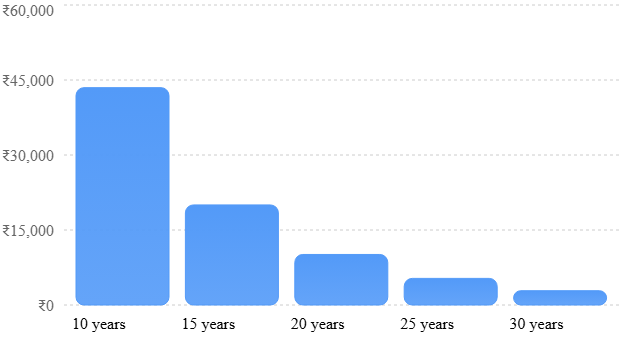
The figures demonstrate why the investment period is so important.
If you have only 10 years to build ₹1 crore, you would need to invest approximately ₹43,471 every month under these assumptions.
However, extending the investment period to 30 years reduces the estimated monthly SIP requirement to approximately ₹2,861.
In the 30-year example, the total amount invested would be approximately ₹10.30 lakh, while the remaining corpus would come from assumed investment growth.
This highlights the potential benefit of starting early and allowing investments more time to compound.
Interactive SIP Calculator: Estimate Your Future Investment Value
Monthly SIP amount
₹5,000
₹1,000₹50,000
Investment duration
25 years
Assumed annual return
12%
ESTIMATED MATURITY VALUE
₹93.94 lakh
Invested amount
₹15.00 lakh
Estimated gains
₹78.94 lakh
Change the SIP, duration or assumed return to explore scenarios. Calculations assume fixed monthly contributions, monthly compounding and no taxes or fees. Reset calculator
Can a ₹5,000 Monthly SIP Grow Into ₹1 Crore?
Consider an investor earning ₹30,000 per month who decides to invest ₹5,000 through a monthly SIP.
If the investment earns an assumed annual return of 12%, the corpus could grow to approximately ₹94 lakh after 25 years.
The investor would have contributed ₹15 lakh during this period.
The remaining amount would represent estimated investment growth.
At the same assumed return, continuing the ₹5,000 SIP for approximately another year could take the corpus beyond ₹1 crore.
This illustrates how maintaining an investment for a longer period can potentially increase its future value.
However, actual equity mutual fund returns fluctuate, and a consistent 12% annual return should not be assumed.
What Happens If You Increase Your SIP by 10% Every Year?
A Step-up SIP is another investment approach that can help investors increase their contributions as their income grows.
Instead of investing the same amount every month throughout the investment period, you increase your SIP by a fixed percentage annually.
For example, if you start with ₹5,000 per month and increase the amount by 10% each year, the investment pattern would look like this:
| Investment Year |
Monthly SIP |
|---|---|
| Year 1 |
₹5,000 |
| Year 2 |
₹5,500 |
| Year 3 |
₹6,050 |
| Year 4 |
₹6,655 |
| Year 5 |
₹7,321 (approx.) |
As the monthly contribution increases, more money is invested over time.
A Step-up SIP can potentially help investors build a larger retirement corpus than a fixed SIP, assuming the same investment period and returns.
However, the annual increase should remain affordable. Investors should consider their income growth, household expenses and other financial commitments before committing to a higher SIP.
Why Is Compounding Important for Retirement Planning?
Compounding occurs when returns generated on an investment remain invested and may generate additional returns over time.
For example, an investment held for 30 years has considerably more time to benefit from potential compounding than one held for only 10 years.
This is why starting retirement investments early can be advantageous.
However, compounding in equity mutual funds does not happen at a fixed or guaranteed rate. Market returns can be positive or negative, and the value of investments may fluctuate substantially.
Long-term projections should therefore be treated as planning estimates rather than promises of future wealth.
Will ₹1 Crore Be Enough for Retirement After 30 Years?
This is an important question that investors should consider before setting a retirement target.
Inflation gradually reduces the purchasing power of money.
For example, if inflation averages 6% annually over 30 years, approximately ₹5.74 crore would be needed in the future to match the purchasing power of ₹1 crore today.
Similarly, ₹1 crore received after 30 years would have purchasing power equivalent to roughly ₹17.4 lakh in today's money under that inflation assumption.
Therefore, a retirement goal should account for future living expenses, medical costs, dependants and expected retirement duration.
Simply targeting ₹1 crore without adjusting for inflation may not provide sufficient financial security.
Important Things to Consider Before Starting a Retirement SIP
Investors should first estimate their retirement age and the number of years available for investment.
Next, they should calculate the approximate corpus needed to support their desired lifestyle after retirement.
Choose a monthly SIP amount that can be maintained consistently without disrupting essential household expenses or emergency savings.
Review investments periodically and consider whether the selected mutual funds remain suitable for your risk tolerance and financial objectives.
Market corrections are a normal part of equity investing, but investors should also recognise that equity funds carry the risk of capital loss.
As retirement approaches, reviewing asset allocation and reducing excessive exposure to volatile investments may become important.
Final Words
Building a ₹1 crore retirement fund through SIP is a long-term financial goal that may become more achievable when investors start early and invest consistently.
At an illustrative 12% annual return, a monthly SIP of approximately ₹2,861 over 30 years could potentially grow to ₹1 crore.
However, achieving the same target in just 10 years would require a much higher monthly investment.
Investors can also consider increasing SIP contributions as their income grows.
The most important factors are starting early, choosing an affordable investment amount, accounting for inflation and reviewing the retirement plan regularly.
Remember that mutual fund investments are subject to market risks, and future returns are not guaranteed.
Disclaimer: This article is intended for general financial education only and does not constitute investment advice. SIP projections are illustrative and exclude taxes, expenses and changes in market returns. Consult a SEBI-registered investment adviser before making investment decisions.