
Senior Citizens Can Earn ₹61,500 Every Quarter From This Government Savings Scheme: See How ₹30 Lakh Works
Retirement often changes the way people think about money. Instead of chasing high returns, many senior citizens begin prioritising capital safety and a predictable income stream that can help meet household expenses.
One government-backed option designed specifically for older investors is the Senior Citizens’ Savings Scheme (SCSS). Available through post offices and authorised banks, the scheme allows eligible senior citizens to invest a lump sum and receive interest at prescribed intervals.
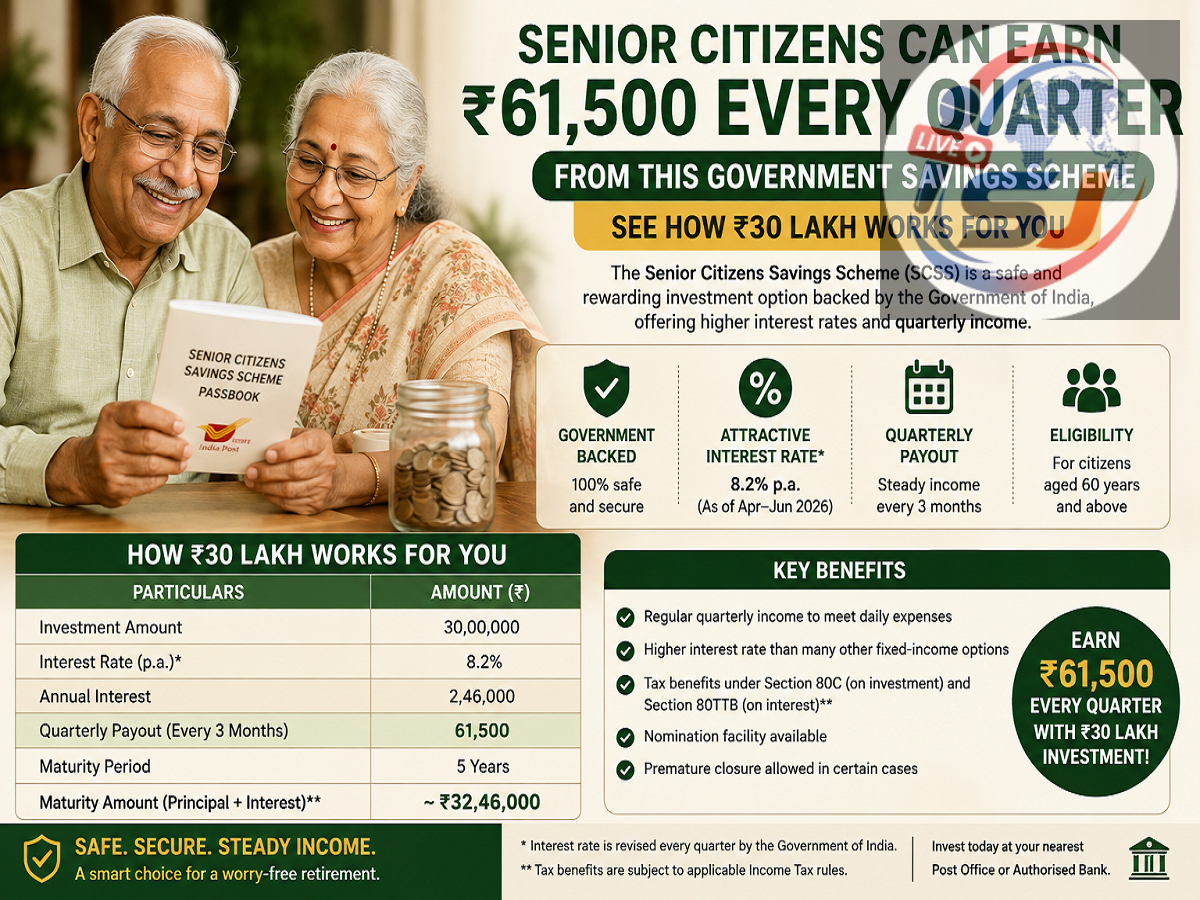
At an annual interest rate of 8.2%, an investment of ₹30 lakh can generate ₹2.46 lakh in interest over a year. However, there is an important detail: SCSS does not actually pay ₹20,500 every month. Interest is paid quarterly. The ₹20,500 figure is simply the monthly equivalent of the annual interest.
Here is how the calculation works and what investors should understand before opening an account.
How Does a ₹30 Lakh Investment Generate ₹2.46 Lakh a Year?
The calculation is straightforward.
If ₹30 lakh is invested at an annual interest rate of 8.2%, the estimated annual interest works out to:
₹30,00,000 × 8.2% = ₹2,46,000
This means the investment can generate ₹2.46 lakh in gross interest during a year, assuming the applicable interest rate and investment conditions.
If that annual amount is divided by 12 for budgeting purposes:
₹2,46,000 ÷ 12 = ₹20,500
Therefore, ₹20,500 represents the average monthly equivalent of the interest earned.
Investors should not confuse this calculation with an actual monthly pension deposited by the government.
You Receive ₹61,500 Every Quarter, Not ₹20,500 Monthly
This distinction is particularly important for retirees planning their monthly expenses.
SCSS interest is generally payable on a quarterly basis.
On a ₹30 lakh investment at 8.2%, the quarterly calculation would be:
₹2,46,000 ÷ 4 = ₹61,500
Therefore, an investor would receive approximately ₹61,500 every quarter, subject to applicable rules and taxes.
A retiree who wants to use the money as monthly income could effectively allocate the ₹61,500 quarterly payment across three months, giving a budget of approximately ₹20,500 per month.
That is why SCSS is sometimes described as providing pension-like income, even though technically it is interest from a savings scheme rather than a pension.
What Is the Senior Citizens’ Savings Scheme?
SCSS is a government-backed small savings scheme intended primarily for senior citizens.
Its structure is relatively simple: an eligible investor deposits money into an SCSS account and receives interest according to the rate notified by the government.
Unlike market-linked investments, returns don't depend directly on movements in stock prices or mutual fund NAVs.
This can make the scheme relevant for retirees who value predictability and don't want a large portion of their retirement corpus exposed to equity-market fluctuations.
How Long Does the Investment Continue?
The standard maturity period of an SCSS account is five years.
After completing the original tenure, eligible account holders can opt for an extension according to the prevailing scheme rules.
Investors should remember that SCSS is intended as a medium-to-long-term retirement savings product. Premature closure is possible under prescribed conditions, but deductions or other rules may apply depending on when the account is closed.
Therefore, money required for immediate emergencies shouldn't automatically be committed entirely to the scheme.
Who Can Open an SCSS Account?
The scheme is primarily available to individuals who have reached the prescribed senior-citizen age.
Generally, an individual aged 60 years or above can open an account.
Certain retired civilian employees between 55 and 60 years may also qualify, subject to conditions regarding retirement benefits and the period within which the investment is made.
Separate provisions can apply to eligible retired defence personnel.
Anyone considering an SCSS account should check the latest eligibility conditions before investing rather than relying solely on age.
Is ₹30 Lakh the Maximum Investment?
Under the current structure referred to here, an eligible investor can invest up to ₹30 lakh in SCSS.
This upper limit is particularly significant because increasing the investment naturally increases the amount of quarterly interest.
For example, using an 8.2% annual rate, the indicative calculations are:
| Investment | Annual Interest | Quarterly Equivalent | Monthly Equivalent |
|---|---|---|---|
| ₹5 lakh | ₹41,000 | ₹10,250 | ₹3,417 |
| ₹10 lakh | ₹82,000 | ₹20,500 | ₹6,833 |
| ₹15 lakh | ₹1,23,000 | ₹30,750 | ₹10,250 |
| ₹20 lakh | ₹1,64,000 | ₹41,000 | ₹13,667 |
| ₹30 lakh | ₹2,46,000 | ₹61,500 | ₹20,500 |
These figures are gross indicative calculations at 8.2% and don't account for the investor's individual tax liability.
Don't Ignore Tax on SCSS Interest
SCSS offers a tax-related benefit on the amount invested, but investors should distinguish between the treatment of the principal investment and interest income.
Eligible investment in SCSS can qualify for deduction under Section 80C of the Income-tax Act, subject to the overall applicable limit and the taxpayer's chosen tax regime and eligibility.
However, the interest earned from SCSS is taxable.
This means the ₹2.46 lakh annual interest calculated on a ₹30 lakh deposit should not automatically be treated as ₹2.46 lakh of tax-free income.
The actual post-tax amount available to an investor will depend on their overall taxable income, applicable tax regime and other relevant rules.
TDS provisions may also apply where the prescribed conditions and thresholds are met.
Why SCSS Can Be Useful After Retirement
One of the biggest challenges after retirement is converting accumulated savings into regular cash flow.
Someone may have a sizeable retirement corpus but still require predictable money for groceries, utility bills, medicines, insurance premiums and other recurring expenses.
SCSS addresses this requirement by providing scheduled interest payments.
Another advantage is that the investment isn't directly exposed to day-to-day stock-market volatility. For investors whose priority is protecting retirement savings rather than maximising long-term capital growth, this can be an important consideration.
But Don't Put the Entire Retirement Corpus in One Place
Safety alone shouldn't determine a retirement strategy.
Senior citizens also need readily accessible emergency funds. Medical expenses, home repairs or family requirements can arise unexpectedly, and money committed to a fixed-tenure product may not provide the same flexibility as savings accounts or short-term deposits.
Inflation is another consideration. A fixed amount that comfortably covers monthly expenses today may have lower purchasing power several years later.
For this reason, SCSS can potentially form one part of a diversified retirement-income strategy rather than automatically becoming the destination for every rupee of retirement savings.
How Can You Open an SCSS Account?
Eligible investors can approach a participating post office or authorised bank for an SCSS account.
Applicants generally need to provide the prescribed application form along with identity, address, age and other required KYC documents. Retirees seeking eligibility under special retirement provisions may need additional documentation.
Before depositing a large amount, investors should confirm the latest interest rate, investment ceiling, premature-withdrawal conditions, extension provisions and tax treatment applicable at that time.
Final Calculation: What Does ₹30 Lakh Actually Give You?
At an annual interest rate of 8.2%, the basic calculation on ₹30 lakh looks like this:
Investment: ₹30,00,000
Annual interest: ₹2,46,000
Quarterly interest: ₹61,500
Monthly equivalent: ₹20,500
The key phrase here is monthly equivalent.
SCSS shouldn't be presented as a scheme that deposits a ₹20,500 pension into the account every month. Instead, the investor receives interest quarterly and can divide that money across the following three months for household budgeting.
For senior citizens seeking predictable returns without direct exposure to market fluctuations, that combination of government backing and scheduled interest payments can make SCSS worth considering—provided liquidity needs, taxation and the latest scheme rules are checked before investing.