SCSS vs Post Office MIS: Which Scheme Can Give Retirees More Regular Income? Check Full Calculation
Creating a reliable stream of income after retirement is one of the biggest financial priorities for senior citizens. Once a regular salary stops, many retirees look for options that can generate predictable interest income while keeping their savings in government-backed small savings schemes.
Two popular options are the Senior Citizens Savings Scheme (SCSS) and the Post Office Monthly Income Scheme (POMIS).
While both can be used to generate regular income, they work differently. SCSS currently offers a higher interest rate and permits a larger investment, while Post Office MIS is designed to provide interest every month.
So, which one may be more suitable after retirement? The answer depends on your age, investment amount and whether you prefer monthly or quarterly income.
SCSS vs Post Office MIS: What's the Main Difference?
SCSS is primarily designed for senior citizens, while Post Office MIS is available to a broader group of investors.
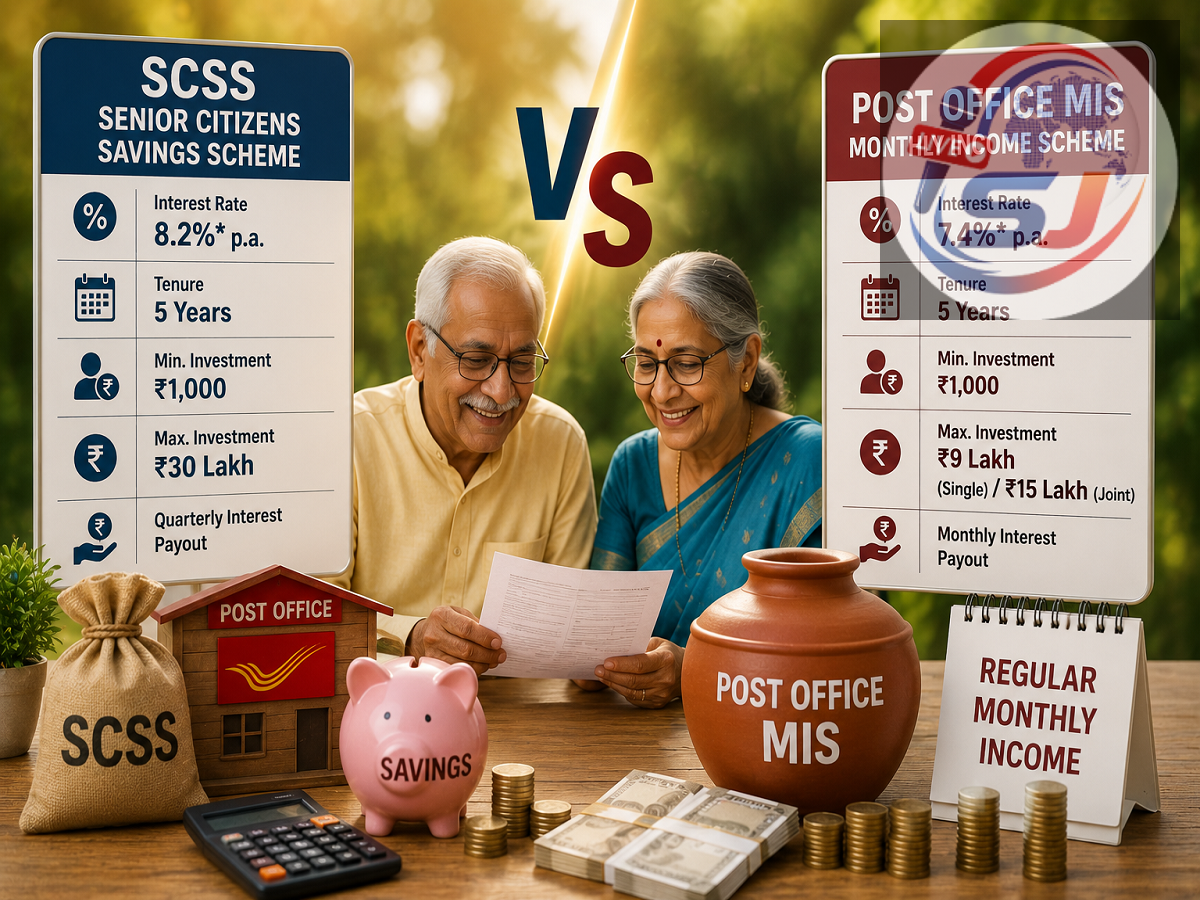
According to the information provided, SCSS offers an annual interest rate of 8.2% for the July-September 2026 quarter.
Post Office MIS, meanwhile, offers 7.4% per annum.
The payout frequency is also different.
SCSS pays interest quarterly, while POMIS provides interest every month.
For retirees who want a relatively larger quarterly payout, SCSS may therefore be attractive. Someone who wants money credited every month for regular household expenses may find POMIS more convenient.
Who Can Open an SCSS Account?
Senior Citizens Savings Scheme is primarily available to individuals aged 60 years or above.
The source also notes that certain employees who take voluntary retirement or retire from government service may be allowed to open an SCSS account before turning 60, subject to the applicable eligibility conditions.
This makes SCSS specifically focused on retirement-related savings.
Who Can Invest in Post Office MIS?
Post Office Monthly Income Scheme has a wider eligibility base.
According to the supplied information, an adult Indian citizen can open an account, meaning the scheme is not restricted only to senior citizens.
This is an important distinction between the two schemes.
A person does not necessarily have to wait until retirement to use POMIS for generating regular interest income.
SCSS Interest Rate and Payment Frequency
For the July-September 2026 quarter, the interest rate mentioned for SCSS is 8.2% per annum.
Interest is paid every three months.
According to the source, payments are made on the first working day of April, July, October and January.
This means retirees receive four interest payouts during the year rather than a monthly payment.
For someone who can manage household expenses on a quarterly cash-flow cycle, this arrangement may work well.
Post Office MIS Provides Monthly Income
POMIS works differently.
The interest rate cited for the scheme is 7.4% annually, lower than the 8.2% offered by SCSS in the comparison.
Its main advantage, however, is its payout frequency.
Interest is paid every month and can be credited to the investor's eligible bank or post office account.
That monthly payout can be particularly useful for retirees who need a predictable amount for groceries, utility bills, medicines and other recurring household expenses.
How Much Can You Invest in SCSS?
The maximum investment amount mentioned for SCSS is ₹30 lakh per individual.
The larger investment ceiling, combined with the higher interest rate in this comparison, means SCSS can generate considerably more interest income than POMIS when the maximum permitted amounts are invested.
However, SCSS eligibility restrictions mean it is not available to every investor.
Maximum Investment Allowed in Post Office MIS
POMIS has different limits for individual and joint accounts.
According to the supplied information:
-
A single account can hold up to ₹9 lakh
-
A joint account can hold up to ₹15 lakh
Because the maximum permitted investment is lower than in SCSS, the absolute amount of interest income is also lower when comparing the schemes at their respective maximum investment limits.
SCSS Calculation: ₹30 Lakh Investment at 8.2%
Consider a senior citizen investing the maximum ₹30 lakh in SCSS at an annual interest rate of 8.2%.
The calculation would be:
Total investment: ₹30,00,000
Annual interest: ₹2,46,000
Since SCSS pays interest quarterly:
Quarterly income: ₹61,500
If the annual interest is converted into a simple monthly average for comparison:
Average monthly equivalent: approximately ₹20,500
The investor does not actually receive ₹20,500 every month under SCSS. The payment is made quarterly at ₹61,500 based on this example.
That distinction is important when planning monthly household cash flow.
POMIS Joint Account: Income on ₹15 Lakh
Now consider a joint Post Office MIS account with the maximum ₹15 lakh investment at 7.4% annual interest.
The calculation works out as follows:
Investment: ₹15,00,000
Annual interest: ₹1,11,000
Monthly interest income: ₹9,250
Unlike SCSS, this amount is paid every month.
For a retired couple looking for a regular monthly cash flow, ₹9,250 can therefore be available each month under the assumptions used in this example.
POMIS Single Account: Income on ₹9 Lakh
For an individual POMIS account, the maximum investment in the supplied comparison is ₹9 lakh.
At an annual interest rate of 7.4%:
Investment: ₹9,00,000
Annual interest: ₹66,600
Monthly interest income: ₹5,550
The investor therefore receives ₹5,550 each month based on the stated rate and investment amount.
SCSS vs POMIS: Income Comparison
| Feature | SCSS | POMIS Joint | POMIS Single |
|---|---|---|---|
| Interest Rate | 8.2% p.a. | 7.4% p.a. | 7.4% p.a. |
| Investment Used | ₹30 lakh | ₹15 lakh | ₹9 lakh |
| Annual Interest | ₹2,46,000 | ₹1,11,000 | ₹66,600 |
| Regular Payout | ₹61,500 quarterly | ₹9,250 monthly | ₹5,550 monthly |
| Monthly Equivalent | ₹20,500 | ₹9,250 | ₹5,550 |
The table makes SCSS appear significantly more rewarding in absolute rupee terms, but this is partly because the SCSS example uses a much larger investment amount.
A fair comparison should therefore consider both the interest rate and the amount of capital invested.
Which Scheme Offers the Higher Interest Rate?
Based on the rates cited in the supplied article, SCSS has the advantage.
SCSS offers 8.2% per annum, compared with 7.4% for POMIS.
That is a difference of 0.8 percentage points.
On the same investment amount, therefore, SCSS would generate higher interest at these stated rates.
However, interest rates on government small savings schemes can be revised. Investors should check the applicable rate when opening an account rather than assuming the current rate will apply to a new investment indefinitely.
Both Schemes Have a Five-Year Maturity
According to the supplied information, both SCSS and POMIS have a five-year maturity period.
Premature closure may be possible, but applicable conditions and deductions can apply.
Investors should therefore avoid committing money that could be needed immediately for emergencies.
Retirees, in particular, may benefit from keeping a separate liquid emergency fund rather than putting their entire retirement corpus into long-term savings products.
How Is the Interest Taxed?
Interest earned from both schemes is taxable according to the investor's applicable income-tax position.
The source also notes that TDS may apply when interest exceeds the prescribed limits, subject to prevailing tax rules.
SCSS additionally provides a tax-related benefit on the initial investment under Section 80C, subject to the overall ₹1.5 lakh limit and applicable income-tax provisions.
Investors should remember that tax rules can change and that the post-tax return may be lower than the headline interest rate.
When Could SCSS Be More Suitable?
SCSS may be worth considering for an eligible senior citizen who has a relatively large retirement corpus and prefers a higher interest rate.
It may particularly suit someone who is comfortable receiving interest every three months instead of requiring a monthly payout.
With ₹30 lakh invested at the 8.2% rate used in this example, the quarterly payout comes to ₹61,500.
That translates to ₹2.46 lakh of annual interest before considering applicable taxes.
When Could Post Office MIS Be More Convenient?
POMIS can be useful for someone whose priority is regular monthly cash flow.
A retiree may have expenses that occur every month—groceries, electricity bills, medicines, insurance payments and other household costs.
Receiving interest monthly can make budgeting easier.
POMIS is also not restricted to senior citizens, making it available to a wider range of investors.
Can You Use SCSS and POMIS Together?
The two schemes do not necessarily have to be treated as an either-or choice.
Depending on eligibility, available retirement savings and income requirements, an investor may consider using both.
For example, an eligible senior citizen could allocate part of the retirement corpus to SCSS for its higher stated interest rate and quarterly payouts, while using POMIS to create a monthly cash-flow stream.
Diversifying across the two could help align income receipts with different household requirements.
However, the appropriate allocation depends on the individual's retirement corpus, expenses, taxes, liquidity requirements and other sources of income.
SCSS or POMIS: Which One Is Better After Retirement?
There is no single answer for every retiree.
If the priority is a higher interest rate and a larger permissible investment, SCSS has an advantage based on the rates and limits cited in the supplied comparison.
If the priority is receiving interest every month, POMIS offers a simpler monthly-income structure.
At the maximum investment levels used in the example, ₹30 lakh in SCSS generates ₹61,500 every quarter, equivalent to an average of about ₹20,500 per month.
A ₹15 lakh joint POMIS account generates ₹9,250 per month, while ₹9 lakh in an individual POMIS account generates ₹5,550 monthly.
Ultimately, the better choice depends not simply on which scheme pays more interest but on how much you can invest, when you need the income and whether you meet the eligibility requirements.
Disclaimer: This article is for general informational purposes and is based on the interest rates, investment limits and calculations provided in the supplied source. Small-savings rates, tax rules and other conditions can change. Investors should verify the latest applicable rules and consider their financial needs before investing.