
SCAN 2.0: Government Brings AI-Based Verification to Make Food Subsidy Claims Faster and More Transparent
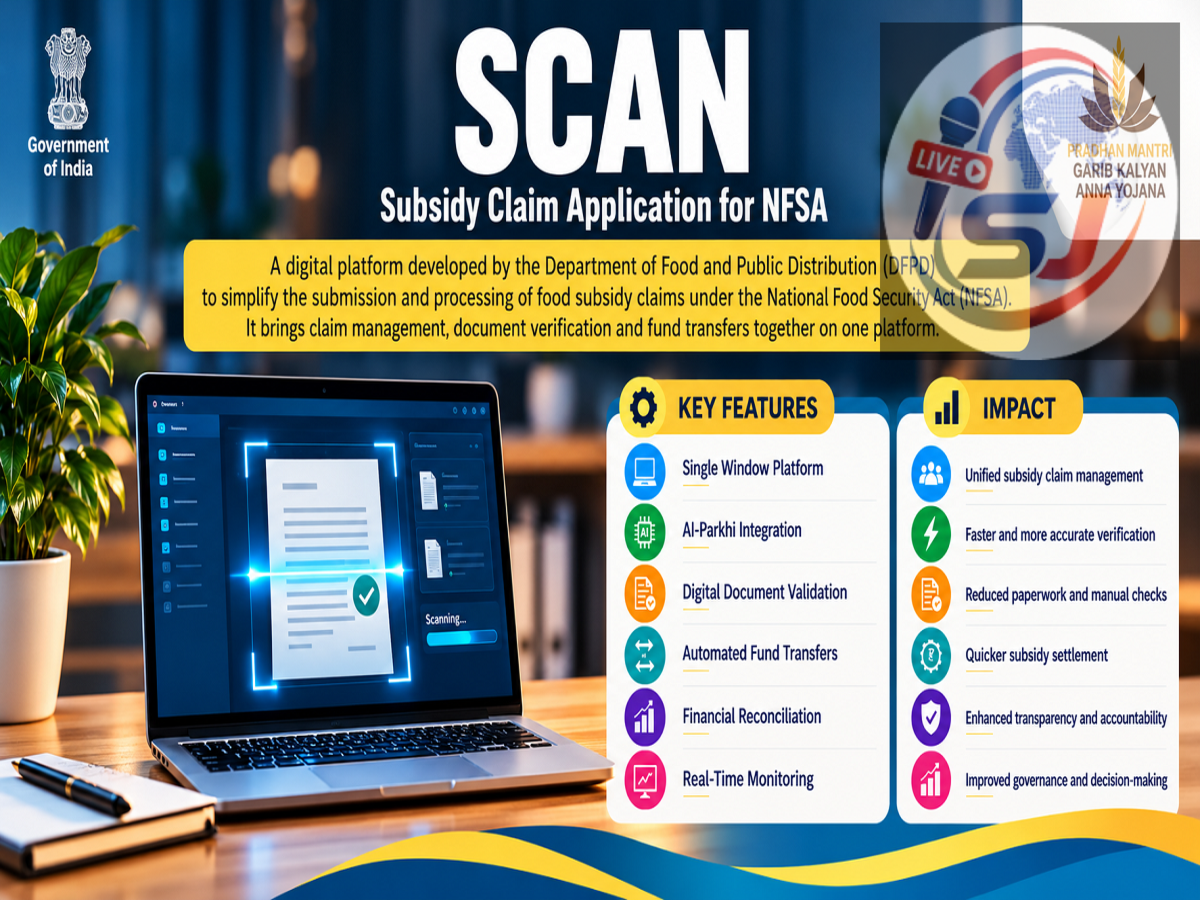
SCAN 2.0 Food Subsidy Update 2026: The Department of Food and Public Distribution (DFPD) is working to modernise India's food subsidy claim processing system through SCAN 2.0. The platform aims to improve efficiency, transparency and accuracy by introducing artificial intelligence-based verification, digital document validation, automated fund transfers and real-time monitoring.
The initiative is designed to simplify administrative procedures and reduce the time required to process food subsidy claims. By using digital technology, the department aims to strengthen financial management and improve accountability in the food subsidy system.
What Is SCAN 2.0 and Why Is It Important?
SCAN 2.0 is a technology-driven initiative intended to improve the way food subsidy claims are verified, processed and monitored.
Food subsidy administration involves documentation, financial verification, claim assessment and payment-related procedures. These activities require coordination and accurate recordkeeping to ensure that public funds are handled appropriately.
Traditional administrative processes can involve repeated document checks, manual verification and communication between different offices.
SCAN 2.0 aims to address these challenges by bringing important functions into a more streamlined digital environment.
The platform's proposed capabilities include AI-assisted verification, electronic document checks, automated financial processes and monitoring tools.
These improvements could help authorities identify discrepancies earlier and manage claims more efficiently.
AI-Based Verification to Improve Claim Processing
One of the major features highlighted under SCAN 2.0 is artificial intelligence-based verification.
AI technology can assist officials in examining claim information, identifying inconsistencies and highlighting records that may require additional scrutiny.
This approach could reduce repetitive manual work and allow officials to concentrate on cases needing closer examination.
For example, an automated verification system may help identify missing information, mismatched figures or unusual entries in submitted records.
However, the effectiveness of such systems depends on the quality of the underlying data, the verification rules and appropriate human oversight.
AI-assisted checks should support accurate decision-making rather than replace necessary administrative review.
Digital Document Validation to Reduce Paperwork
SCAN 2.0 also includes digital document validation, which is intended to simplify the verification of supporting records.
Documentation is an important part of subsidy claim processing because authorities must examine relevant information before approving payments.
A digital validation mechanism can make it easier to review records and identify incomplete or inconsistent submissions.
It may also reduce dependence on physical paperwork and repeated manual handling of documents.
For government departments, improved document management could support better recordkeeping and more consistent verification procedures.
Digital records may also make it easier to trace the history of a claim when clarification or an audit is required.
Automated Fund Transfers to Support Faster Payments
Another important capability highlighted for SCAN 2.0 is automated fund transfers.
Payment processing is a critical stage in the administration of government subsidies.
Delays in verification, approval or financial documentation can affect the overall settlement process.
By connecting relevant stages through a digital workflow, automated fund transfer systems may help reduce avoidable administrative delays.
Such automation can also improve the consistency of payment-related procedures when supported by appropriate approval controls.
However, the announcement does not specify a guaranteed payment timeline or confirm that every subsidy claim will be settled automatically.
Actual processing times will depend on claim eligibility, verification requirements and the operational rules of the platform.
Real-Time Monitoring to Strengthen Transparency
Real-time monitoring is another major component of the SCAN 2.0 initiative.
Monitoring tools can help authorised officials track the progress of claims and identify stages where processing may be delayed.
Better visibility into administrative workflows can support timely intervention and more effective coordination between departments.
It can also improve accountability by making it easier to review the status of pending cases and financial transactions.
For public financial management, timely access to reliable information is important because it helps authorities assess whether procedures are functioning as intended.
The platform aims to strengthen this oversight through digital tracking and monitoring capabilities.
How Could SCAN 2.0 Improve India's Food Subsidy System?
India's food subsidy framework plays an important role in supporting food security programmes and the distribution of subsidised foodgrains.
The system involves significant administrative and financial coordination, making efficient claim processing essential.
A more integrated digital process could help improve the management of supporting documents, verification activities and payment workflows.
It may also reduce repetitive administrative tasks and improve the availability of information for authorised government officials.
These benefits could contribute to better financial oversight and smoother administration of food subsidy claims.
However, SCAN 2.0 should not be confused with a new cash assistance scheme for ration cardholders.
The information provided describes improvements to subsidy claim administration. It does not announce additional free foodgrains, higher household benefits or a new application requirement for beneficiaries.
Does SCAN 2.0 Change Ration Card Benefits?
The SCAN 2.0 announcement focuses on improving government processes rather than changing the benefits available to individual ration cardholders.
There is no indication in the supplied announcement that eligible households must register separately for SCAN 2.0 or submit a new application to continue receiving existing food security benefits.
Likewise, no change to ration card eligibility, foodgrain entitlements or beneficiary payment amounts has been specified.
Citizens should rely on official government notifications for any future changes to ration card services or food subsidy eligibility.
What Happens Next?
The Department of Food and Public Distribution's SCAN 2.0 initiative reflects a broader effort to use digital systems to improve government administration.
Its effectiveness will depend on successful implementation, accurate verification mechanisms, secure handling of records and reliable integration with existing financial procedures.
The supplied announcement does not provide a specific nationwide rollout date, implementation schedule or measurable processing-time targets.
Further official updates will therefore be important for understanding how the platform operates and what improvements it delivers.
Final Update
SCAN 2.0 aims to make India's food subsidy claim processing system faster, simpler and more transparent.
Through AI-assisted verification, digital document validation, automated fund transfers and real-time monitoring, the Department of Food and Public Distribution intends to strengthen administrative efficiency and financial accountability.
The key objective is to improve how food subsidy claims are processed and monitored, not to introduce a new benefit for ration cardholders. As the initiative progresses, its practical impact will depend on implementation and the results achieved across the subsidy administration system.