
SBI Senior Citizen FD 2026: Invest ₹10 Lakh and Earn Up to ₹5,875 Monthly Equivalent; Check Interest Rates and Tax Rules
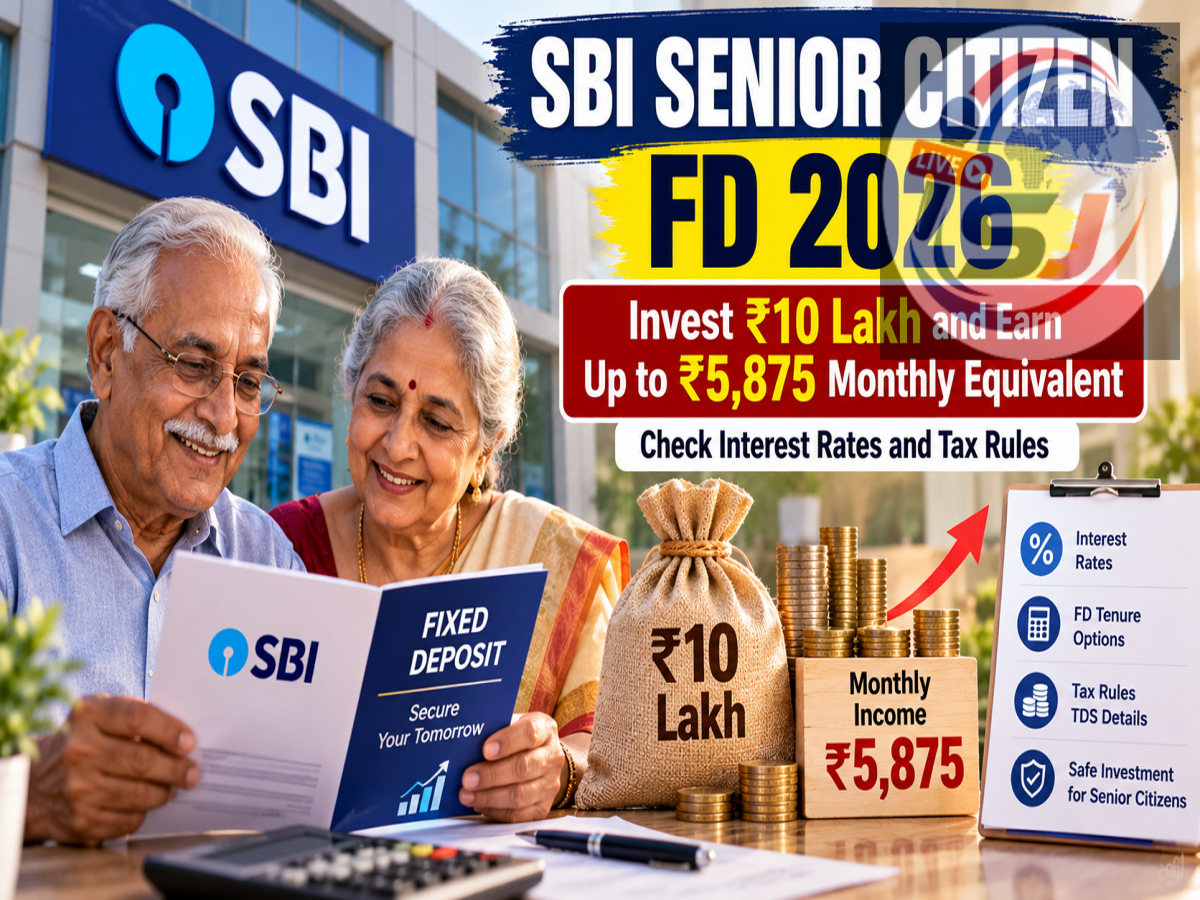
SBI Senior Citizen FD Interest Rates 2026: For retired individuals looking for a relatively stable source of income, bank fixed deposits remain a popular savings option. The State Bank of India (SBI) offers additional interest benefits to eligible senior citizens, allowing them to earn higher returns than regular depositors on selected tenures.
According to the interest rates reported as of October 19, 2026, SBI offers senior citizens annual FD interest rates ranging from 6.75% to 7.05% across the selected deposit periods discussed here.
For example, a senior citizen investing ₹10 lakh at an annual interest rate of 7.05% could earn approximately ₹70,500 in a year on a simple-interest basis.
Dividing this amount by 12 gives an average monthly equivalent of ₹5,875.
However, ₹5,875 is an illustrative monthly equivalent, not necessarily the exact amount SBI will credit every month. The actual payout depends on the deposit scheme, interest calculation method and chosen payment frequency.
Here is a detailed explanation of SBI's reported senior citizen FD rates, potential returns on ₹10 lakh, monthly income options, taxation and important precautions before investing.
SBI Senior Citizen FD Interest Rates: October 2026
SBI provides different fixed deposit interest rates depending on the investment period.
Senior citizens aged 60 years or above are generally eligible for preferential rates on qualifying domestic term deposits.
The rates mentioned in the October 21 report apply to domestic fixed deposits below ₹3 crore and were stated to be available as of October 19, 2026.
SBI Senior Citizen FD Rates
| FD Tenure |
Reported Annual Interest Rate |
|---|---|
| 1 year to less than 2 years |
6.75% |
| 2 years to less than 3 years |
6.90% |
| 3 years to less than 5 years |
6.80% |
| 5 years to 10 years |
7.05% |
The longer-term rate reportedly includes the additional interest benefit available under SBI's WeCare arrangement.
These rates are based on the supplied report and should be confirmed through SBI's official website before opening a deposit, as bank rates can change.
How Much Interest Will ₹10 Lakh Earn in SBI FD?
Suppose a senior citizen deposits ₹10,00,000 in SBI.
The annual interest equivalent will depend on the applicable interest rate.
For a straightforward comparison, the following table calculates annual interest by multiplying the principal by the quoted annual rate.
| Annual FD Rate |
Annual Interest Equivalent |
Average Monthly Equivalent |
|---|---|---|
| 6.75% |
₹67,500 |
₹5,625 |
| 6.90% |
₹69,000 |
₹5,750 |
| 6.80% |
₹68,000 |
₹5,667 |
| 7.05% |
₹70,500 |
₹5,875 |
These calculations are useful for estimating income.
They do not represent exact bank payout quotations because the interest crediting method can affect the final amount.
SBI FD Calculator: ₹10 Lakh at 7.05% Interest
Consider an eligible senior citizen investing ₹10 lakh in an SBI fixed deposit carrying an annual rate of 7.05%.
The basic annual interest calculation is:
\[ ₹10,00,000 \times \frac{7.05}{100}=₹70,500 \]
To find the average monthly equivalent:
\[ ₹70,500 \div 12=₹5,875 \]
Illustrative monthly interest equivalent
₹5,875
On ₹10 lakh at 7.05% per annum, before tax
Principal
₹10,00,000
Annual interest equivalent
₹70,500
This calculation assumes a full year of interest at the stated annual rate without adjusting for monthly payout discounting.
Actual monthly interest paid by SBI may be slightly lower.
Will SBI Credit ₹5,875 Every Month?
Not necessarily.
This is an important distinction for retired investors planning their monthly expenses.
SBI offers term deposit options with periodic interest payments, including monthly and quarterly payout arrangements where applicable.
Under a monthly income option, the bank generally calculates interest according to its applicable deposit rules and pays it at the prescribed discounted monthly rate.
As a result, the actual monthly credit can differ from simply dividing the annual interest by 12.
Investors should request the exact monthly payout figure from SBI before booking the deposit.
This is especially important if the FD income will be used to pay recurring household expenses.
Monthly Payout FD vs Cumulative FD: What's the Difference?
SBI fixed deposits may offer different interest payment structures.
The most suitable option depends on whether the depositor needs regular income or wants the money to grow until maturity.
| Feature |
Periodic Payout FD |
Cumulative FD |
|---|---|---|
| Interest payment |
Monthly or quarterly, as applicable |
At maturity |
| Suitable for |
Regular income needs |
Long-term savings |
| Compounding benefit |
Generally lower due to withdrawals |
Interest accumulates |
| Monthly cash flow |
Available under selected options |
Not available |
| Maturity amount |
Generally principal plus any remaining payable amount |
Principal plus accumulated interest |
A retired person who depends on FD interest for monthly expenses may prefer a payout option.
Someone who does not need regular withdrawals may consider a cumulative deposit.
However, both choices should be evaluated against the investor's liquidity needs and tax position.
Who Is Eligible for SBI Senior Citizen FD Rates?
SBI generally provides senior citizen FD benefits to eligible individuals aged 60 years or above.
The higher rates apply according to the bank's prevailing deposit terms.
Eligibility may depend on the type of deposit, depositor category and applicable scheme conditions.
Before opening an FD, customers should confirm whether the selected product qualifies for senior citizen benefits.
They should also verify whether any additional interest benefit applies to the chosen tenure.
Not every deposit period necessarily carries the same senior citizen premium.
What Is SBI WeCare FD?
SBI WeCare is associated with additional interest benefits for eligible senior citizen term deposits with longer maturities.
The supplied report states that the 7.05% rate for deposits of five to ten years includes an additional benefit under this arrangement.
However, the availability, extension and conditions of special deposit programmes can change.
Investors should verify the current WeCare terms directly with SBI before assuming that a particular rate will remain available.
The reported 7.05% rate should not be treated as a permanent offer.
Is SBI FD Interest Taxable?
Yes. Interest earned on bank fixed deposits is generally taxable according to the depositor's applicable income tax provisions.
Senior citizens do not automatically receive a complete income tax exemption on FD interest.
The final tax liability depends on total taxable income, available deductions and the chosen tax regime.
For example, an individual whose total income remains within the applicable tax-free limits may have little or no final tax liability.
Another investor receiving the same FD interest may have to pay tax because of additional pension income, rental income or other earnings.
Therefore, the interest amount alone does not determine the final tax payable.
Section 80TTB: Tax Deduction for Senior Citizens
Under the old income tax regime, eligible resident senior citizens can claim a deduction under Section 80TTB on qualifying interest income.
The maximum deduction is ₹50,000 per financial year.
The deduction can cover eligible interest from deposits with specified banks, post offices and cooperative banks, subject to statutory conditions.
It is important to understand that the ₹50,000 limit is not a separate allowance for each fixed deposit.
It applies to the qualifying interest income covered by the provision, subject to the overall statutory ceiling.
Example: ₹70,500 Annual FD Interest
| Particulars |
Amount |
|---|---|
| Annual FD interest |
₹70,500 |
| Maximum Section 80TTB deduction |
₹50,000 |
| Interest remaining after deduction |
₹20,500 |
This illustration assumes the depositor qualifies for the full deduction under the old tax regime and has no other qualifying interest income using up the limit.
The remaining amount is not necessarily the final tax payable. It forms part of the individual's overall income tax calculation.
Section 80TTB is generally not available under the new income tax regime.
When Does SBI Deduct TDS on FD Interest?
Tax Deducted at Source, or TDS, is another important consideration.
For eligible senior citizens, the threshold for TDS on bank deposit interest is ₹1 lakh per financial year under the applicable provisions discussed in the report.
This means that if a qualifying senior citizen earns ₹70,500 in total interest from deposits with the bank during a financial year, the interest would ordinarily remain below that threshold.
However, the bank considers the relevant aggregate interest, not merely the interest earned on one particular FD.
For example, if a customer has several deposits at SBI, the combined interest may cross the applicable limit.
The depositor's eligibility and the bank's records also matter.
No TDS deduction does not mean that FD interest is tax-free.
A person may still have to report taxable interest income in their income tax return.
What If You Have Multiple Fixed Deposits?
Consider a retired investor who has three fixed deposits with the same bank.
The bank may calculate the relevant annual interest across those deposits when determining whether TDS provisions apply.
Therefore, a single FD earning less than ₹1 lakh in annual interest does not automatically guarantee that no TDS will be deducted.
Senior citizens should review their total interest income from the bank.
Where legally eligible, they may also explore the prescribed declaration procedures to prevent unnecessary TDS.
However, such declarations should be submitted only when the statutory conditions are satisfied.
Is a ₹10 Lakh SBI FD Completely Risk-Free?
Bank fixed deposits are generally considered lower-risk investments than market-linked products because their contractual interest rates are not directly affected by daily stock market movements.
SBI is also a major public-sector bank.
However, it is important not to describe any bank deposit as entirely risk-free.
Deposit insurance in India is provided by the Deposit Insurance and Credit Guarantee Corporation (DICGC), subject to applicable rules.
The insurance limit is ₹5 lakh per depositor per bank, including eligible principal and interest.
This means a ₹10 lakh FD is not fully covered by deposit insurance simply because it is held at a large bank.
Investors should understand the difference between a bank's financial strength and the statutory deposit insurance limit.
What Happens If You Break the FD Before Maturity?
Senior citizens may sometimes need emergency funds for medical expenses, household requirements or unexpected family obligations.
Premature withdrawal of a fixed deposit may be permitted under the applicable deposit terms.
However, SBI may impose a premature withdrawal penalty or recalculate interest at a lower applicable rate.
The actual outcome depends on the tenure completed and the relevant scheme conditions.
Investors should therefore avoid placing all their liquid savings into a single long-term FD.
Maintaining a separate emergency fund can help reduce the need to break a deposit early.
Things to Check Before Opening an SBI Senior Citizen FD
Before investing ₹10 lakh, retired customers should carefully examine the selected deposit.
Important considerations include the interest rate applicable on the booking date, deposit tenure, monthly or quarterly payout options, and premature withdrawal conditions.
Investors should also calculate their expected annual interest income and consider the possible tax liability.
If the main objective is regular monthly income, the exact interest payout schedule should be confirmed with the bank.
If the objective is long-term capital accumulation, a cumulative deposit may be more appropriate.
Customers can check the latest deposit terms through the official SBI website or an authorised bank branch.
SBI Senior Citizen FD 2026: Final Update
SBI's reported senior citizen FD rates for selected tenures range from 6.75% to 7.05% annually as of October 19, 2026.
A ₹10 lakh investment at 7.05% provides an illustrative annual interest equivalent of ₹70,500.
That works out to an average of ₹5,875 per month before tax.
However, the actual monthly payout may differ depending on SBI's interest payment calculation.
For eligible resident senior citizens, Section 80TTB may provide a deduction of up to ₹50,000 under the old tax regime, while the applicable TDS threshold on bank deposit interest is ₹1 lakh per financial year.
For retirees seeking regular income, the most important step is to compare the actual monthly payout, tax implications and liquidity conditions before selecting an FD tenure.
Disclaimer: The interest rates are based on the supplied October 21, 2026 report, citing SBI rates as of October 19. Rates and deposit conditions may change. Calculations are illustrative and should not be treated as an exact bank payout quotation or personalised investment advice.