
SBI 5-Year FD: How Much Can ₹1 Lakh Grow to? Check Returns From SBI, HDFC, ICICI and PNB
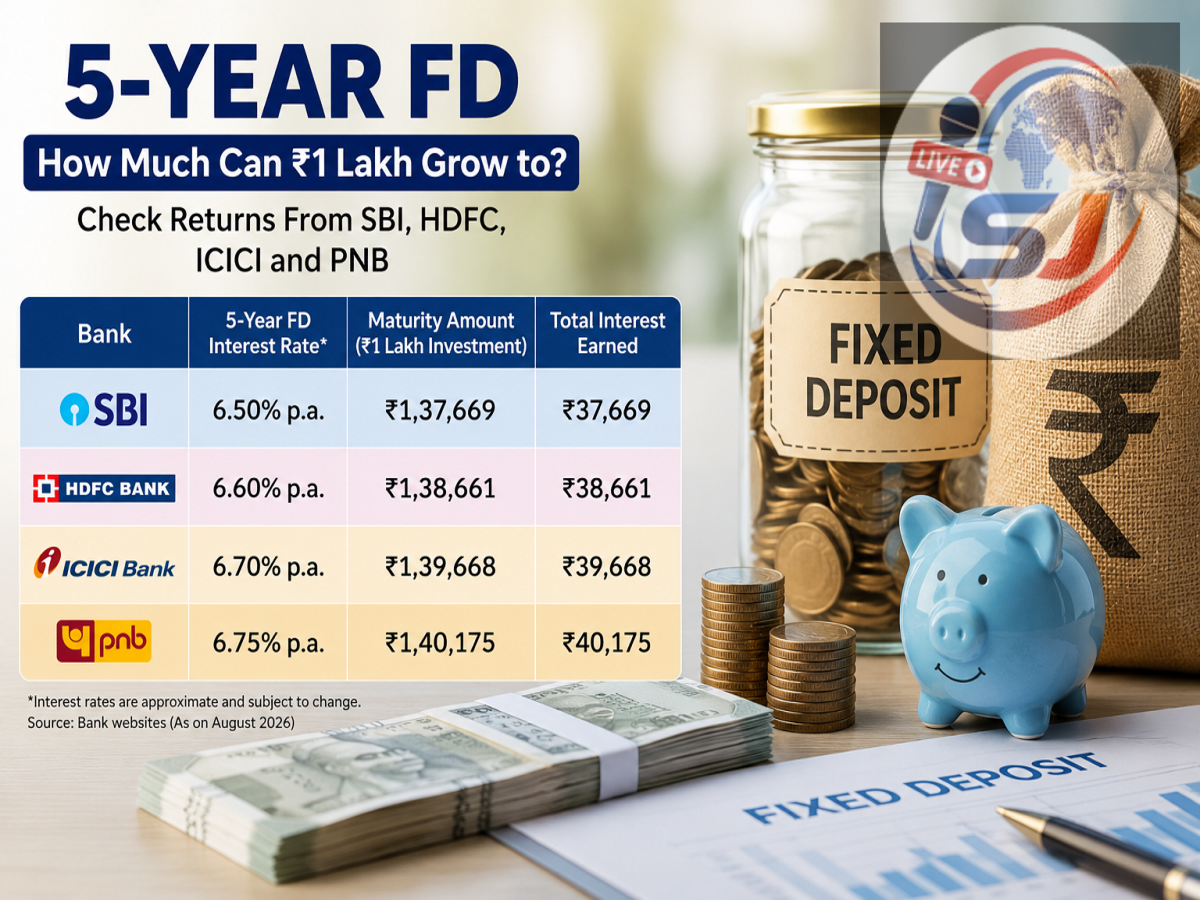
Bank FD Returns 2026: Fixed deposits remain a popular choice for people who want predictable returns without directly exposing their savings to stock-market fluctuations. If you are planning to invest ₹1 lakh for five years, major banks such as SBI, HDFC Bank, ICICI Bank and Punjab National Bank (PNB) offer multiple FD options.
However, investors should not assume that every bank will provide the same return. Even a small difference in the annual interest rate can change how much money you receive at maturity, particularly when the deposit is allowed to compound for several years.
As of August 2026, FD rates also vary according to the depositor's age, tenure, deposit amount and the bank's prevailing rate structure. Senior citizens generally receive a higher rate than regular customers. Recent data show that five-year senior-citizen FD rates at major banks can differ noticeably.
How Does a 5-Year FD Work?
A fixed deposit allows a customer to deposit a lump sum with a bank for a predetermined period. The interest rate applicable when the FD is booked generally remains fixed for that deposit until maturity, subject to the product's terms.
For example, if you put ₹1 lakh into a cumulative five-year FD, the interest earned during the tenure is added to the deposit and earns further interest. This compounding effect means the maturity value can be considerably higher than the original investment.
The exact amount depends on the interest rate and compounding method used by the bank.
SBI 5-Year FD: What Interest Rate Is Available?
SBI's current retail domestic term-deposit schedule shows an interest rate of 6.05% per annum for regular customers on deposits with a tenure of five years and up to 10 years.
For eligible senior citizens, SBI lists a higher rate of 7.05% for this tenure, subject to applicable conditions.
This means senior citizens can potentially earn significantly more than regular depositors when investing the same amount for the same period.
Investors should note that banks can revise rates for new deposits. The rate applicable to an existing FD is normally determined when it is booked, according to the deposit's terms.
How Much Can ₹1 Lakh Become in Five Years?
Suppose an investor places ₹1 lakh in a cumulative FD and leaves both the principal and interest untouched for five years.
At an annual interest rate around 6% to 7%, ₹1 lakh can grow to roughly ₹1.35 lakh to ₹1.41 lakh, depending on the exact interest rate and compounding frequency.
For perspective, HDFC Bank's FD calculator illustrates that an investment of ₹1 lakh for five years at 7% interest compounded quarterly could grow to approximately ₹1.41 lakh.
Therefore, investors should look beyond the advertised interest rate and check the actual maturity amount before choosing a deposit.
HDFC Bank 5-Year FD Rates
HDFC Bank is another option for customers looking for long-term deposits.
Its August 2026 FD schedule shows that interest rates vary according to the exact tenure and customer category. Senior citizens receive an additional preferential rate on eligible deposits.
The difference may appear small when looking only at annual percentages, but over a five-year period, compounding can create a noticeable difference in the final amount.
Customers should therefore use the bank's official FD calculator with the exact tenure they intend to select rather than estimating returns using a rounded interest rate.
ICICI Bank Also Offers Higher Rates to Senior Citizens
ICICI Bank's FD rates effective from August 14, 2026 show that deposits for five years and one day to 10 years offer 6.50% for general customers and 7.00% for senior citizens.
The bank states that senior citizens can receive an additional 0.50 percentage point on eligible fixed deposits.
This higher rate can make a meaningful difference for retirees who depend on fixed-income investments and prefer relatively predictable returns.
What About PNB Fixed Deposits?
Punjab National Bank also offers fixed deposits across different maturity periods, with preferential rates available for eligible senior citizens.
Recent comparisons of five-year senior-citizen FDs across major banks show that rates vary from one lender to another. This makes comparison especially important before locking money away for several years.
Rather than choosing an FD solely because you already have a savings account with a particular bank, compare the prevailing five-year rate, maturity value and premature-withdrawal rules.
Why a Small Difference in FD Rates Matters
Imagine Bank A offers 6.0% while Bank B offers 6.5%. A difference of just half a percentage point may not appear substantial.
But the impact increases with the amount invested and the length of the deposit. Compounding means interest itself starts earning interest, so the gap between two maturity values becomes larger over time.
For someone investing ₹1 lakh, the difference may amount to a few thousand rupees. For an investor placing ₹5 lakh, ₹10 lakh or more into an FD, the difference becomes considerably more important.
Senior Citizens Can Get Better Returns
One of the biggest advantages available to senior-citizen FD investors is the additional interest offered by many banks.
Major lenders such as SBI, HDFC Bank and ICICI Bank provide preferential FD rates to eligible senior citizens. Recent market comparisons show that some banks are offering senior citizens substantially higher rates, with certain five-year deposits reaching around 8% depending on the institution.
However, a higher interest rate should not be the only consideration. Investors should also evaluate the bank, deposit conditions, liquidity requirements and applicable deposit-insurance limits.
Check Premature Withdrawal Rules Before Investing
A five-year commitment can be a long period if you unexpectedly need money.
Banks generally allow premature closure of many callable fixed deposits, but a penalty or reduced interest rate may apply. Consequently, the actual return can be lower if the FD is withdrawn before maturity.
Investors should therefore avoid locking all of their emergency savings into a long-term FD merely to earn a slightly higher interest rate.
Maintaining some liquid savings alongside long-term deposits can provide greater financial flexibility.
Don't Forget Tax on FD Interest
FD returns are not automatically tax-free.
Interest earned from bank fixed deposits is generally taxable according to applicable income-tax rules. TDS provisions may also apply when interest crosses the prescribed threshold, subject to prevailing regulations and the depositor's circumstances.
Investors should therefore distinguish between the gross maturity amount displayed by an FD calculator and the effective post-tax return they ultimately receive.
Tax-saving five-year FDs have separate rules, including a lock-in period, and should not be confused with an ordinary five-year bank FD.
Should You Invest ₹1 Lakh in a 5-Year FD?
A five-year FD can suit investors whose primary priorities are capital stability and predictable returns rather than aggressive wealth creation.
Before investing ₹1 lakh, compare the latest interest rates offered by SBI, HDFC Bank, ICICI Bank, PNB and other banks. Also check whether you qualify for a senior-citizen rate, how frequently interest is compounded and what happens if you withdraw the deposit early.
SBI's current retail schedule, for example, lists 6.05% for regular customers and 7.05% for eligible senior citizens for the five-year-to-10-year bucket. Other banks may offer different rates.
Ultimately, the best FD is not necessarily the one carrying the biggest advertised percentage. The more useful comparison is the final maturity value, liquidity conditions, taxation and whether the tenure fits your financial goal.