
Savings Account Alert: Balance Checks, SMS Alerts and Other Bank Charges You Should Know
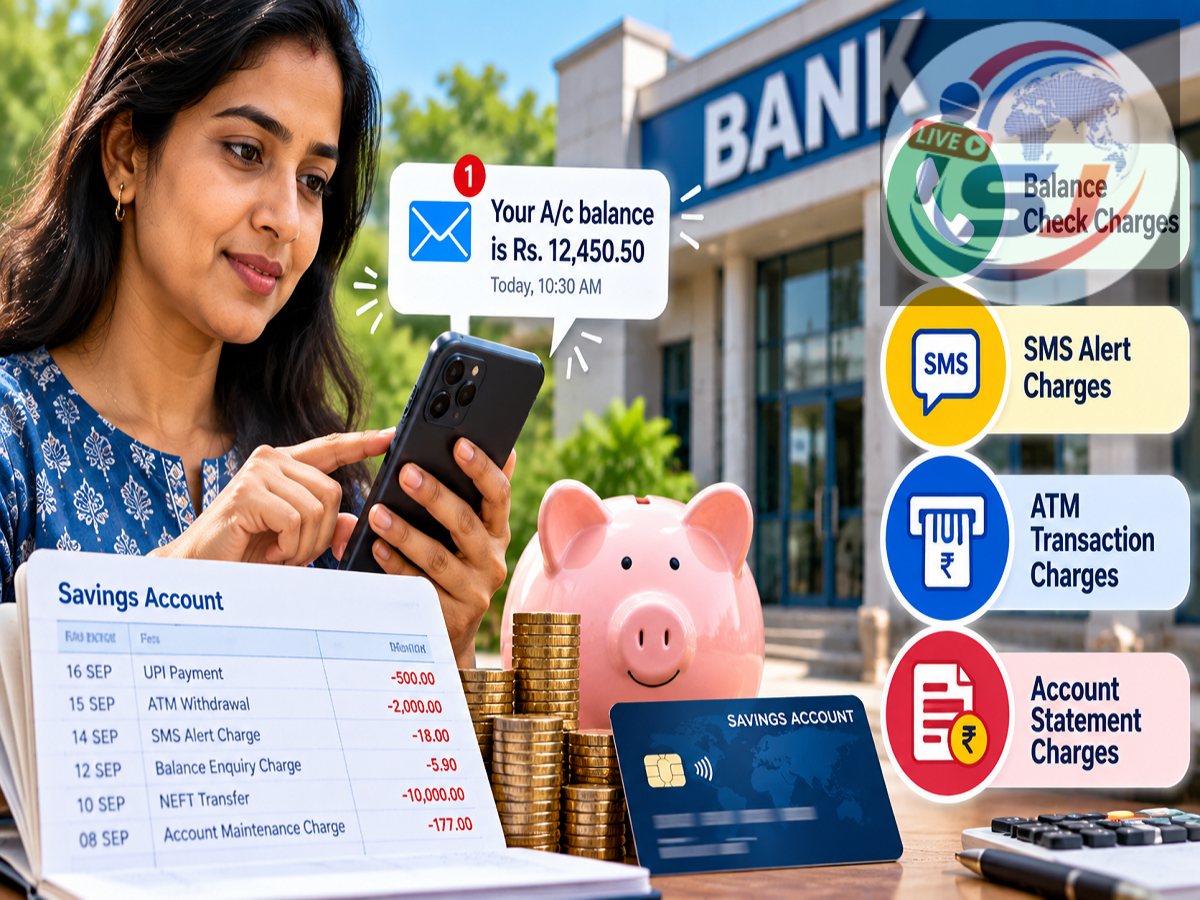
Have you ever checked your bank statement and noticed a small deduction that you do not immediately recognise? Charges of ₹10, ₹20, ₹50 or even more can sometimes appear even when you have not made a major purchase or transferred money.
The reason may be a banking service charge rather than an unauthorised transaction. Savings-account customers can be charged for certain services depending on their bank, account type and the number of transactions performed.
ATM usage, SMS alerts and account-maintenance requirements are among the areas where customers should understand their bank's rules.
Importantly, these charges are not necessarily the same across all banks. Customers should check their bank's latest schedule of charges rather than assuming that a particular fee applies universally.
Can a Bank Charge You Just for Checking Your ATM Balance?
Potentially, yes—particularly after the applicable free transaction limit has been exhausted.
ATM transactions are not limited to cash withdrawals. They can broadly include financial and non-financial transactions.
A cash withdrawal is a financial transaction, while activities such as checking an account balance or requesting a mini statement can be treated as non-financial ATM transactions.
Depending on the applicable rules and the bank's policy, these transactions can count toward an ATM usage limit.
This means repeatedly using an ATM simply to check your account balance could eventually result in a charge if you exceed the applicable free-use allowance.
Don't Assume Every Customer Gets the Same ATM Limit
The supplied report refers to free-transaction limits at own-bank and other-bank ATMs. However, customers should not assume that a single number applies to every savings account across India.
The number of free transactions can depend on factors such as the bank, account category, ATM location and regulatory framework applicable at the time.
Charges after the free limit may also differ between financial and non-financial transactions.
Taxes can additionally apply to chargeable banking services.
For this reason, customers should check their own bank's current ATM fee schedule before deciding how many transactions are available free of charge.
Balance Enquiry Is Different From a Cash Withdrawal
One common misunderstanding is that the free ATM limit applies only when cash is withdrawn.
That is not always the case.
Non-financial ATM services can also matter when banks calculate usage under the applicable transaction rules.
For example, visiting an ATM multiple times to check the balance or obtain a mini statement could consume free transactions under the relevant bank's policy.
Customers who frequently check their balance can instead consider digital alternatives.
SMS Alert Charges Can Also Appear in Your Statement
Another small deduction customers may notice is an SMS-related fee.
Banks send transactional alerts to help customers keep track of account activity. Depending on the bank and account type, certain SMS-alert services may carry charges.
The supplied report cites charges in the range of roughly ₹15 to ₹25 per quarter at some banks, but this should not be treated as a standard fee charged by every bank.
Some banks may charge differently, while some accounts may have different arrangements or exemptions.
Customers should therefore check the bank's official service-charge schedule to understand exactly what is being deducted.
Transaction Alerts Are Important for Security
Even where certain SMS-related services carry a fee, customers should not disable important transaction notifications simply to save a small amount.
Alerts can play a major role in detecting unauthorised activity.
For example, if an unknown debit appears in your account, receiving a timely notification can help you report the transaction quickly.
Banks also have regulatory obligations regarding various transaction and security communications. Therefore, promotional messages, optional alerts and mandatory security-related notifications should not automatically be treated as the same category.
Can Bank Charges Push a Savings Account Into Negative Balance?
This question often worries customers who maintain accounts with low or zero balances.
There is an important RBI-related principle concerning penalties for failure to maintain a minimum balance in a savings account.
Such penal charges should not result in the savings-account balance becoming negative solely because of the minimum-balance penalty.
For example, if an account has a very low balance, a bank should not simply keep imposing minimum-balance penalties in a manner that turns the balance negative because of those penalties.
However, customers should not interpret this as meaning that no type of bank debit can ever produce an overdraft or negative amount under any circumstances.
Different products, authorised transactions, linked facilities and contractual arrangements can operate differently.
The safer rule is to review the specific charge rather than assuming every negative balance is prohibited.
Minimum Balance Rules Depend on Your Account
Not every savings account has the same minimum-balance requirement.
Some accounts are designed as zero-balance accounts, while other savings-account products may require customers to maintain a specified average balance.
The requirement can also vary according to factors such as branch location or account category.
If your account requires a minimum balance, check how the bank calculates it. It may be based on a monthly or another prescribed average rather than simply the balance on one particular day.
How to Avoid Unnecessary ATM Charges
One of the easiest ways to reduce unnecessary ATM usage is to stop visiting an ATM only to check the account balance.
Most banks provide alternative options.
Customers can use their bank's official mobile application, internet banking, authorised missed-call banking service or other supported digital channels.
UPI applications can also offer balance-checking facilities for linked accounts, subject to authentication requirements.
Using these options can reduce unnecessary ATM visits and help preserve available free ATM transactions.
Check Your Bank Statement Regularly
Small deductions are easy to ignore, but regularly reviewing a bank statement can help customers understand where their money is going.
If you see an unfamiliar deduction, check its transaction description.
Common descriptions may relate to ATM charges, SMS services, debit-card fees, account-maintenance charges or other banking services.
If the description is unclear, contact the bank through its official customer-care channel or branch and ask for an explanation.
Do not automatically assume that an unfamiliar debit is legitimate. If you suspect an unauthorised transaction, report it promptly through the bank's official fraud-reporting process.
What Should You Do With an Unused Savings Account?
If you have an old bank account that you no longer need, leaving it unattended for years may not always be the best option.
First check whether the account has standing instructions, recurring payments, linked investments, deposits, loan repayments or other services connected to it.
If there is no reason to keep it, you can ask the bank about the account-closure process.
Closing an unnecessary account can simplify your finances and reduce the need to monitor additional statements, cards and account-related services.
Three Things Every Savings Account Holder Should Check
To avoid unpleasant surprises, customers should understand three aspects of their savings account: the ATM transaction allowance and charges, the bank's SMS or alert fee structure, and the minimum-balance or account-maintenance conditions applicable to their particular account.
These rules are often available in the bank's official schedule of charges.
Instead of assuming that every everyday banking service is free, spending a few minutes reviewing these terms can prevent repeated small deductions from becoming a bigger expense over time.
Most importantly, banking charges can differ significantly between banks and account types. A fee quoted for one bank should not automatically be assumed to apply to another.
Note: ATM limits, SMS charges, minimum-balance requirements and other service fees are subject to RBI regulations and individual bank policies, which can change. Customers should check their bank's latest official schedule of charges for the exact fees applicable to their account.