
Retirement Planning: How to Allocate ₹25 Lakh, ₹50 Lakh or ₹75 Lakh Across FDs, Bonds and Liquid Funds
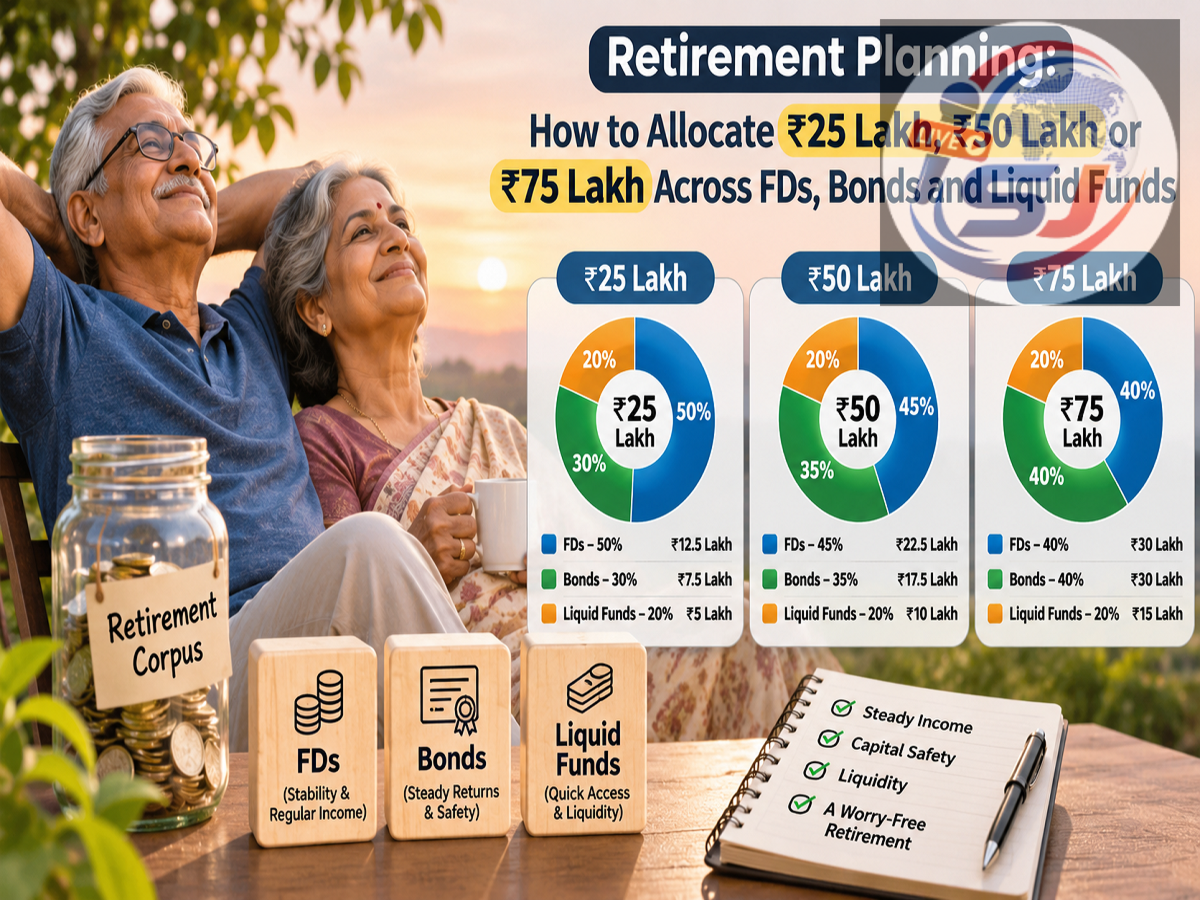
Retirement Investment Planning 2026: Building a substantial retirement fund is an important financial achievement, but managing those savings effectively after leaving employment is equally essential. With regular salary income coming to an end, retirees need a financial structure that supports everyday expenses, emergency requirements and long-term financial security.
Whether an individual retires with ₹25 lakh, ₹50 lakh or ₹75 lakh, distributing savings across fixed deposits, bonds and liquid investment instruments can help balance income generation, capital preservation and access to funds.
However, the appropriate investment allocation depends on several factors, including monthly expenses, existing pension income, healthcare requirements, financial responsibilities and individual risk tolerance.
Why Asset Allocation Matters After Retirement
During their working years, individuals generally focus on accumulating wealth. After retirement, financial priorities often shift towards preserving accumulated savings and generating a sustainable income.
According to Saurabh Jain, Co-founder and CEO of Stable Money, retirement investments should focus on regular cash flow, sufficient liquidity and capital protection rather than wealth creation alone.
He explained that smaller retirement portfolios generally require greater emphasis on stability and liquidity, while larger portfolios may offer additional opportunities for diversification through bonds and different investment categories.
Investors should also evaluate credit ratings, maturity periods, taxation and emergency requirements instead of selecting financial products solely on the basis of higher returns.
Retirement With ₹25 Lakh: Focus on Financial Stability
Individuals retiring with a corpus of ₹25 lakh may require a relatively conservative allocation to ensure sufficient funds remain available for regular expenses and unexpected financial requirements.
An illustrative allocation suggested in the original report is as follows:
| Investment Category |
Allocation |
Investment Amount |
|---|---|---|
| Fixed Deposits (FDs) |
50% |
₹12,50,000 |
| Liquid Investments |
30% |
₹7,50,000 |
| Bonds |
20% |
₹5,00,000 |
| Total |
100% |
₹25,00,000 |
Fixed deposits can provide predictable interest earnings, while liquid investments can support immediate financial requirements.
A smaller allocation towards bonds may provide diversification and additional income opportunities. However, investors need to examine the issuer's financial strength, repayment capacity and credit quality before purchasing bonds.
Retirement With ₹50 Lakh: Balance Income and Accessibility
A retirement corpus of ₹50 lakh provides greater flexibility to distribute savings across different fixed-income instruments.
At this level, an individual may consider a more diversified structure while maintaining sufficient funds for emergencies and routine expenses.
| Investment Category |
Allocation |
Investment Amount |
|---|---|---|
| Fixed Deposits (FDs) |
40% |
₹20,00,000 |
| Bonds |
35% |
₹17,50,000 |
| Liquid Investments |
25% |
₹12,50,000 |
| Total |
100% |
₹50,00,000 |
Under this illustrative allocation, fixed deposits remain a major component of the portfolio, while bonds receive a comparatively larger share.
Distributing bond investments across different issuers and maturity periods can help reduce concentration risk. Maintaining adequate liquid savings can also prevent retirees from having to sell long-term investments during unfavourable market conditions.
Retirement With ₹75 Lakh: Greater Scope for Diversification
Individuals retiring with ₹75 lakh may have more opportunities to create separate investment portfolios for short-term expenses, regular income and future financial requirements.
The following allocation illustrates how a larger retirement corpus could be distributed:
| Investment Category |
Allocation |
Investment Amount |
|---|---|---|
| Bonds |
40% |
₹30,00,000 |
| Fixed Deposits (FDs) |
35% |
₹26,25,000 |
| Liquid Investments |
25% |
₹18,75,000 |
| Total |
100% |
₹75,00,000 |
A larger allocation towards bonds may provide additional fixed-income opportunities, while fixed deposits can contribute to predictable cash flow.
However, having a larger retirement fund does not automatically justify taking higher financial risks. Bond selection should involve careful assessment of credit quality, yield to maturity, repayment terms and liquidity.
Retirement Corpus Allocation: Complete Comparison
| Investment Category |
₹25 Lakh Corpus |
₹50 Lakh Corpus |
₹75 Lakh Corpus |
|---|---|---|---|
| Fixed Deposits |
₹12.50 lakh |
₹20 lakh |
₹26.25 lakh |
| Bonds |
₹5 lakh |
₹17.50 lakh |
₹30 lakh |
| Liquid Investments |
₹7.50 lakh |
₹12.50 lakh |
₹18.75 lakh |
| Total Investment |
₹25 lakh |
₹50 lakh |
₹75 lakh |
These allocations are illustrative examples rather than universal investment recommendations.
What Is the Three-Bucket Retirement Investment Strategy?
Instead of managing retirement savings as a single investment portfolio, individuals can divide their money into separate categories based on when they expect to need it.
This approach is commonly known as the bucket strategy.
1. Liquidity Bucket
This category contains funds required for immediate expenses, medical emergencies, household bills and other short-term financial commitments.
Savings accounts, short-term deposits and suitable liquid investment instruments may serve this purpose, depending on their accessibility and risk characteristics.
2. Regular Income Bucket
The second category focuses on generating income to support recurring expenses after retirement.
Fixed deposits and suitable interest-paying bonds can form part of this bucket. Investors can also spread maturity dates across different periods to maintain a more consistent cash flow.
3. Long-Term Investment Bucket
The third category contains funds that are unlikely to be required immediately.
These investments are intended to support future financial requirements and help address the impact of inflation over an extended retirement period.
The appropriate investment instruments depend on the individual's financial circumstances and ability to tolerate risk.
Why Retirees Need a Separate Emergency Fund
Unexpected expenses can disrupt even a carefully prepared retirement income plan.
Medical treatment, home repairs, family responsibilities and rising healthcare costs may require immediate access to substantial amounts of money.
Maintaining a dedicated emergency reserve can reduce the need to prematurely close fixed deposits or sell bonds at unfavourable prices.
The size of this reserve should depend on household expenses, health insurance coverage, medical requirements and other financial commitments.
Important Factors to Check Before Investing Retirement Savings
Retirees should evaluate several important aspects before allocating their accumulated savings:
-
Credit quality: Assess the financial strength and repayment capacity of bond issuers.
-
Liquidity: Understand how quickly investments can be converted into cash.
-
Taxation: Calculate actual returns after applicable taxes.
-
Inflation: Consider the possibility of rising living and healthcare expenses.
-
Maturity periods: Distribute investments across different timelines to manage cash flow.
-
Deposit insurance: Eligible bank deposits are covered by DICGC insurance up to ₹5 lakh per depositor per bank, including principal and interest.
-
Investment risks: Bonds and liquid mutual funds carry risks, and their returns or capital values are not universally guaranteed.
-
Concentration risk: Avoid excessive dependence on a single financial institution, issuer or investment instrument.
Can Retirement Savings Last for Several Decades?
Retirement savings may need to support an individual for 20 to 30 years or longer. During this period, inflation, healthcare expenses, changing interest rates and unexpected financial commitments can affect the sustainability of accumulated wealth.
Therefore, the objective of retirement planning extends beyond earning the highest possible interest rate. A well-structured financial plan should account for regular income, emergency accessibility, capital preservation and long-term purchasing power.
Periodic portfolio reviews can also help individuals assess whether their investments remain aligned with changing financial requirements.
Ultimately, the suitability of any retirement investment strategy depends not only on the size of the accumulated corpus but also on the individual's expenses, pension benefits, liabilities and long-term financial goals.
Disclaimer: This article is intended for educational and informational purposes. The investment allocations are illustrative examples reproduced from the expert framework described in the original report and are not personalised recommendations. I'm not a financial advisor. Bonds and mutual funds are subject to investment risks. Readers should consult a qualified financial advisor before making investment decisions.