
Repo Rate Hike: How Much Could EMI Rise on ₹20 Lakh, ₹30 Lakh and ₹50 Lakh Home Loans?
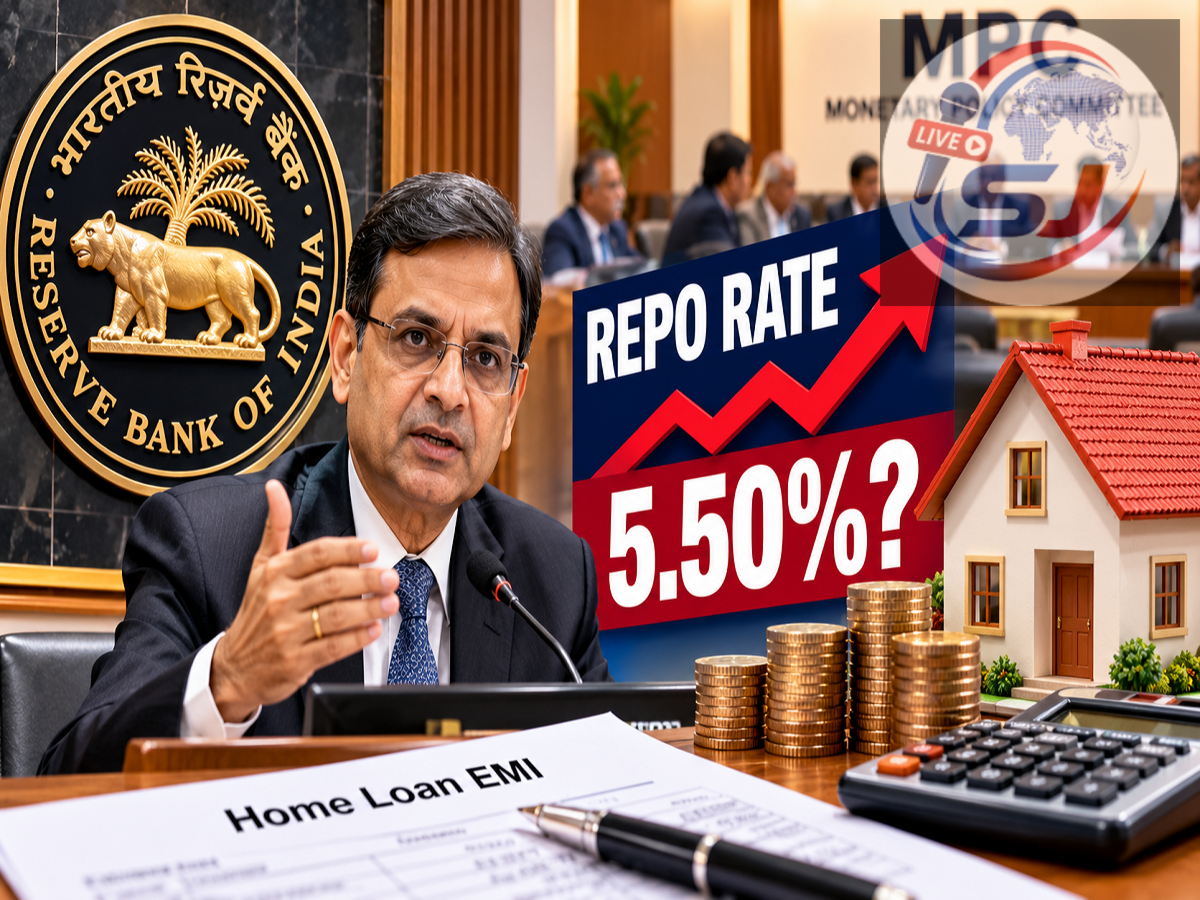
RBI Repo Rate Hike Impact: Loan borrowers may have to prepare for higher borrowing costs after the Reserve Bank of India (RBI) increased the repo rate by 25 basis points, taking it from 5.25% to 5.50%.
The move, announced on October 7, 2026, puts home loan, car loan and personal loan borrowers in focus because an increase in the policy rate can eventually lead banks and other lenders to revise interest rates on benchmark-linked loans.
For existing floating-rate home loan borrowers, the key question is simple: How much could the EMI increase on loans of ₹20 lakh, ₹30 lakh or ₹50 lakh?
The exact impact will vary from borrower to borrower, but an illustration shows how even a 0.25 percentage point increase can affect monthly payments over a long tenure.
Repo Rate Increased by 25 Basis Points
The RBI has raised the repo rate by 25 basis points to 5.50%.
A 25-basis-point increase is equivalent to 0.25 percentage point.
The repo rate is the policy rate at which the RBI provides short-term funds to banks against eligible securities. Changes in this rate can influence interest rates across the banking system.
If lenders pass on the latest increase to borrowers, floating-rate loans linked to relevant external benchmarks could become more expensive.
However, borrowers should remember that a 25-basis-point repo-rate hike does not automatically mean every loan rate will increase immediately by exactly 0.25 percentage point.
The actual change depends on the loan's benchmark, spread, reset frequency and the lender's applicable terms.
How Much Could Home Loan EMI Increase?
Consider an illustrative home loan with 20 years remaining and an existing interest rate of 8.50% per annum.
If the lender passes on the entire 25-basis-point increase and the applicable rate rises to 8.75%, the approximate EMI impact would look like this:
| Loan Amount | EMI at 8.50% | EMI at 8.75% | Approx. Monthly Increase |
|---|---|---|---|
| ₹20 lakh | ₹17,356 | ₹17,674 | ₹318 |
| ₹30 lakh | ₹26,035 | ₹26,511 | ₹476 |
| ₹50 lakh | ₹43,391 | ₹44,186 | ₹795 |
These figures are illustrative calculations, not the EMI that every borrower will necessarily pay.
Actual EMIs can differ depending on the remaining principal, tenure, interest rate, lender and reset date.
₹20 Lakh Loan: What Could Change?
For a ₹20 lakh home loan with a 20-year tenure, an interest rate of 8.50% gives an EMI of roughly ₹17,356.
If the rate rises to 8.75%, the EMI would increase to approximately ₹17,674.
That represents an increase of about ₹318 per month.
Although ₹318 may not appear very large on a monthly basis, the cumulative impact can become significant when the higher rate remains in place for a long period.
₹30 Lakh Home Loan EMI
For a ₹30 lakh loan under the same assumptions, the EMI at 8.50% works out to approximately ₹26,035 per month.
At an interest rate of 8.75%, the EMI would be around ₹26,511.
The difference is approximately ₹476 every month.
The impact becomes larger as the outstanding loan amount increases.
₹50 Lakh Loan Could See a Bigger Impact
A borrower with a ₹50 lakh home loan would naturally see a bigger rupee impact from the same interest-rate increase.
At 8.50% for 20 years, the EMI is approximately ₹43,391.
At 8.75%, it increases to around ₹44,186.
That works out to an additional monthly burden of approximately ₹795.
Again, these calculations assume that the entire 25-basis-point increase is passed on to the borrower and that the remaining tenure is 20 years.
Your EMI May Not Increase Immediately
An RBI repo-rate increase and a home loan EMI increase do not necessarily happen on the same day.
Floating-rate loans generally have a defined reset mechanism.
A lender may revise the applicable interest rate when the loan reaches its next reset date. Therefore, some borrowers could see the impact sooner, while others may see it later.
Borrowers should check their loan agreement or online loan account to determine the benchmark and reset frequency applicable to their loan.
EMI May Rise—or Loan Tenure Could Become Longer
There is another important point home loan borrowers should understand.
When the applicable interest rate rises, the lender may not always simply increase the EMI.
Depending on the loan terms, lender policy and borrower choices, the impact may instead be reflected through a longer repayment tenure.
In some situations, lenders may provide borrowers with options to increase the EMI, make a partial prepayment or adjust the tenure.
A longer tenure can keep the immediate monthly payment more manageable, but it may increase the total interest paid over the life of the loan.
Home, Car and Personal Loans Could Be Affected
The impact of the RBI's decision is not limited to home loans.
New car loans, personal loans and other borrowing products could also become more expensive if lenders revise their interest-rate structures.
Existing fixed-rate borrowers may not experience the same immediate impact because their interest rate is fixed according to the terms of their loan agreement.
Floating-rate borrowers are generally more sensitive to changes in policy rates and external benchmarks.
What Should Existing Borrowers Check?
Home loan customers should check their current interest rate, outstanding principal, remaining tenure and the benchmark to which their loan is linked.
They should also verify the next reset date.
If the lender increases the applicable rate, borrowers can compare the impact of increasing the EMI versus allowing the loan tenure to extend.
Those with surplus funds may also consider whether partial prepayment makes financial sense, subject to their emergency savings and other financial priorities.
Don't Assume Every EMI Will Rise by the Same Amount
The most important point for borrowers is that there is no single EMI increase applicable to everyone.
Two people with ₹30 lakh outstanding on their home loans could experience different changes because their current interest rates, remaining tenures, benchmarks and reset dates may be different.
Therefore, the ₹20 lakh, ₹30 lakh and ₹50 lakh calculations above should be viewed only as examples of how a 0.25 percentage point increase from 8.50% to 8.75% could affect a 20-year loan.
Following the RBI's decision to raise the repo rate to 5.50%, borrowers should now watch for communication from their banks or housing finance companies regarding changes to applicable lending rates.
If the increase is transmitted to floating-rate loans, borrowers could face a higher EMI, longer repayment tenure or both—making it important to review the loan account before making any repayment decision.