RBI Repo Rate December 2026: Will Loan EMIs Rise as Retail Inflation Crosses 6%? Check Latest Outlook
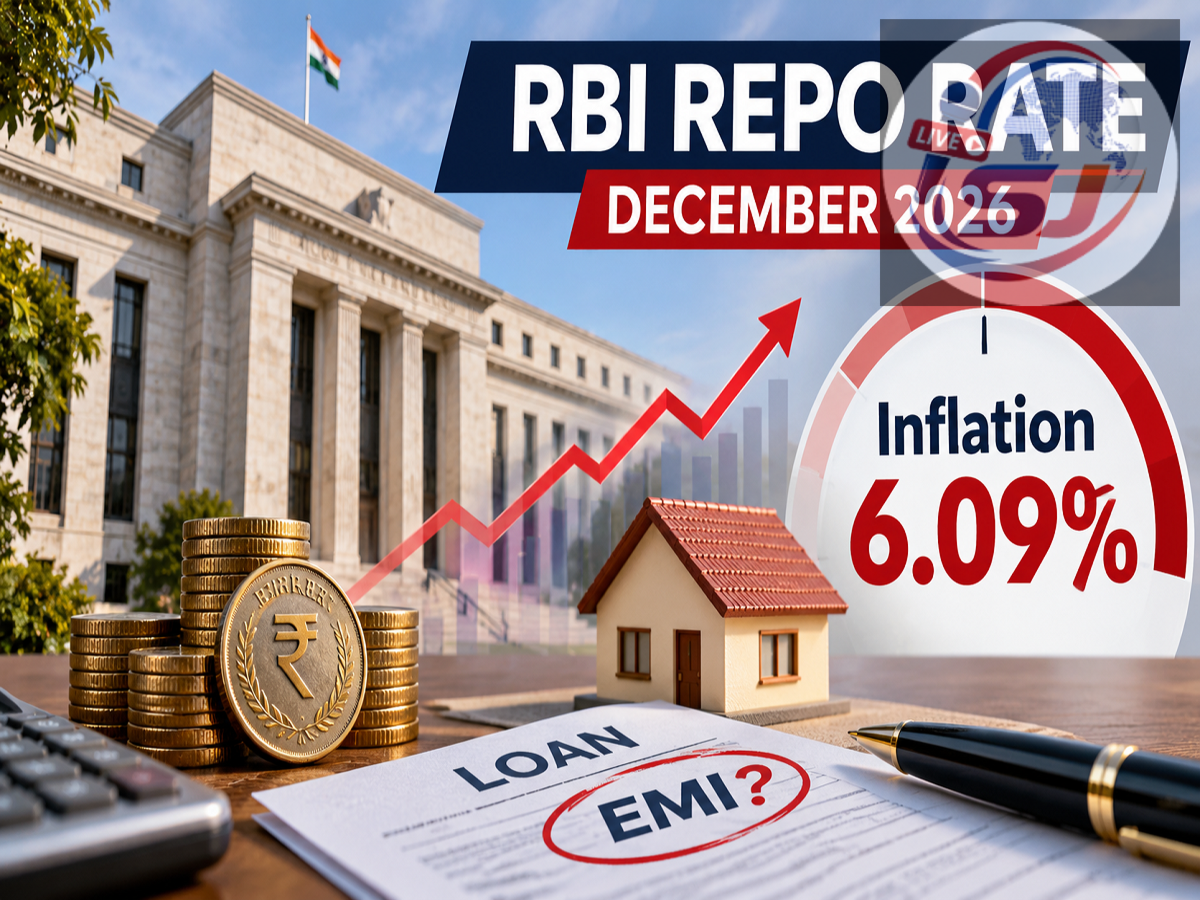
RBI Repo Rate Update 2026: Borrowers across India could face higher loan repayments if the Reserve Bank of India (RBI) decides to increase its benchmark repo rate during the December 2026 Monetary Policy Committee (MPC) meeting. According to the latest reported inflation figures, India's retail inflation reached 6.09% in October, exceeding the central bank's upper tolerance threshold of 6%. Rising food prices and persistent inflationary pressures have prompted economists to consider the possibility of another 25-basis-point interest rate increase.
However, no decision regarding the December repo rate has been announced, and any increase will depend on the MPC's assessment of inflation, economic growth and broader financial conditions.
Retail Inflation Reaches 6.09% in October 2026
India's reported Consumer Price Index (CPI) inflation increased to 6.09% in October 2026, raising fresh concerns about the cost of living.
The figure is particularly significant because the RBI's inflation-targeting framework uses a 4% target with a tolerance band of 2% to 6%.
According to the original report, October marked the ninth consecutive month of increasing headline inflation.
Higher prices of essential goods, particularly food products, have placed additional pressure on household budgets.
For families already managing home loan EMIs, education expenses, transportation costs and everyday purchases, persistently high inflation can reduce disposable income.
The latest figures have also strengthened expectations among some economists that the RBI may maintain a restrictive monetary policy stance.
Food Inflation Climbs to 8.94%
Food prices have emerged as a major contributor to the reported increase in overall inflation.
According to the figures cited in the report, Consumer Food Price Index (CFPI) inflation rose from 7.74% in September to 8.94% in October 2026.
This represents an increase of 1.20 percentage points in just one month.
The report also states that 19 of the 43 CPI subgroups recorded inflation of at least 4%, suggesting that price pressures were not limited to food alone.
Here is a summary of the key reported inflation indicators:
| Inflation Indicator |
Reported Figure |
|---|---|
| October 2026 retail inflation |
6.09% |
| October 2026 food inflation |
8.94% |
| September 2026 food inflation |
7.74% |
| RBI inflation target |
4% |
| RBI upper tolerance threshold |
6% |
| Reported Q3 FY27 inflation projection |
6.0% |
| Reported Q4 FY27 inflation projection |
5.4% |
Note: These figures are reproduced from the supplied November 13, 2026 report and have not been independently checked against official statistical releases.
Will RBI Increase the Repo Rate in December 2026?
Market attention is now focused on the RBI's December monetary policy review.
The original report states that the central bank raised the repo rate to 5.50% in October 2026 and shifted its policy stance from neutral to calibrated tightening.
With inflation reportedly moving above the upper tolerance threshold, some economists believe another increase of 25 basis points is possible.
A 25-basis-point increase is equivalent to 0.25 percentage points.
If the RBI raises the repo rate from 5.50% by 25 basis points, the benchmark rate would reach 5.75%.
However, this remains a possible scenario rather than a confirmed policy decision.
The Monetary Policy Committee will need to evaluate whether inflationary pressures are likely to persist and how higher borrowing costs could affect economic activity.
What Are Economists Predicting About the December RBI Meeting?
Several economists cited in the original report expect the central bank to maintain a cautious approach toward inflation.
Deepti Deshpande, Principal Economist at Crisil, reportedly believes that the RBI may continue with a restrictive policy stance and that a 25-basis-point increase in December remains a possibility.
The assessment reflects concerns that inflation may remain elevated despite changes in international commodity prices.
Meanwhile, Garima Kapoor, Deputy Head of Research at Elara Capital, has reportedly indicated that lower crude oil prices may not immediately reduce domestic inflation.
She expects inflation to average approximately 6.1% during the third quarter of FY2026-27, according to the source report.
These projections are economic assessments, not official RBI announcements.
Could Interest Rates Rise Again in February 2027?
Some economists are also considering the possibility of further monetary tightening beyond December.
Madhavi Arora, Chief Economist at Emkay Global, reportedly maintains an expectation of 75 basis points of cumulative tightening during the current interest rate cycle.
According to the report, this outlook includes possible increases of 25 basis points each in December 2026 and February 2027.
The reasoning is that inflation may remain persistent even if global crude oil prices soften and foreign portfolio investment inflows provide support to the Indian rupee.
Nevertheless, the timing and scale of future interest rate decisions remain uncertain.
The RBI could choose to raise rates, keep them unchanged or alter its approach depending on incoming economic data.
How Will a Repo Rate Increase Affect Your Home Loan EMI?
A higher repo rate can increase borrowing costs for customers whose loans are linked to external benchmarks, including the RBI repo rate.
When banks pass on higher benchmark rates, borrowers with floating-rate loans may face an increase in their monthly instalments or an extension of their loan tenure.
The exact impact depends on the outstanding loan amount, remaining repayment period, interest rate structure and lender policy.
For illustration, consider a home loan with an outstanding principal of ₹30 lakh and a remaining repayment period of 20 years.
Illustrative home loan EMI calculator
Outstanding loan amount
₹30 lakh
Current annual interest rate
8.50%
Remaining loan tenure
20 years
Current EMI
₹26,035
EMI after 0.25% increase
₹26,511
Additional monthly EMI
+₹477
Illustrative calculation assumes the full 0.25-percentage-point increase is passed on immediately, with unchanged principal and remaining tenure. Actual lender adjustments may differ.
For borrowers with fixed-rate loans, existing repayments generally remain unchanged during the fixed-rate period, subject to the terms of their loan agreement.
Why Has Inflation Remained High Despite Lower Crude Oil Prices?
The report highlights that Brent crude oil prices had declined from levels around $110 per barrel to approximately $93 per barrel.
Despite this moderation, inflationary pressures have reportedly continued.
One explanation is that changes in international crude prices take time to influence domestic transportation, production and distribution costs.
Businesses may also continue passing previously incurred higher costs to consumers.
Additionally, food inflation can be affected by factors unrelated to crude oil, including agricultural supply conditions, weather disruptions, storage costs and distribution challenges.
Economists therefore caution that a decline in crude oil prices does not guarantee an immediate reduction in overall consumer inflation.
What Should Borrowers Do Before the December RBI Policy Decision?
Borrowers with floating-rate loans should monitor their lender's interest rate announcements and understand how benchmark changes affect repayment schedules.
Customers may also review whether their loans allow adjustments to the EMI amount, repayment tenure or both.
Those considering new home, vehicle or personal loans should compare interest rates, processing fees and repayment terms before making financial commitments.
Importantly, borrowers should not assume that a possible RBI repo rate increase will automatically result in an identical increase in their loan interest rate.
RBI December 2026 Policy Outlook: What Happens Next?
The December monetary policy meeting will be closely watched because inflation has reportedly moved above the RBI's upper tolerance threshold.
While several economists expect another 25-basis-point increase, the central bank must also consider the potential effect of higher interest rates on investment, consumption and economic growth.
If inflation remains elevated, the RBI may face pressure to maintain tighter monetary conditions. Conversely, evidence of easing inflation or weakening growth could influence the committee's decision.
For now, a repo rate increase in December 2026 remains a forecast, not a confirmed announcement.
Borrowers should follow official RBI communications and bank notifications for reliable updates on interest rates and loan repayment obligations.
Disclaimer: This article is intended for general financial information and does not constitute investment or lending advice. Economic forecasts and potential interest rate changes are subject to uncertainty.