
RBI Banking Rules 2026: Banks May Have to Pay Customers Up to ₹5,000 Per Day for These Service Delays
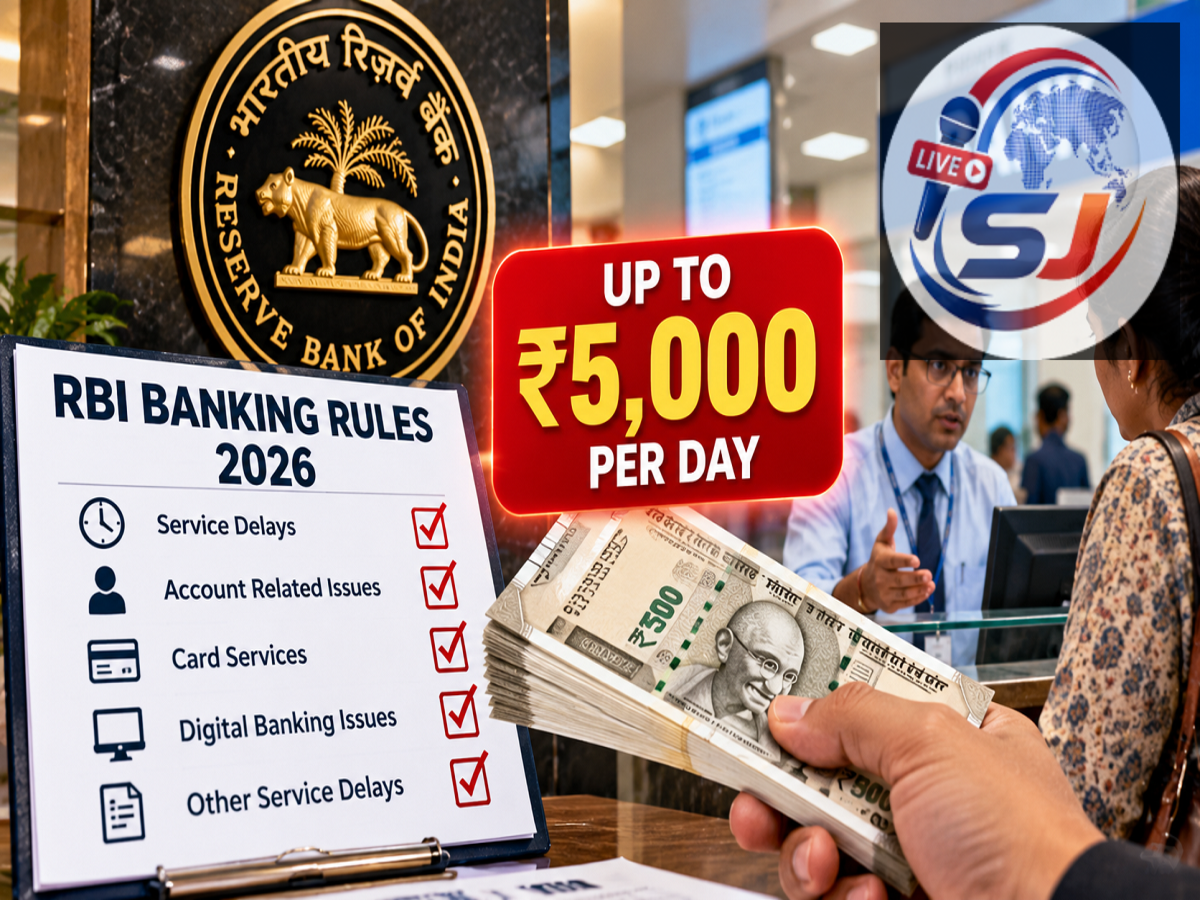
RBI Banking Rules 2026: Many bank customers know that banks can charge penalties for missed payments, insufficient balances or other account-related issues. However, fewer people are aware that banks may also be required to compensate customers when certain services are delayed beyond prescribed deadlines.
Under various Reserve Bank of India (RBI) directions, customers can receive compensation for specific banking service failures, including delays in settling claims, returning property documents or resolving certain transaction problems.
Depending on the type of violation, the compensation may be calculated on a daily basis.
A report published on October 10, 2026, highlights five situations in which banks may be required to pay compensation ranging from ₹100 to as much as ₹5,000 per day.
However, there is no single RBI rule requiring banks to pay ₹5,000 daily for every delayed banking service. Different rules specify different amounts, eligibility conditions and deadlines.
Here are five important situations customers should understand.
1. Failed UPI, ATM or Digital Transactions: ₹100 Per Day
One of the most common banking complaints involves failed digital transactions.
For example, a customer may attempt to withdraw money from an ATM, but no cash is dispensed even though the amount is deducted from the account.
Similarly, a UPI payment may fail while the customer's account is debited.
RBI rules prescribe timelines for reversing certain failed transactions.
If the responsible bank or payment service provider fails to reverse the amount within the applicable deadline, the customer may be entitled to ₹100 per day for the delay.
The deadline depends on the transaction type. For instance, a failed ATM cash withdrawal generally requires reversal within five calendar days, while certain UPI transfer failures have a shorter reversal timeline.
The compensation applies after the prescribed deadline, not automatically from the moment the transaction fails.
2. Delay in Closing a Credit Card: ₹500 Per Day
Customers have the right to request closure of their credit cards.
Under RBI's credit card directions, card issuers are generally required to honour a valid closure request within seven working days, provided all outstanding dues have been cleared.
If the issuer fails to close the account within the stipulated period, it may have to compensate the cardholder at ₹500 for each calendar day of delay until closure.
For example, if a valid closure request remains pending for four compensable days beyond the deadline, the amount could reach ₹2,000.
However, customers should remember that merely blocking a credit card is not the same as formally closing the card account.
3. Delay in Returning Property Documents: ₹5,000 Per Day
This is one of the most significant compensation provisions for borrowers.
When a borrower fully repays or settles an eligible loan, the regulated lender must release the original movable or immovable property documents and remove registered charges within 30 days.
If the lender is responsible for a delay beyond the prescribed period, it must pay ₹5,000 per day.
Consider a borrower who has repaid a home loan but does not receive the original property documents within the required timeframe.
If the delay attributable to the lender continues for 10 days beyond the deadline, the compensation could amount to ₹50,000.
The RBI directions also distinguish between delays caused by the lender and those arising from circumstances beyond its control. In the latter situation, the lender must communicate the reasons, and compensation is not automatically payable on the same basis.
4. Delay in Correcting a Credit Report: ₹100 Per Day
Errors in credit reports can affect a person's ability to obtain loans or credit cards.
Common problems include incorrectly reported overdue payments, loans that continue appearing as active after closure or inaccurate outstanding balances.
Under RBI's credit information complaint framework, a complaint must generally be resolved within 30 calendar days.
If the complaint remains unresolved beyond the prescribed period, the complainant may be eligible for compensation of ₹100 per calendar day.
Responsibility for the payment can rest with the credit institution, the credit information company or both, depending on the reason for the delay.
Customers should retain their complaint reference numbers and relevant documents to support their claims.
5. Bank Locker Loss: Compensation Can Reach 100 Times the Annual Rent
Bank locker customers also have protection under RBI rules.
If locker contents are lost because of certain incidents, such as fire, theft, burglary, robbery or fraud attributable to the bank's employees, the bank may be liable to compensate the customer.
Under the applicable locker framework, the bank's liability for such incidents is generally capped at 100 times the prevailing annual locker rent.
For example, if the annual locker rent is ₹3,000, the bank's liability under this rule could reach ₹3 lakh.
Unlike the previous four cases, this is not a daily compensation rule.
It is also not insurance covering every possible loss. Specific exclusions and liability conditions apply, and the bank is not automatically responsible for every incident affecting locker contents.
RBI Compensation Rules: Quick Comparison
| Banking Service Problem |
Compensation |
Key Condition |
|---|---|---|
| Failed UPI or ATM Transaction |
₹100 per day |
Reversal delayed beyond applicable deadline |
| Credit Card Closure Delay |
₹500 per day |
Valid closure request not completed within seven working days |
| Property Document Return Delay |
₹5,000 per day |
Lender-attributable delay beyond 30 days |
| Credit Report Correction Delay |
₹100 per day |
Eligible complaint unresolved beyond 30 calendar days |
| Bank Locker Loss |
Up to 100 times annual rent |
Covered incident for which the bank is liable |
How Can Customers Claim Compensation?
Customers should first submit a complaint to the bank, card issuer or other responsible financial institution.
The complaint should include relevant transaction details, dates, account information and supporting records. Customers should keep the complaint reference number for future correspondence.
Where compensation is required automatically under the applicable RBI rules, the institution should follow those requirements without forcing the customer to make repeated requests.
If the complaint is rejected, remains unresolved for 30 days or the customer is dissatisfied with the response, an eligible complaint may be escalated through the RBI's Integrated Ombudsman Scheme.
The RBI Complaint Management System provides a mechanism for filing and tracking eligible complaints against regulated entities.
Final Takeaway
RBI's consumer protection framework gives bank customers important rights when financial institutions fail to meet certain service standards.
Depending on the violation, compensation may range from ₹100 per day for delayed failed-transaction reversals to ₹5,000 per day for lender-attributable delays in returning original property documents.
Credit card closure delays and credit reporting complaints also have specific compensation provisions.
The important point is that compensation is not automatic for every inconvenience. Customers must satisfy the conditions and deadlines prescribed for the particular banking service.
Knowing these rules can help account holders, borrowers and credit card users protect their financial interests and raise complaints when necessary.
Based on the Aaj Tak report dated October 10, 2026. Compensation amounts depend on the applicable RBI directions, transaction type, eligibility and cause of delay.