
Ration Card Update: Fingerprint Not Working? Face Authentication Can Help You Collect Ration at Supported Shops
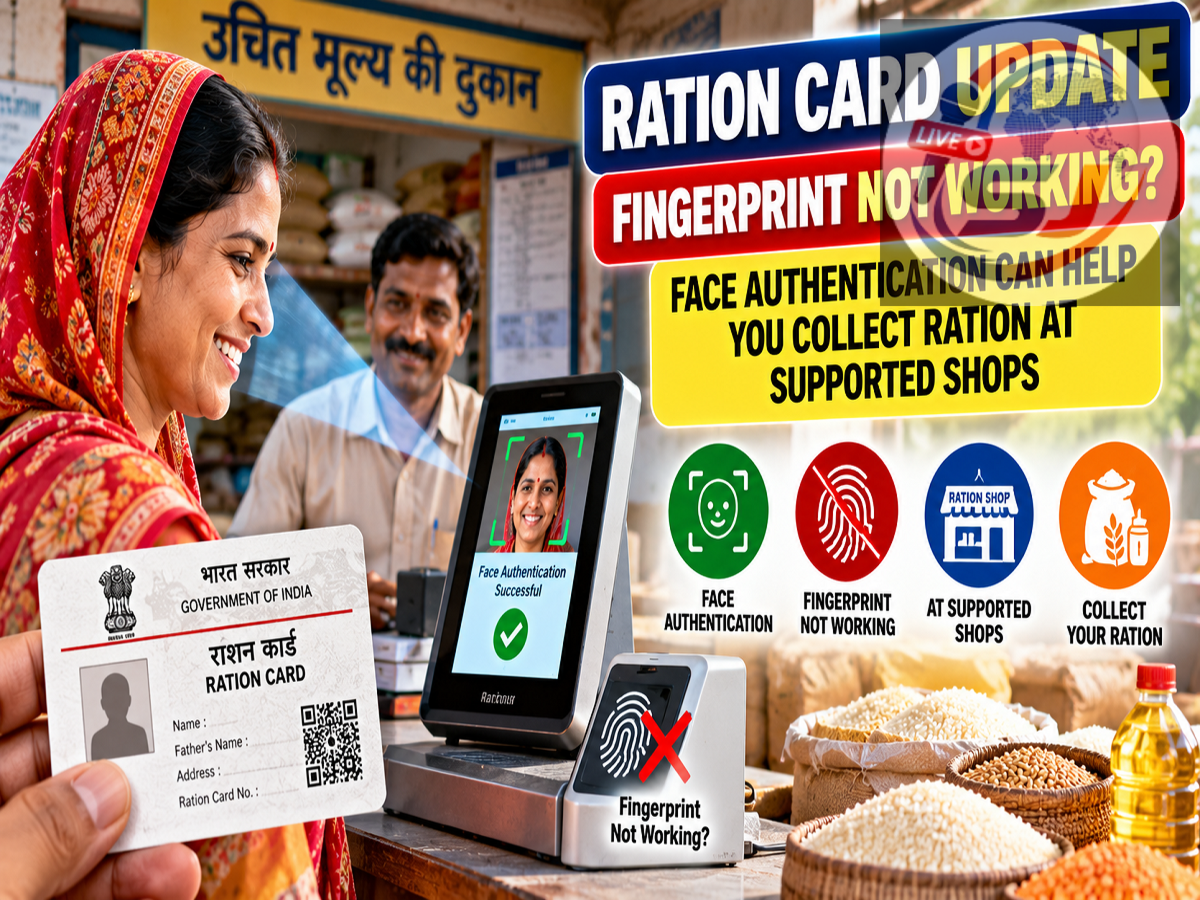
Ration card beneficiaries who struggle with fingerprint authentication at fair price shops may now have another way to verify their identity. A face authentication facility is being introduced for ration distribution through compatible electronic Point of Sale (e-POS) systems, providing an alternative when fingerprint verification does not work.
According to the supplied information, the facility became operational from October 1, 2026, following an announcement on September 29.
The change can be particularly useful for elderly beneficiaries and manual labourers, whose fingerprints may sometimes be difficult for biometric scanners to recognise.
However, ration card holders should note an important condition: face authentication will be available only at locations where the required technology, camera-enabled e-POS system and software updates have been deployed.
Therefore, beneficiaries should not assume that every ration shop across India will immediately offer the facility.
Face Authentication Added as an Alternative
Until now, Aadhaar-based fingerprint authentication has been commonly used at e-POS-enabled ration shops for beneficiary verification.
A person generally places a finger or thumb on the biometric scanner connected to the e-POS system. After successful authentication, the dealer proceeds with the eligible ration transaction.
However, biometric verification can sometimes fail.
The scanner may have difficulty reading fingerprints because of age, worn fingerprints, the nature of a person's work or technical problems with the device.
The newly introduced face authentication option is intended to provide another verification method in such situations.
How Will Face Authentication Work at Ration Shops?
The process is intended to be straightforward for beneficiaries.
Where the facility is enabled, the normal authentication procedure can be attempted first. If fingerprint authentication fails, the supported system can provide face authentication as an alternative.
The process broadly works as follows:
-
The beneficiary visits an eligible fair price shop to collect ration.
-
The beneficiary's details are processed through the e-POS system.
-
Biometric fingerprint authentication is attempted where applicable.
-
If fingerprint authentication fails and face authentication is available, the alternative option can be selected.
-
The beneficiary's face is captured using the supported camera system.
-
Authentication is performed using the applicable Aadhaar-based verification framework.
-
After successful verification, the ration transaction can proceed according to the beneficiary's entitlement.
The exact on-screen process may vary depending on the state, e-PDS platform and equipment being used.
Fingerprint Authentication Is Not Being Removed
The introduction of face authentication does not necessarily mean fingerprint verification is being discontinued.
Instead, face verification is designed as an additional authentication option where supported.
Fingerprint-based verification can continue to be used normally when it works successfully.
The alternative becomes particularly relevant when a beneficiary repeatedly encounters fingerprint-matching problems.
Why Do Fingerprints Sometimes Fail?
Fingerprint authentication can become difficult for several reasons.
One common problem occurs among people involved in intensive manual work.
Farm workers, construction workers and other labourers may develop worn or damaged fingerprints over time, which can make biometric recognition more difficult.
Senior citizens can also experience difficulties because fingerprint patterns may become less distinct with age.
Other potential causes include scanner problems, improper placement of the finger or temporary technical issues.
Face authentication can help provide another route for identity verification in compatible systems.
Elderly Ration Card Holders Could Benefit
Senior citizens are among the groups that may benefit from an alternative authentication method.
If an elderly beneficiary's fingerprint repeatedly fails, making several attempts on the same scanner can create inconvenience and delays.
Where the upgraded face-authentication facility is available, the person's face can instead be used for authentication through the supported system.
This could make ration collection easier for beneficiaries who previously faced recurring biometric difficulties.
Manual Labourers May Also Get Relief
People engaged in regular physical labour can also encounter fingerprint-authentication problems.
Repeated contact with soil, construction material, chemicals or tools can affect fingerprint clarity.
A person can therefore be an eligible ration beneficiary with valid identification but still experience problems when the biometric scanner attempts to read the fingerprint.
Face authentication provides another method of establishing identity in supported locations.
What Is an e-POS Machine?
An electronic Point of Sale (e-POS) machine is used at fair price shops to digitally process ration transactions and authenticate eligible beneficiaries.
These systems help connect beneficiary information with the electronic Public Distribution System.
Depending on the technology deployed, an e-POS device may support biometric authentication and other digital functions required for ration distribution.
For face authentication to work, the necessary camera capability, software and backend integration must be available.
This is why the new facility may not appear at every ration shop at exactly the same time.
What Is e-PDS?
The Electronic Public Distribution System (e-PDS) is the digital infrastructure used to manage different parts of the Public Distribution System.
It helps maintain beneficiary records and supports electronic processing of ration transactions.
Digitisation is intended to improve record keeping, beneficiary identification and transparency in foodgrain distribution.
The addition of face authentication expands the available digital verification options where the necessary infrastructure has been installed.
Will Every Ration Shop Offer Face Verification?
Not necessarily.
This is one of the most important points for ration card holders.
According to the supplied report, the facility depends on the required technical upgrades being completed.
A ration shop may need compatible equipment, camera functionality, updated e-POS software and connectivity with the relevant authentication system.
As a result, availability can vary during the rollout.
If the option is not visible at a particular shop, beneficiaries should check whether face authentication has been activated there rather than assuming their ration-card eligibility has changed.
Face Authentication Does Not Change Ration Entitlement
The new verification method concerns identity authentication, not the amount of ration a beneficiary is entitled to receive.
A person's foodgrain entitlement continues to depend on the applicable ration-card category and Public Distribution System rules.
Face verification simply provides another way of authenticating an eligible beneficiary where the facility is supported.
It does not automatically increase or reduce the quantity of wheat, rice or other commodities allocated to a household.
What Should You Do If Fingerprint Verification Fails?
If your fingerprint is not being recognised at an e-POS-enabled fair price shop, first ask whether face authentication has been activated on that shop's system.
If available, the dealer can follow the prescribed process for alternative face-based authentication.
If the shop has not yet received the required update or compatible equipment, beneficiaries should ask about the alternative authentication or grievance mechanism available under their state's PDS rules.
Repeated fingerprint failure should not automatically be treated as proof that a person is ineligible for ration benefits.
Don't Share OTPs or Banking Information With Strangers
Beneficiaries should also remain cautious about fraud surrounding new government digital services.
Face authentication for ration distribution does not mean an unknown person needs access to your bank account, UPI PIN, ATM PIN or internet-banking password.
Do not share sensitive credentials with anyone claiming that they are required to “activate” ration benefits.
Use only authorised systems and government-approved processes for authentication.
Ration Face Authentication: Key Details
| Feature | Details |
|---|---|
| Reported rollout date | October 1, 2026 |
| Purpose | Alternative identity authentication for eligible ration beneficiaries |
| Useful when | Fingerprint authentication fails |
| Authentication method | Face-based verification through supported system |
| Existing fingerprint facility | Continues where applicable |
| Main beneficiaries likely to benefit | Elderly, manual labourers and others facing fingerprint mismatch |
| Equipment required | Compatible/upgraded e-POS and camera/authentication facility |
| Available at every ration shop immediately? | Not necessarily |
| Does it change ration entitlement? | No, it changes the verification method, not entitlement |
What Beneficiaries Should Remember
The most important advantage of face authentication is that a failed fingerprint does not necessarily have to become a repeated obstacle to collecting ration.
At locations where the technology is active, an eligible beneficiary may be able to authenticate through facial verification instead.
This could reduce inconvenience for senior citizens, workers with worn fingerprints and others who have difficulty using biometric fingerprint scanners.
At the same time, the rollout depends on the technological readiness of individual PDS systems and fair price shops.
Key Takeaway
The ration-distribution authentication system is being expanded with face verification as an alternative to fingerprint authentication at supported e-POS locations.
According to the supplied information, the facility started rolling out from October 1, 2026.
The change is particularly relevant for beneficiaries whose fingerprints are difficult for biometric scanners to recognise.
Where a ration shop has received the necessary hardware and software upgrades, the beneficiary's face can be used for authentication through the supported system, allowing the ration transaction to proceed after successful verification.
However, beneficiaries should remember that this is an authentication-related change rather than a new ration entitlement. Availability can also differ from one location to another while the required e-POS upgrades are rolled out.