Ration Card Sugar Subsidy: Who Can Get Cheap Sugar Through PDS and How to Claim the Benefit
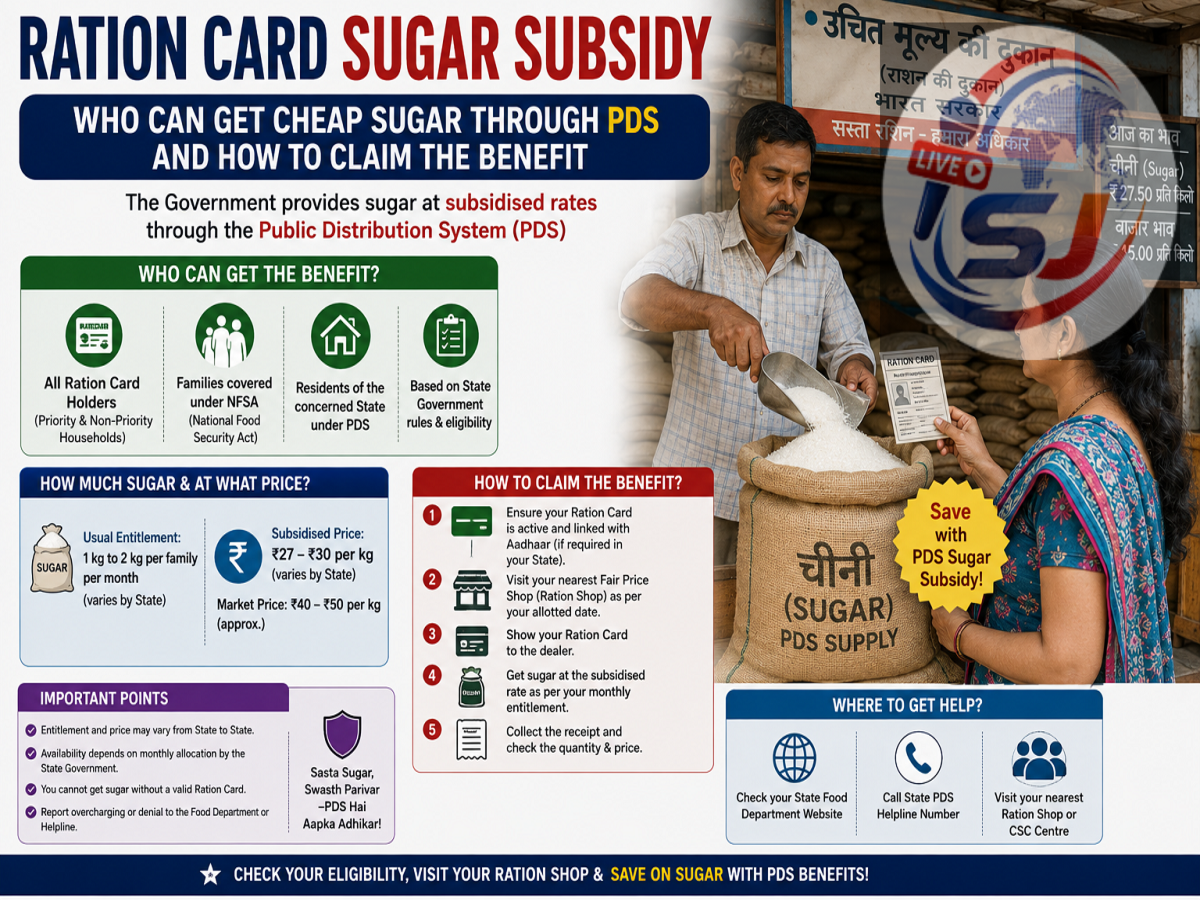
Ration Card Sugar Benefit: Holding a ration card does not automatically make every family eligible for subsidised sugar. Under the central sugar subsidy arrangement, the benefit is primarily meant for Antyodaya Anna Yojana (AAY) households in participating states and Union Territories. Eligible families can receive a limited quantity of sugar through the Public Distribution System at a price significantly below the open-market rate.
The Department of Food and Public Distribution states that the sugar subsidy scheme provides 1 kg of sugar per AAY family per month. The Centre provides a subsidy of ₹18.50 per kg to participating states and UTs. The retail issue price has traditionally been ₹13.50 per kg, although states may add certain transportation, handling or dealer-related costs or bear those expenses themselves.
Does Every Ration Card Holder Get Cheap Sugar?
No. This is the most important point consumers should understand.
Simply having a ration card does not mean that subsidised sugar will automatically be included in your monthly ration entitlement.
Under the central scheme, subsidised sugar is specifically targeted at AAY families, which represent some of the most economically vulnerable households covered under the food-security system.
Priority Household or other ration-card categories may receive foodgrains under separate provisions, but they are not automatically entitled to the central sugar subsidy.
Some state governments may offer additional benefits from their own resources, including sugar or special festival packages. Therefore, entitlement can vary depending on the state and the category of ration card.
How Much Sugar Can an AAY Family Get?
Under the central sugar subsidy framework, an eligible AAY household can receive:
1 kg of sugar per family per month.
This quantity is calculated per household, not per individual family member.
For example, an AAY family of two people and another AAY family of six people would both ordinarily receive the same 1 kg monthly allocation under this particular central sugar scheme.
This is different from some foodgrain entitlements, where benefits may be calculated per household or per person depending on the category.
How Cheap Is Subsidised Sugar?
The Centre provides states and UTs participating in the scheme with a fixed subsidy of ₹18.50 per kg.
The Department of Food and Public Distribution says the retail issue price has been ₹13.50 per kg, while states may either absorb additional expenses such as transportation, handling and dealer commission or pass some of those costs on to beneficiaries.
This means consumers should not assume that the final price will be exactly ₹13.50 per kg in every state or ration shop.
The amount actually charged can depend on the state's distribution policy and local implementation.
Why Is Sugar Not Free Like Some Foodgrains?
This is another area where confusion is common.
Under the National Food Security framework and PMGKAY arrangements, eligible AAY and Priority Household beneficiaries receive specified foodgrains free of cost. AAY households are entitled to 35 kg of foodgrains per family per month under the applicable scheme.
Sugar, however, operates under a separate subsidy programme.
It is therefore incorrect to assume that because rice or wheat is being supplied free of cost, sugar must also be free.
Eligible consumers generally pay the applicable subsidised issue price for sugar.
Which Families Are Covered Under AAY?
Antyodaya Anna Yojana is meant for the poorest and most vulnerable sections of society.
The exact identification of AAY households is carried out under government eligibility criteria and state-level implementation.
If your ration card clearly identifies your household as an AAY beneficiary, you may be eligible for subsidised sugar provided your state or Union Territory participates in the scheme.
Consumers who are unsure about their ration-card category should check the details printed on the card, use their state's food department portal or contact the local ration dealer or food-supply office.
Do All States Provide Subsidised Sugar?
No.
The central government provides the subsidy, but procurement and distribution are handled by participating states and Union Territories.
The Department of Food and Public Distribution currently notes that multiple states and UTs participate in the sugar subsidy programme, but implementation is not identical everywhere.
This is why two AAY beneficiaries living in different states may not necessarily see the same final retail price or distribution arrangements.
Before visiting a Fair Price Shop, it is sensible to verify whether sugar is part of the current monthly allocation in your state.
How to Get Subsidised Sugar From a Ration Shop
If your household is eligible, visit the Fair Price Shop linked to your ration card.
The dealer can check your entitlement through the Public Distribution System database. In states using electronic Point of Sale machines, identity authentication may be carried out through the prescribed method before ration is issued.
Once your eligibility is confirmed, the entitled quantity of sugar can be supplied at the applicable subsidised rate.
It is advisable to collect a receipt showing the quantity and amount charged.
Do You Need Aadhaar to Get Sugar?
Ration distribution increasingly uses electronic authentication, but consumers should follow the rules applicable in their state.
Aadhaar-linked verification, biometric authentication or other approved identification mechanisms may be used depending on the local PDS system.
Consumers should not assume that carrying a physical Aadhaar card is the only way to receive their entitlement in every situation. State food departments may provide alternative procedures where authentication fails.
If there is a problem with fingerprints or Aadhaar authentication, contact the ration dealer or local food-supply authority instead of paying an unauthorised extra amount.
What If the Dealer Charges More?
Eligible beneficiaries should know the official issue price applicable in their state.
If a Fair Price Shop dealer demands substantially more than the notified amount, refuses to issue the approved quantity or does not provide a receipt, the consumer can approach the state's food and civil supplies department.
The Department of Food and Public Distribution also provides food-related grievance and assistance channels, including the national food helpline framework.
Keeping the transaction receipt can make it easier to raise a complaint.
Can PHH or Other Card Holders Get Subsidised Sugar?
Not automatically under the central AAY sugar subsidy scheme.
The Centre's programme specifically covers eligible AAY households.
However, individual states may run additional schemes or provide sugar to other ration-card categories using their own policies and budgets.
Some states may also announce temporary benefits around festivals or during periods of sharp food-price increases.
Therefore, PHH or other ration-card holders should check state-specific announcements rather than assuming they are either definitely eligible or definitely excluded.
Why the Scheme Matters When Market Sugar Prices Rise
When retail sugar prices rise sharply, even a small subsidised allocation can reduce household expenses for economically vulnerable families.
The programme is designed to give AAY households access to sugar at a controlled price through the PDS network rather than forcing them to buy the entire requirement at open-market rates.
The Department of Food and Public Distribution says the scheme is specifically aimed at improving access to sugar for the poorest households.
Check Your Eligibility Before Visiting the Shop
Before going to collect subsidised sugar, check three things: whether your ration card is classified as AAY, whether your state is currently distributing sugar under the scheme and what quantity and price have been notified locally.
This can prevent confusion at the ration shop and also protect consumers from misleading social-media messages claiming that every ration-card holder is now entitled to very cheap or free sugar.
Bottom Line
Having a ration card alone does not guarantee subsidised sugar.
Under the central PDS sugar subsidy scheme, the main beneficiaries are Antyodaya Anna Yojana families in participating states and Union Territories. Eligible households can receive 1 kg of sugar per family per month, while the Centre provides a subsidy of ₹18.50 per kg to participating governments.
The final retail price and distribution process can vary by state. Therefore, beneficiaries should check their ration-card category, local PDS entitlement and notified price before visiting the Fair Price Shop.