
Ration Card Rules: PHH or AAY? Your Category Decides How Much Wheat and Rice Your Family Gets
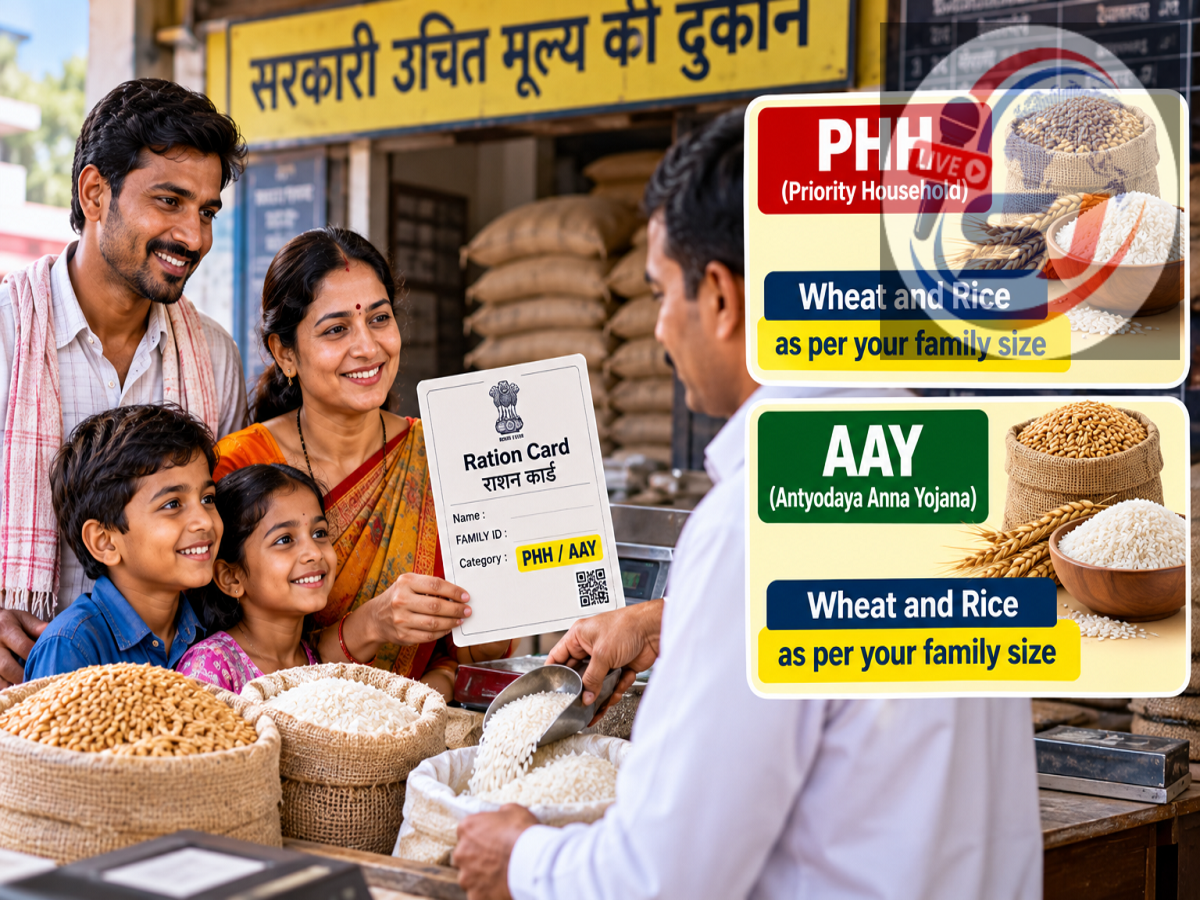
If your family receives foodgrains through the government ration system, knowing the category of your ration card is important. Many beneficiaries assume that every ration card holder receives the same quantity of wheat or rice every month, but the entitlement can differ depending on the category under which the household is covered.
According to the information shared in the supplied source, the Department of Food & Public Distribution (DFPD) has highlighted the difference between two important beneficiary categories—Priority Household (PHH) and Antyodaya Anna Yojana (AAY).
The key difference is straightforward. Under PHH, the monthly entitlement is calculated according to the number of eligible members in the household. Under AAY, the entitlement is fixed for the household as a whole.
Understanding this distinction can help beneficiaries know how their monthly ration entitlement is calculated.
PHH vs AAY: How Much Ration Is Provided?
The supplied information gives the following entitlement:
| Ration Category | Monthly Entitlement |
|---|---|
| PHH – Priority Household | 5 kg per person per month |
| AAY – Antyodaya Anna Yojana | 35 kg per household per month |
This means the method used to calculate the quantity is different for the two categories.
For PHH beneficiaries, adding or removing an eligible household member can affect the total household entitlement because the allocation is calculated per person.
For AAY households, the source describes the entitlement as a fixed 35 kg for the entire family per month, rather than 35 kg for every member.
How Much Ration Do PHH Card Holders Get?
PHH stands for Priority Household.
According to the supplied information, an eligible PHH beneficiary is entitled to 5 kg of foodgrains per person every month.
Therefore, the total entitlement of a PHH household depends on how many eligible members are recorded under the household.
For example, if there are two eligible members, the calculation would be:
2 members × 5 kg = 10 kg per month
For a family with four eligible members:
4 members × 5 kg = 20 kg per month
Similarly, a household with six eligible members would have a calculated entitlement of:
6 members × 5 kg = 30 kg per month
The important point is that PHH entitlement is calculated per person, not as one fixed quantity for every household.
PHH Ration Calculation Explained
Here is a simple illustration:
| Eligible Members in PHH Household | Monthly Entitlement |
|---|---|
| 1 member | 5 kg |
| 2 members | 10 kg |
| 3 members | 15 kg |
| 4 members | 20 kg |
| 5 members | 25 kg |
| 6 members | 30 kg |
| 7 members | 35 kg |
| 8 members | 40 kg |
This is simply the result of multiplying the number of eligible household members by the stated entitlement of 5 kg per person.
Therefore, two PHH families may receive different quantities even if both hold ration cards under the same category.
How Much Ration Do AAY Families Get?
AAY stands for Antyodaya Anna Yojana.
The method of calculating the monthly entitlement under this category is different from PHH.
According to the supplied information, an AAY household receives 35 kg of foodgrains per month for the family.
This is a household-based entitlement.
Therefore, the source does not describe the AAY entitlement as:
35 kg × number of family members.
Instead, the stated entitlement is 35 kg for the AAY household as a whole every month.
This distinction is important because otherwise beneficiaries may incorrectly calculate their expected ration quantity.
AAY Does Not Follow the PHH Per-Person Formula
Suppose an AAY household has four family members.
Based on the supplied information, the entitlement would remain 35 kg for the household, rather than 5 kg per person under the PHH formula.
Similarly, the source describes AAY entitlement as household-based rather than changing the allocation by multiplying 35 kg by the number of family members.
This is one of the main differences beneficiaries should understand when checking their ration entitlement.
Why Two Families May Receive Different Quantities
If two households receive different quantities of foodgrains, it does not automatically mean that one has been given an incorrect allocation.
Their beneficiary categories may be different.
One family may fall under PHH, where the quantity is calculated according to the number of eligible members. Another may be covered under AAY, where the monthly household entitlement is fixed at 35 kg according to the supplied information.
Even among PHH households, the total quantity can differ depending on the number of eligible members recorded.
For example, a three-member PHH household would have a 15 kg monthly entitlement under the stated calculation, while a five-member PHH household would have a 25 kg entitlement.
Know Your Ration Card Category
Beneficiaries should therefore know whether their household is registered under PHH or AAY.
Without knowing the category, simply comparing the quantity received by one household with another can create confusion.
The basic distinction can be remembered as:
PHH = 5 kg per eligible person per month
AAY = 35 kg per eligible household per month
This makes it easier to understand how the monthly foodgrain entitlement is calculated.
What If Your PHH Family Has Seven Members?
An interesting point emerges when comparing the two formulas.
A PHH household with seven eligible members would have a calculated entitlement of:
7 × 5 kg = 35 kg per month
That is numerically the same as the 35 kg household entitlement stated for an AAY family.
However, the underlying rule remains different.
PHH reaches 35 kg in this example because the household has seven eligible members. Under AAY, the source states that 35 kg is provided to the household as a fixed family entitlement.
What About Wheat and Rice Separately?
The supplied source explains the total foodgrain entitlement for PHH and AAY beneficiaries but does not provide a universal breakup specifying exactly how much of that quantity will be wheat and how much will be rice.
Therefore, it would be incorrect to assume from this source alone that every beneficiary across India receives the same wheat-rice combination.
Beneficiaries should check the applicable allocation information for the foodgrains being distributed to them rather than assuming a particular wheat-to-rice ratio.
What Should You Check If the Quantity Seems Wrong?
If the ration quantity available to your household appears different from what you expect, first check the category under which the household is registered.
For PHH households, it is also important to know how many eligible members are recorded because the entitlement is calculated per person.
A mismatch in the number of recorded members can therefore affect the total calculated entitlement.
For AAY beneficiaries, the supplied information describes the monthly entitlement as 35 kg per household.
Understanding these details before collecting ration can make it easier to identify whether the difference is simply due to category or household size.
PHH and AAY Ration Rules at a Glance
| Particular | PHH | AAY |
|---|---|---|
| Full form | Priority Household | Antyodaya Anna Yojana |
| Basis of entitlement | Per eligible person | Per household |
| Monthly quantity stated | 5 kg per person | 35 kg per household |
| Does household size affect calculation? | Yes | Not under the fixed household formula described in the source |
| Example: 4-member household | 20 kg | 35 kg |
| Example: 6-member household | 30 kg | 35 kg |
Don't Compare Your Ration With Another Family Without Checking the Category
The amount received by a neighbouring family should not automatically be used to determine what your household should receive.
The two families may belong to different beneficiary categories or, in the case of PHH, may have a different number of eligible members recorded.
The better approach is to first identify whether your household falls under PHH or AAY and then calculate the entitlement according to the applicable method.
Ration Card Entitlement: Key Takeaway
Government foodgrain entitlement is not necessarily calculated in the same way for every ration-card household.
According to the supplied information, PHH beneficiaries receive 5 kg of foodgrains per eligible person every month. This means a household with four eligible members would have an entitlement of 20 kg, while six eligible members would correspond to 30 kg.
For AAY households, the stated entitlement is 35 kg of foodgrains per household per month, rather than a per-person allocation.
Beneficiaries should therefore check their ration category before calculating how much foodgrain their household is entitled to receive.
Note: This article is based on the supplied information regarding PHH and AAY entitlements. The source does not provide a universal state-wise wheat-rice breakup, detailed eligibility rules for inclusion in each category, or state-specific distribution variations. Those details should not be inferred from the information provided here.