
Rajasthan Farmer Welfare Schemes 2026: Government Focuses on Financial Aid, Crop Insurance and Rural Growth
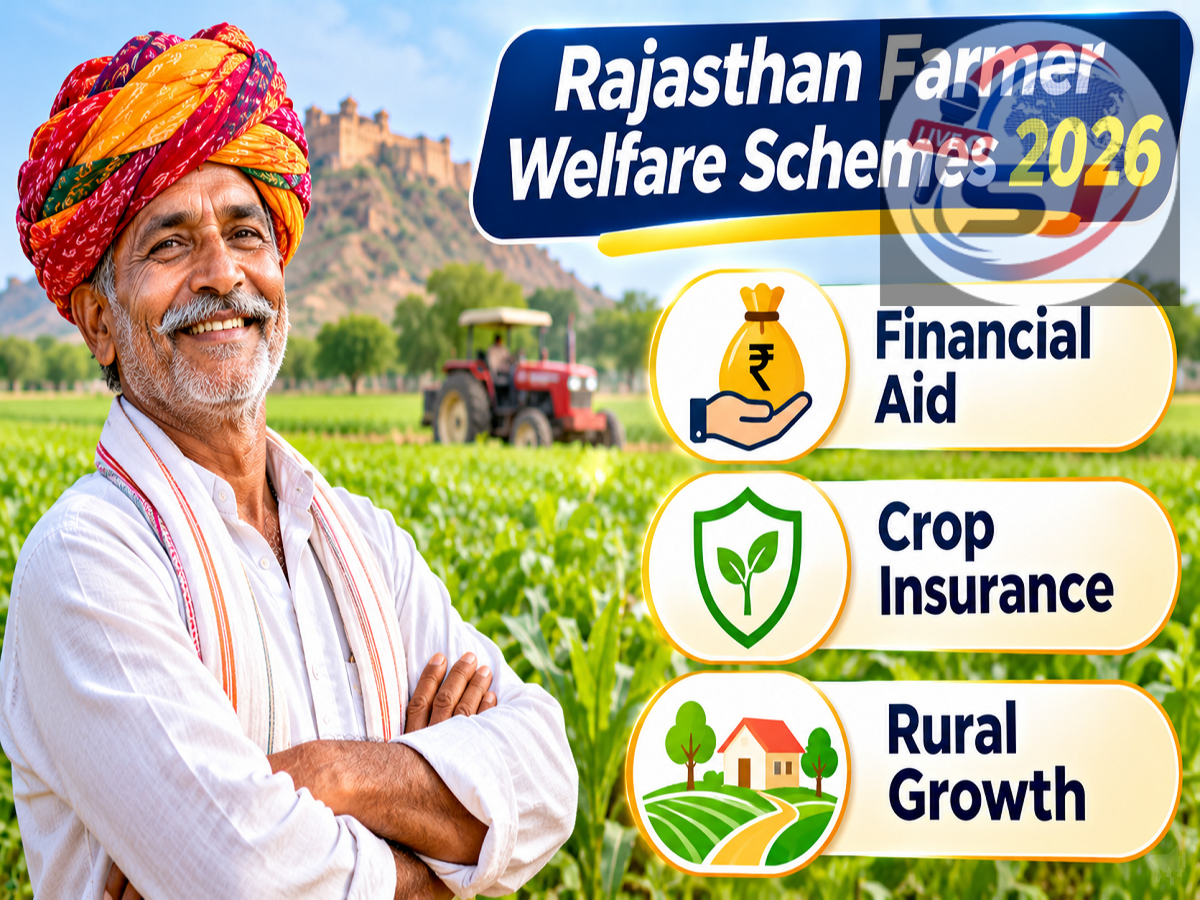
Rajasthan Farmers Welfare Update 2026: The Rajasthan government is highlighting its efforts to improve farmers' financial security, strengthen agricultural infrastructure and expand access to welfare schemes. In a special Sujas Bulletin released on November 8, 2026, the state's Department of Information and Public Relations (DIPR) focused on government initiatives aimed at supporting farmers and developing the rural economy.
Under Chief Minister Bhajan Lal Sharma's administration, various programmes covering agricultural assistance, irrigation, crop insurance, livestock development and financial support have been promoted across the state.
These initiatives aim to address challenges faced by farmers, including rising cultivation expenses, unpredictable weather conditions, limited irrigation facilities and access to affordable agricultural credit.
Rajasthan Government Highlights Farmer Welfare Initiatives
Agriculture remains an important source of employment and income for Rajasthan's rural population. However, farming conditions vary considerably across the state because of differences in rainfall, groundwater availability and agricultural infrastructure.
Government assistance programmes seek to address these challenges through direct financial transfers, agricultural subsidies, insurance protection and rural development activities.
The Rajasthan government's November 8 Sujas Bulletin focuses on its broader farmer welfare efforts. The bulletin's publicly accessible title identifies farmer welfare as its central subject, although a complete transcript of the video was not available for independent examination.
The following overview draws on separately reported government initiatives and published information about agricultural support programmes in Rajasthan.
PM-Kisan and Mukhyamantri Kisan Samman Nidhi: Financial Support for Farmers
Direct financial assistance is one of the major components of agricultural welfare programmes.
Under the central government's PM-Kisan Samman Nidhi scheme, eligible farming families receive financial assistance of ₹6,000 annually in three instalments, subject to the scheme's conditions.
Rajasthan also operates the Mukhyamantri Kisan Samman Nidhi initiative to provide additional assistance to eligible beneficiaries.
During a government programme in January 2026, Chief Minister Bhajan Lal Sharma stated that the combined annual assistance available to eligible farmers in Rajasthan had reached ₹9,000, including ₹3,000 from the state government.
The actual payment received by an individual farmer depends on eligibility, verification and successful processing of the relevant instalments.
Financial Assistance and Direct Benefit Transfers
Direct Benefit Transfer (DBT) is intended to deliver government assistance directly into eligible beneficiaries' bank accounts.
In January 2026, the Rajasthan government announced transfers exceeding ₹1,590 crore to more than one crore beneficiaries across several welfare programmes.
The reported disbursements included approximately ₹653 crore under the state farmer assistance scheme for more than 65 lakh farmers.
The government also reported transferring over ₹327 crore as crop-loss compensation to nearly five lakh farmers.
These amounts relate to the January 2026 programme and should not be interpreted as fresh payments announced in the November bulletin.
Crop Insurance Helps Farmers Manage Agricultural Risks
Unseasonal rainfall, drought, hailstorms and other weather-related events can cause substantial losses to agricultural households.
Crop insurance programmes, including the Pradhan Mantri Fasal Bima Yojana, are designed to provide financial protection against specified agricultural risks.
Eligible farmers can obtain coverage for notified crops in designated areas according to the applicable insurance conditions.
The amount of compensation depends on factors such as the insured crop, notified risks, assessed losses and policy provisions.
Farmers should check the current crop notification, enrolment deadline and premium requirements before applying.
Interest-Free Agricultural Loans and Credit Facilities
Access to affordable credit is another important issue for farmers, particularly during sowing and harvesting seasons.
Rajasthan has promoted agricultural credit through cooperative institutions and other approved lending channels.
At a January 2026 event, the state government reported providing approximately ₹50,000 crore in interest-free crop loans over the preceding two years.
Such credit facilities are intended to help eligible farmers meet seasonal expenses, including seeds, fertilisers and other agricultural inputs.
However, interest-free treatment is subject to the conditions of the relevant scheme. Loan eligibility, repayment deadlines and applicable subsidies should be confirmed with the participating financial institution.
Irrigation and Solar Pumps Receive Attention
Water availability remains a major concern for agricultural production in Rajasthan.
Government programmes support eligible farmers through irrigation-related infrastructure, including pipelines, farm ponds, drip irrigation systems, sprinklers and solar-powered pumps.
Solar irrigation systems can help reduce dependence on conventional electricity supply and diesel-powered equipment where suitable conditions exist.
The Rajasthan government has also promoted installations under the PM-KUSUM framework.
According to figures reported in January 2026, the state had installed approximately 52,000 solar pumps with subsidy support of ₹822 crore.
These are previously reported figures rather than independently verified November totals.
Support for Livestock Farmers and Dairy Producers
Animal husbandry is an important supplementary source of income for many rural households.
Dairy farming, cattle rearing and related activities can provide earnings alongside seasonal crop production.
Rajasthan's welfare measures include support for eligible livestock owners through dairy-related assistance, veterinary services and other programmes.
During the January 2026 benefit distribution programme, the government reported releasing approximately ₹50 crore to around four lakh livestock owners under the Mukhyamantri Dugdh Utpadak Sambal Yojana.
Livestock owners should consult the relevant department or dairy cooperative for current eligibility and payment conditions.
Gram Utthan Shivirs: Bringing Agricultural Services Closer to Villages
Rajasthan has also organised Gram Utthan Shivirs to improve access to government services in rural areas.
These camps are intended to help farmers and other eligible residents obtain information, submit applications and complete prescribed formalities for welfare programmes.
Services highlighted for the camps include agricultural fencing assistance, irrigation facilities, solar pumps, crop insurance, Kisan Credit Cards and livestock-related schemes.
The statewide initiative was launched in January 2026, with camps planned at designated local administrative locations.
Farmers should verify current camp schedules through their district administration rather than assuming that registration is continuously available at every location.
How Can Rajasthan Farmers Apply for Government Schemes?
The Rajasthan government's Raj Kisan portal provides information and online application facilities for various agriculture, horticulture and agricultural marketing schemes.
Depending on the programme, farmers may need to submit land-related information, identification documents, bank account details and other supporting records.
Applications are subject to the relevant eligibility rules, verification requirements and availability of sanctioned benefits.
Farmers can visit the official Raj Kisan portal to explore available services.
Applicants should avoid unofficial agents promising guaranteed subsidies or immediate approval.
Why Farmer Welfare Programmes Matter for Rural Rajasthan
Agricultural development involves more than direct financial assistance.
Reliable irrigation, affordable credit, crop-risk protection, access to modern equipment and livestock support can all influence the financial stability of farming households.
The Rajasthan government's initiatives address several of these areas through different schemes.
However, the effectiveness of individual programmes depends on implementation, beneficiary access, timely payments and local agricultural conditions.
Farmers should therefore examine the specific rules and benefits of each scheme before making financial or cultivation decisions.
Conclusion
Rajasthan's farmer welfare initiatives cover a wide range of agricultural needs, from financial assistance and crop insurance to irrigation, solar pumps and rural service delivery.
The November 8, 2026, Sujas Special Bulletin highlights the government's continuing focus on farmer welfare. Separately documented programmes demonstrate the types of support being provided to eligible agricultural households.
Farmers interested in receiving assistance should consult official government portals, verify current eligibility requirements and follow the prescribed application process.
Source Credit: Department of Information and Public Relations (DIPR), Government of Rajasthan, Sujas Special Bulletin – November 8, 2026: Government Efforts Towards Farmer Welfare. Original video: https://youtu.be/pqBoXyQPE7s. Additional references: Government of Rajasthan's Raj Kisan Portal, Rajasthan Chief Minister's Office and PTI reporting on farmer welfare initiatives.