
PPF Rate for October-December 2026 Remains 7.1%: Know Deposit Limit, Maturity and Tax Benefits
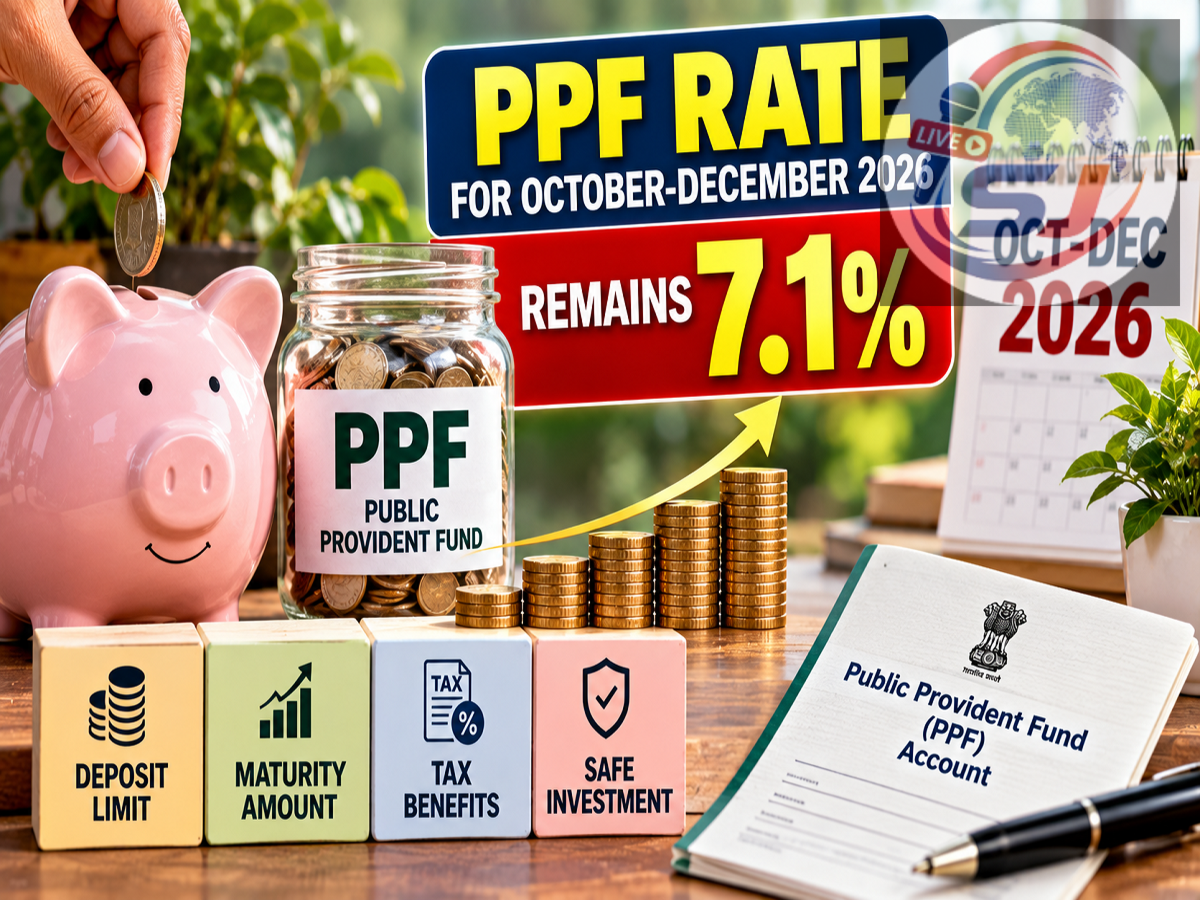
Public Provident Fund investors will continue to earn 7.1% annual interest during the October-December 2026 quarter, as the government has decided not to revise the interest rates on small savings schemes.
The Department of Economic Affairs issued the latest interest-rate notification on September 30, 2026 for the October-December quarter of financial year 2026-27. Following the quarterly review, the government kept small savings rates at the same levels applicable during the preceding quarter.
For PPF investors, this means there is no increase or reduction in the interest rate. The scheme will continue with its 7.10% per annum rate for the quarter.
Apart from the interest rate, investors should also understand several important PPF rules, including the ₹500 minimum annual contribution, ₹1.5 lakh maximum deposit, 15-year maturity period, tax treatment and restrictions on withdrawing money before maturity.
PPF Interest Rate Unchanged at 7.1%
The government reviews the interest rates applicable to small savings schemes every quarter.
After the latest review, the PPF rate has been retained at 7.1% per annum for October 1 to December 31, 2026.
The decision may disappoint investors who were expecting an increase, but it also means there has been no reduction in the return offered for the quarter.
PPF is a government-backed long-term savings scheme, although the interest rate itself is not permanently fixed for the full life of an account.
The government can revise the rate during subsequent quarterly reviews.
Latest PPF Rules at a Glance
| PPF Feature | Details |
|---|---|
| Interest rate for Oct-Dec 2026 | 7.1% per annum |
| Minimum annual contribution | ₹500 |
| Maximum annual contribution | ₹1.5 lakh |
| Initial maturity period | 15 years |
| Extension | In blocks of 5 years |
| Account availability | Authorised banks and post offices |
| Section 80C benefit | Subject to ₹1.5 lakh overall limit and applicable tax regime |
| PPF interest | Tax-exempt under applicable rules |
| Maturity proceeds | Tax-exempt under applicable rules |
| Partial withdrawal | Allowed subject to prescribed conditions |
PPF Comes With a 15-Year Tenure
PPF is not designed as a short-term investment.
The account has an initial tenure of 15 years, making it more suitable for long-term financial goals such as retirement planning, children's future expenses or building a tax-efficient corpus.
The maturity rules should be understood before investing because an investor cannot normally treat a PPF account like a regular bank savings account and withdraw the entire balance whenever desired.
However, the scheme provides certain facilities for partial withdrawal, loans and premature closure under prescribed circumstances.
What Happens After 15 Years?
Reaching the original maturity period does not necessarily mean the PPF account has to be closed.
PPF provides an extension facility after maturity.
An account holder can extend the account in blocks of five years, subject to the applicable rules.
This can be useful for investors who want their accumulated corpus to remain within the PPF framework for a longer period.
Investors approaching maturity should check the available extension options and complete any required formalities within the prescribed period.
You Can Invest Between ₹500 and ₹1.5 Lakh a Year
PPF offers flexibility in terms of the amount invested each financial year.
The minimum annual contribution is ₹500, while the maximum permitted deposit is ₹1.5 lakh in a financial year.
This means an investor does not need to contribute ₹1.5 lakh every year simply to keep the account operational.
Even the minimum required deposit can keep the account active, provided other applicable conditions are met.
At the same time, investors who want to maximise their PPF contribution cannot ordinarily claim PPF benefits on deposits beyond the prescribed ₹1.5 lakh annual ceiling.
What If You Miss the ₹500 Minimum Deposit?
Failing to make the minimum annual contribution can cause the PPF account to become discontinued or inactive under the applicable rules.
The accumulated balance does not simply disappear, but the account holder may have to complete the prescribed revival process.
This generally involves paying the required minimum contribution for the defaulted period along with the applicable penalty.
Investors who intend to keep their PPF account active should therefore make sure that at least ₹500 is deposited during every required financial year.
PPF Offers Section 80C Tax Benefit
Tax treatment remains one of the biggest attractions of PPF.
Eligible PPF contributions can be claimed as a deduction under Section 80C of the Income Tax Act, within the overall ₹1.5 lakh annual limit applicable to eligible Section 80C investments.
However, an important distinction applies.
The conventional Section 80C deduction is generally relevant to taxpayers who choose the old tax regime and meet the applicable conditions.
Investors using the new tax regime should not assume that depositing ₹1.5 lakh into PPF will automatically reduce their taxable income by the same amount.
Why Is PPF Called an EEE Investment?
PPF is widely classified as an EEE investment, meaning Exempt-Exempt-Exempt under the applicable tax framework.
Broadly, this refers to favourable tax treatment across three stages.
Eligible contributions can receive a deduction where Section 80C applies, interest earned in the PPF account is tax-exempt, and qualifying maturity proceeds are also exempt from tax.
This combination makes PPF attractive to long-term investors who want to accumulate savings without paying tax on the interest credited to the account under the prevailing rules.
Can You Withdraw PPF Money Before Maturity?
Yes, but there are restrictions.
PPF permits partial withdrawals after the prescribed period has been completed.
The supplied information describes this facility as generally becoming available from the seventh financial year.
However, the amount an investor can withdraw is not unlimited.
The permissible withdrawal is determined according to the formula and account balances specified under PPF rules.
Therefore, an investor cannot simply withdraw the entire account balance in the seventh year.
Partial Withdrawal Is Different From Closing the Account
Investors should distinguish between a partial withdrawal and premature closure.
A partial withdrawal means taking out an eligible portion of the accumulated amount while allowing the PPF account to continue.
Premature closure means terminating the account before its normal maturity.
Premature closure is permitted only in specified circumstances and is subject to conditions under the scheme.
PPF should therefore be chosen primarily for money that can remain invested for the long term.
Is a Loan Available Against PPF?
PPF also provides a loan facility during the period specified under the scheme rules.
The facility can help an investor access limited funds without immediately withdrawing from or closing the account.
The amount available as a loan and the repayment conditions depend on the applicable PPF provisions.
Investors requiring funds should check whether they are eligible for a loan or partial withdrawal before deciding how to access the accumulated balance.
Where Can You Open a PPF Account?
PPF accounts can be opened through authorised banks and post offices.
Depending on the institution, existing customers may also have access to online facilities for making contributions and checking their account information.
An individual is generally permitted to maintain one PPF account in their own name, subject to the scheme rules.
There are also provisions for accounts opened on behalf of minors, with applicable contribution and account-management conditions.
Does 7.1% Apply for All 15 Years?
Not necessarily.
The current 7.1% rate applies to the October-December 2026 quarter.
The government reviews PPF and other small savings interest rates every three months.
Consequently, an investor who opens an account today should not assume that 7.1% will remain unchanged throughout the entire 15-year tenure.
If the government changes the rate in a future quarter, interest will be credited according to the applicable notified rates.
This point is particularly important when using online PPF calculators. A maturity projection assuming 7.1% for 15 years is an estimate based on the assumption that the rate remains constant.
Why PPF Remains Popular Among Long-Term Investors
PPF combines several features that appeal to conservative long-term savers.
It is government-backed, allows relatively small annual contributions, provides tax-efficient accumulation and offers a long investment horizon.
The scheme can therefore be useful for building a retirement corpus or meeting another long-term financial objective.
However, its limited liquidity means investors should not put all of their emergency savings into PPF.
Money that may be needed at short notice is generally better kept separately in more liquid instruments.
PPF October-December 2026 Update: What Investors Need to Remember
The government's latest small-savings review has brought no change to the PPF interest rate.
For the October-December 2026 quarter, PPF will continue to offer 7.1% annual interest.
Investors must contribute at least ₹500 annually to maintain the account as required, while total permitted deposits are capped at ₹1.5 lakh per financial year.
The initial maturity period is 15 years, with an option to continue the account in five-year blocks under the applicable rules.
PPF also retains its attractive tax treatment: eligible contributions can qualify for Section 80C deduction under the applicable tax regime, while interest and qualifying maturity proceeds remain tax-exempt.
At the same time, investors should remember that the 7.1% rate is reviewed quarterly and is not guaranteed for the entire 15-year tenure. Partial withdrawals and other early-access facilities are also governed by specific conditions, making PPF primarily a long-term savings option.