
Post Office Time Deposit Laddering: How to Balance Returns and Liquidity With a Simple Strategy
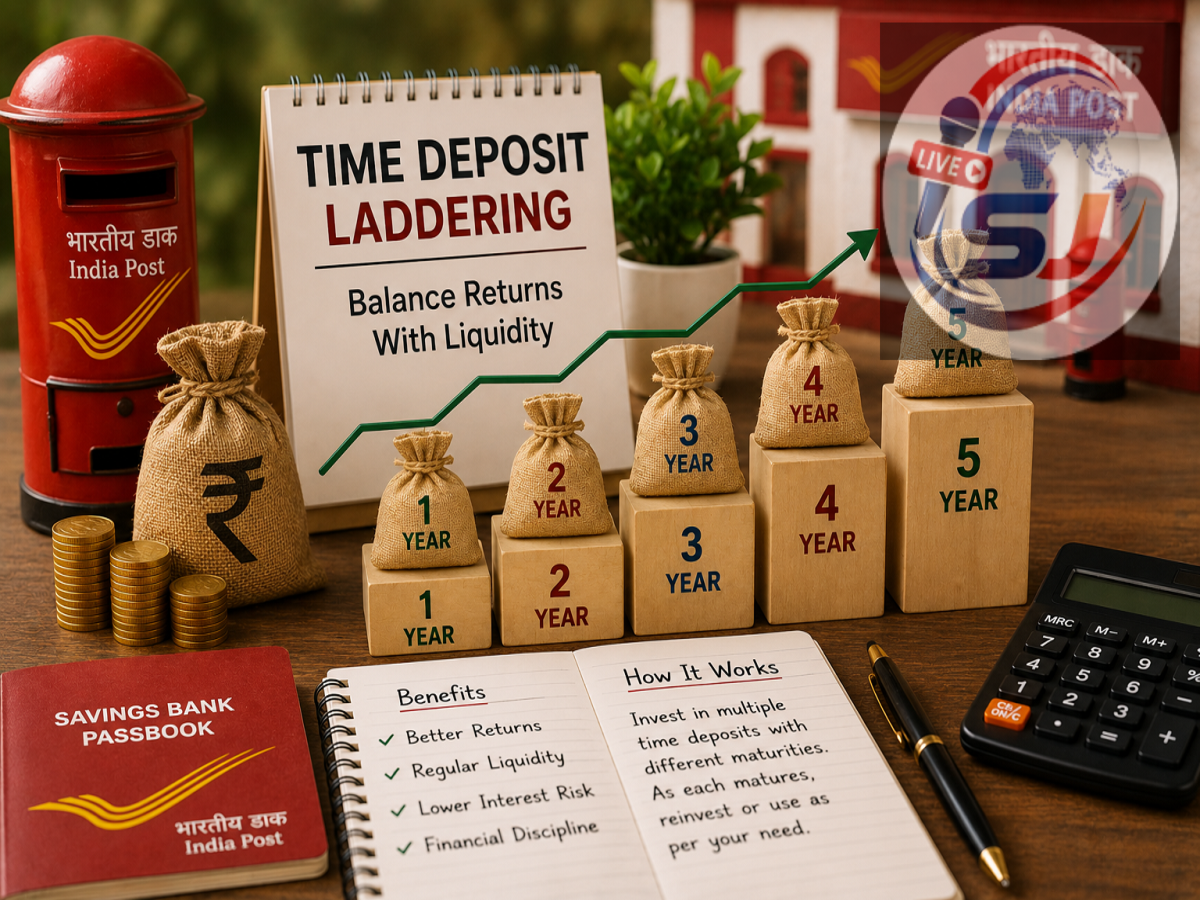
Post Office Time Deposit Laddering: Investors looking for relatively predictable returns often consider Post Office Time Deposit (POTD) accounts. But putting an entire lump sum into a single long-term deposit can create a problem: if money is needed before maturity, the investor may have to prematurely close the deposit, subject to applicable rules.
One way to manage this issue is deposit laddering. Instead of putting the entire amount into one maturity, the money is divided across deposits maturing at different times. This can provide periodic access to funds while reducing the risk of locking all the money at one interest rate.
Importantly, laddering does not guarantee higher returns. Its main advantages are better liquidity management and diversification across interest-rate cycles.
What Is a Post Office Time Deposit?
A Post Office Time Deposit works broadly like a bank fixed deposit. You invest money for a predetermined period and earn interest according to the rate applicable when the account is opened.
Post Office Time Deposit accounts are available for 1 year, 2 years, 3 years and 5 years.
Interest rates on small-savings schemes are determined by the government and may be revised periodically. Therefore, investors should always check the prevailing rate before opening or renewing a deposit.
What Does Deposit Laddering Mean?
Deposit laddering means dividing your investment into several deposits with different maturity dates instead of locking the entire amount into one deposit.
Suppose you have ₹4 lakh available for investment.
Instead of investing all ₹4 lakh for five years, you could divide it like this:
| Deposit | Amount | Initial Tenure |
|---|---|---|
| Deposit 1 | ₹1,00,000 | 1 year |
| Deposit 2 | ₹1,00,000 | 2 years |
| Deposit 3 | ₹1,00,000 | 3 years |
| Deposit 4 | ₹1,00,000 | 5 years |
| Total | ₹4,00,000 | — |
The objective is to ensure that different portions of your money become available at different times.
When a deposit matures, you can either use the money or reinvest it according to the interest rates and financial needs prevailing at that time.
How Can the Ladder Continue?
Suppose the one-year deposit matures and you do not need the money.
You could reinvest it into a fresh longer-term deposit.
Later, another deposit reaches maturity and the same decision can be made again.
Over time, the investor can structure the portfolio so that deposits mature at regular intervals while a substantial portion of the money remains invested for longer periods.
There is no compulsory laddering formula. The maturity schedule should be designed according to when you are likely to need the money.
Why Not Put Everything Into a 5-Year Deposit?
A five-year deposit may offer an attractive rate compared with shorter maturities at certain times, but putting the entire corpus into one deposit also concentrates the investment in a single maturity date.
Suppose you invest ₹5 lakh for five years and unexpectedly need ₹1 lakh after two years.
You may have to consider premature withdrawal of the deposit according to the applicable rules.
With laddering, only a portion of the portfolio is tied to each maturity date. A deposit approaching maturity may provide the required cash without disturbing the remaining investments.
Laddering Can Help Manage Interest-Rate Risk
Interest rates do not remain unchanged forever.
Suppose you invest your entire corpus for five years today and rates rise substantially next year. Most of your money will remain invested at the older rate until maturity or premature closure.
Now consider a ladder.
If part of your portfolio matures next year, that amount can potentially be reinvested at the newer rate.
The reverse can also happen.
If interest rates fall, the portions already locked into longer-term deposits continue earning according to the rates applicable when those deposits were opened.
This creates a mix of old and new interest rates across the portfolio.
Does Laddering Always Increase Returns?
No.
This is one of the most important points to understand.
A deposit ladder is primarily a liquidity and interest-rate management strategy, not a guaranteed method of generating extra returns.
If interest rates fall continuously, money from shorter deposits may eventually have to be reinvested at lower rates.
Conversely, if an investor had locked the entire corpus at an attractive long-term rate before rates declined, that single long-term deposit might deliver a better return.
Therefore, laddering trades some certainty about one fixed long-term rate for greater flexibility.
Liquidity Is the Biggest Advantage
Imagine that ₹10 lakh is your major pool of savings.
Putting all ₹10 lakh into one long-term deposit means the entire investment shares the same maturity date.
Instead, an investor could create several deposits — for example ₹2 lakh each — with maturity dates spread over different periods.
When one deposit matures, the investor gets a decision point.
The money can be used for an upcoming expense, moved to another suitable investment or reinvested into another Time Deposit.
This makes financial planning easier.
What Happens If You Need Money Before Maturity?
Post Office Time Deposits have rules governing premature closure.
Investors should not assume that a deposit can be broken at any time without consequences.
The amount of interest ultimately received can be affected when a Time Deposit is closed before its scheduled maturity, depending on how long it has remained invested and the applicable rules.
This is another reason to build a ladder around anticipated expenses.
If you know that you will need ₹2 lakh for education expenses two years from now, for example, it may be more sensible to align part of the investment with that requirement rather than locking everything for five years.
A ₹5 Lakh Laddering Example
Suppose an investor has ₹5 lakh and wants to maintain relatively frequent access to some of the money.
One possible structure could be:
| Investment | Amount | Maturity |
|---|---|---|
| TD 1 | ₹1,00,000 | 1 year |
| TD 2 | ₹1,00,000 | 2 years |
| TD 3 | ₹1,00,000 | 3 years |
| TD 4 | ₹2,00,000 | 5 years |
| Total | ₹5,00,000 | — |
This is only an illustration, not a recommended allocation.
An investor expecting a major expense after three years could put more money into the three-year deposit. Someone with sufficient emergency savings might choose a larger allocation to longer maturities.
Laddering Can Also Be Based on Annual Expenses
Another approach is to build the ladder around specific financial needs rather than simply dividing money equally.
Suppose a retired investor expects additional expenses of approximately ₹1 lakh every year.
Deposits can be arranged so that a portion of the portfolio matures around those expected dates.
This creates predictable liquidity without requiring the investor to prematurely withdraw the entire corpus.
However, retirees should evaluate Post Office Time Deposits alongside other suitable savings and income products rather than assuming that laddering alone will meet all retirement needs.
Don't Confuse Maturity With Regular Income
A Time Deposit ladder provides money when individual deposits mature.
That is different from an investment designed specifically to generate monthly cash flow.
If an investor's primary objective is monthly income, other products may need to be evaluated based on eligibility, interest rates, taxation, liquidity and risk.
The investment product should match the financial goal rather than being chosen solely because it is offered by the Post Office.
What About the 5-Year Time Deposit Tax Benefit?
A five-year Post Office Time Deposit has specific tax characteristics that differ from shorter-tenure deposits.
Eligible investment in a five-year Post Office Time Deposit can qualify for deduction under Section 80C of the Income-tax Act, subject to applicable conditions and the overall Section 80C limit under the relevant tax regime.
The interest earned, however, should not automatically be treated as tax-free.
Tax implications can materially affect the effective return, so investors should consider post-tax returns rather than looking only at the headline interest rate.
Who May Find Deposit Laddering Useful?
This strategy can be useful for investors who have a lump sum but do not want the entire amount to mature on the same date.
It may particularly suit people who value capital stability and expect expenses at different points in the future.
Retirees may also use a maturity ladder as one component of their cash-flow planning, while conservative investors may use it to reduce the risk of committing all their money at a single interest rate.
However, investors who already have adequate emergency funds and a very long investment horizon may have different priorities.
Keep an Emergency Fund Separate
A deposit ladder should not replace an emergency fund.
Money required for immediate medical expenses, household emergencies or sudden loss of income should generally remain sufficiently accessible.
A Time Deposit ladder can improve liquidity compared with putting everything into one long-term deposit, but it still involves fixed maturity periods.
Keeping emergency money separate can prevent investors from having to prematurely close deposits.
The Bottom Line
Post Office Time Deposit laddering is less about chasing the highest possible return and more about balancing return, liquidity and interest-rate risk.
Instead of investing an entire lump sum at one rate and one maturity date, investors spread the money across multiple maturities. As deposits mature, they can decide whether to spend the proceeds or reinvest them at prevailing rates.
If rates rise, maturing deposits provide opportunities to reinvest at potentially higher rates. If rates fall, longer deposits already booked at earlier rates continue according to their original terms.
For conservative investors, that flexibility can be valuable. But before creating a ladder, check the latest Post Office Time Deposit interest rates, premature-closure conditions, taxation and your expected cash requirements.
Disclaimer: This article is for general information only and does not constitute investment or tax advice. Interest rates, taxation and Post Office scheme rules can change. Check the latest official rules and consider professional advice before making financial decisions.