
Post Office Time Deposit 2026: Invest ₹5 Lakh for 3 Years, Check Interest Rate and Maturity Returns
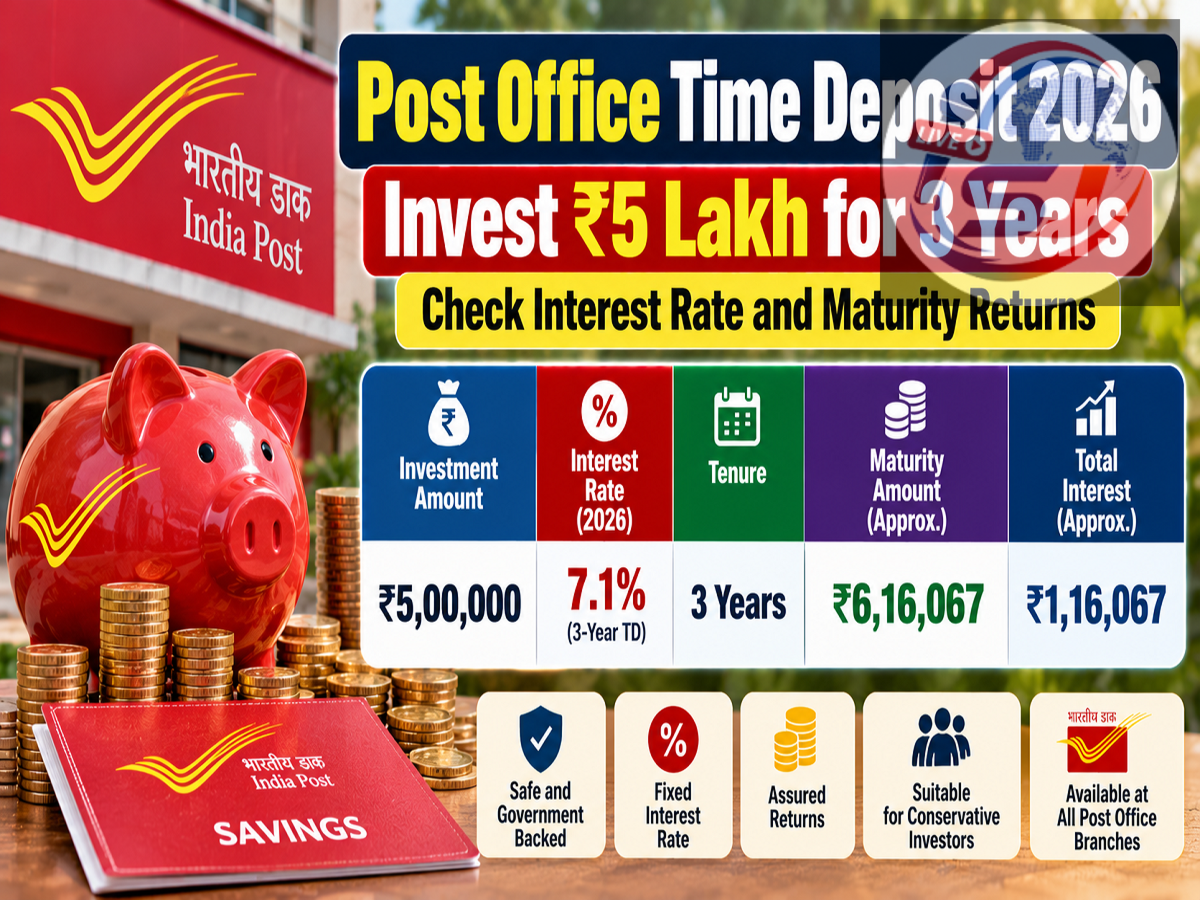
Post Office Time Deposit Scheme 2026: Investors looking for predictable returns without exposure to stock market fluctuations can consider the Post Office Time Deposit (POTD) scheme. This government-backed savings option allows individuals to deposit a lump sum for a fixed period and earn interest at the applicable rate.
The scheme offers four maturity options: 1 year, 2 years, 3 years and 5 years. Interest rates vary depending on the selected tenure.
For investors planning to deposit ₹5 lakh for three years, the main questions are how much interest they can earn, what amount they will receive at maturity, and how the scheme compares with other fixed-income savings products.
Unlike equity investments, Post Office Time Deposits do not depend on stock market movements. However, investors should also consider inflation, taxation and premature withdrawal rules before committing their savings.
What Is the Post Office Time Deposit Scheme?
The Post Office Time Deposit is a fixed-term savings scheme available through India Post.
It works similarly to a bank fixed deposit: an investor deposits money for a selected tenure and earns interest at the rate applicable when the account is opened.
The available tenures are:
-
1 year
-
2 years
-
3 years
-
5 years
The minimum deposit is ₹1,000, with further deposits generally made in multiples of ₹100. There is no prescribed maximum investment limit under the standard scheme rules.
Interest is calculated quarterly and paid annually. Interest that becomes payable but is not withdrawn does not earn additional interest merely by remaining unpaid.
The principal amount is repayable at maturity, subject to the account terms.
Post Office FD Interest Rates for October–December 2026
The government has kept small savings scheme interest rates unchanged for the October–December 2026 quarter.
The applicable annual rates are:
| Deposit Tenure | Interest Rate |
|---|---|
| 1 Year | 6.9% |
| 2 Years | 7.0% |
| 3 Years | 7.1% |
| 5 Years | 7.5% |
The 3-year Time Deposit currently offers 7.1% annually, while the 5-year option provides the highest rate among the four tenures at 7.5%.
₹5 Lakh Investment in a 3-Year Post Office Time Deposit: Return Calculation
Suppose an investor deposits ₹5,00,000 in a three-year Post Office Time Deposit at the current annual interest rate of 7.1%.
Under the scheme, interest is calculated with quarterly compounding within each annual interest period, but the interest is payable annually. Interest that has become payable does not continue earning interest if left unclaimed.
The approximate calculation is:
| Particulars | Amount |
|---|---|
| Initial Deposit | ₹5,00,000 |
| Annual Interest Rate | 7.1% |
| Investment Period | 3 years |
| Annual Interest | ₹36,456 |
| Total Interest Over 3 Years | ₹1,09,368 |
| Principal Repaid at Maturity | ₹5,00,000 |
| Total Principal and Interest | ₹6,09,368 |
The total interest is approximately ₹1.09 lakh before tax.
Important: The ₹6.09 lakh figure represents the principal plus all three annual interest payments. It is not necessarily a single lump-sum payment at maturity because the scheme pays interest annually.
How Much Will ₹5 Lakh Earn in Different Post Office FD Tenures?
Investors can compare the approximate total interest earned under the four available deposit periods.
| Tenure | Interest Rate | Total Interest | Principal + Interest |
|---|---|---|---|
| 1 Year | 6.9% | ₹35,656 | ₹5,35,656 |
| 2 Years | 7.0% | ₹71,859 | ₹5,71,859 |
| 3 Years | 7.1% | ₹1,09,368 | ₹6,09,368 |
| 5 Years | 7.5% | ₹1,92,856 | ₹6,92,856 |
Figures are approximate, before tax, and assume that each annual interest payment is received separately. Actual credited amounts may vary slightly because of prescribed rounding rules.
A longer tenure produces more total interest partly because the money remains invested for additional years.
Is Post Office Time Deposit a Risk-Free Investment?
Post Office Time Deposits are government-backed small savings products, making them different from market-linked investments such as equity mutual funds.
The principal and prescribed interest are supported by the government savings framework, and the return does not fluctuate with daily stock market movements.
Nevertheless, describing any investment as completely free from risk can be misleading.
Inflation may reduce the purchasing power of future payments. Investors may also face reduced returns if they close the account prematurely.
The scheme is therefore better described as a government-backed, fixed-return savings option rather than an investment without any financial considerations.
Who Can Open a Post Office Time Deposit Account?
The scheme permits eligible individuals to open accounts under the prescribed rules.
An account can generally be opened by a single adult or jointly by up to three adults.
A guardian may open an account on behalf of a minor or another eligible person requiring guardianship. Minors aged 10 or above may also open accounts in their own names, subject to the rules.
There is no specified maximum deposit limit, and investors may open multiple accounts where permitted.
How to Open a Post Office Time Deposit Account
Investors can visit an authorised post office offering savings banking services.
The general procedure involves selecting the deposit tenure, completing the prescribed account-opening requirements, and depositing the chosen amount.
Customers should carry the identity and address documents required under current KYC rules.
Existing eligible post office banking customers may also have access to supported digital account services, depending on their account facilities.
Before depositing funds, investors should confirm the interest rate, account-opening requirements, nomination details, and annual interest payment arrangements.
Can You Withdraw the Money Before Maturity?
Premature closure is permitted only under the applicable scheme conditions.
A Post Office Time Deposit generally cannot be closed before six months from the deposit date.
If an account is closed after six months but before one year, the applicable Post Office Savings Account interest rate is used instead of the originally contracted Time Deposit rate.
Other premature closure situations are governed by separate rules, which can reduce the effective return.
Investors should therefore avoid locking up money they may need for immediate expenses.
Is the Interest Taxable?
Yes. Interest earned on a Post Office Time Deposit is generally taxable according to the investor's applicable income-tax provisions.
The three-year Time Deposit does not qualify for the specific five-year tax-saving deposit deduction.
The five-year Post Office Time Deposit is eligible for a deduction under the applicable tax-saving provisions, subject to the taxpayer's chosen tax regime and other statutory conditions.
Investors should also remember that tax benefits on the deposited principal and taxation of interest are separate matters.
Post Office FD vs Bank FD: Which Should You Choose?
Both Post Office Time Deposits and bank fixed deposits provide predictable returns, but their interest rates, withdrawal rules, and account features can differ.
Post Office Time Deposits offer government-backed returns at the notified rates.
Bank fixed deposits may provide additional choices such as monthly interest payout options, different maturity periods, and special rates for eligible senior citizens.
The appropriate choice depends on the investor's need for liquidity, preferred investment duration, after-tax returns, and access to banking services.
Comparing only the advertised annual interest rate may not provide a complete picture.
Final Word
The Post Office Time Deposit scheme remains an option for investors seeking predictable interest income and government-backed savings.
At the October–December 2026 rate of 7.1%, a ₹5 lakh investment in the three-year scheme can generate approximately ₹1,09,368 in total interest before tax.
Combined with the original principal, the investor receives approximately ₹6.09 lakh over the investment period, including the annual interest payments.
The five-year option currently offers a higher rate of 7.5%, but it also requires a longer investment commitment.
Before investing, customers should consider taxation, inflation, premature withdrawal rules, and whether annual interest payouts meet their financial needs.
Official information is available on the https://www.indiapost.gov.in/banking-services/savings" title="India Post savings schemes website"/>.
Disclaimer: Calculations are illustrative, based on interest rates applicable during October–December 2026, and exclude income tax. Actual payouts are subject to scheme rules and rounding.