
Post Office SSY Scheme 2026: Invest ₹12,500 Monthly and Earn Nearly ₹50 Lakh in Interest, Check Details
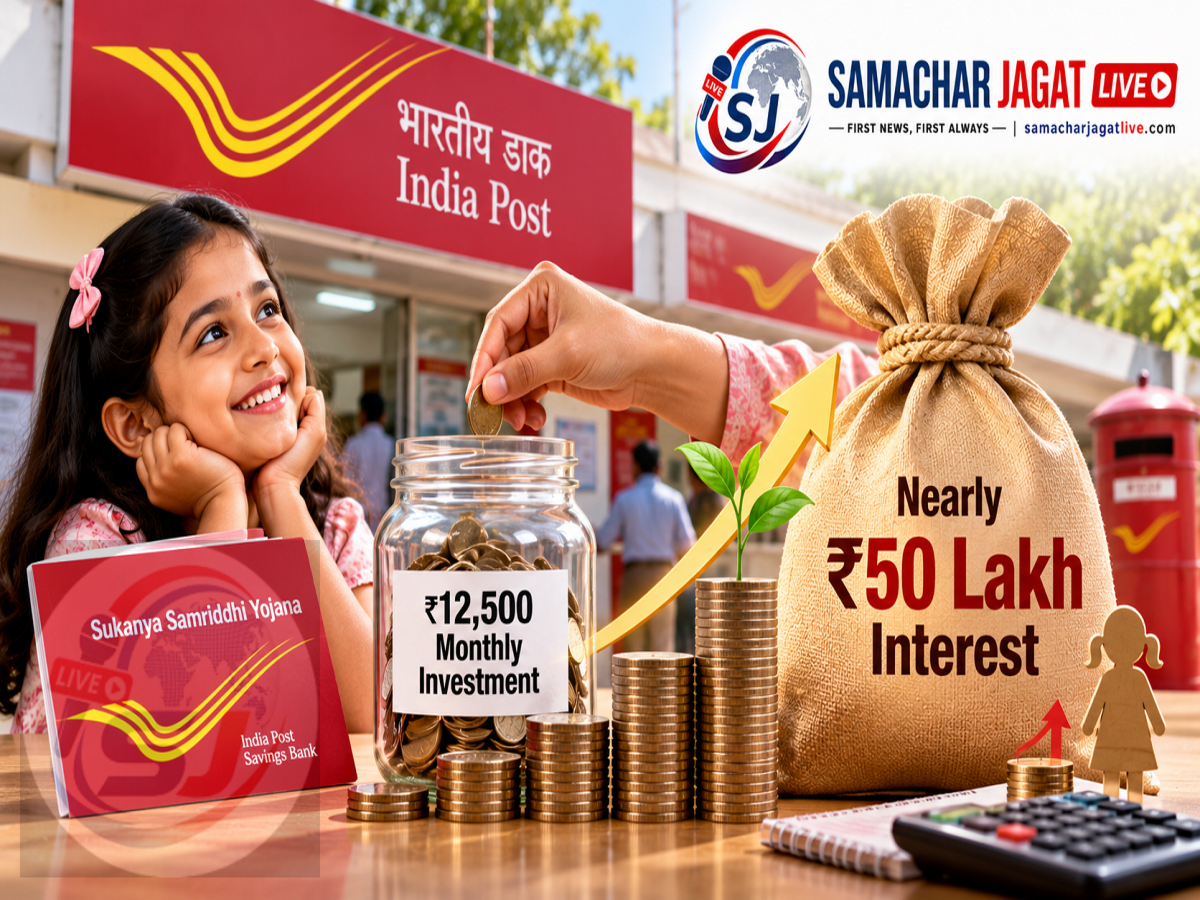
Sukanya Samriddhi Yojana 2026: Parents looking to build a substantial financial fund for their daughter's future may find the government's Sukanya Samriddhi Yojana (SSY) worth considering. This popular small savings scheme offers an attractive interest rate, government-backed security and tax benefits for eligible investors.
According to an illustrative calculation, parents who invest ₹12,500 every month, equivalent to ₹1.5 lakh annually, could accumulate approximately ₹70 lakh or more by the time the account matures after 21 years.
Of this amount, around ₹22.5 lakh would represent the family's own contributions, while approximately ₹49 lakh to ₹50 lakh could come from accumulated interest, assuming the current interest rate remains unchanged throughout the investment period.
The scheme is particularly designed to help families save for a girl child's higher education, marriage and other long-term financial requirements.
However, investors should understand that the interest rate is reviewed periodically and the final maturity amount is not fixed at the time of opening the account.
What Is Sukanya Samriddhi Yojana?
Sukanya Samriddhi Yojana is a government-supported savings scheme introduced under the Beti Bachao, Beti Padhao initiative.
It is specifically designed to encourage parents and legal guardians to save for the future of a girl child.
An SSY account can be opened through an authorised post office or participating bank.
The scheme combines long-term savings with compound interest, allowing contributions made during the initial years to grow until maturity.
Unlike many market-linked investments, SSY does not depend on stock market performance.
The interest rate is notified by the government and may change from one quarter to another.
Sukanya Samriddhi Yojana Interest Rate in 2026
For the October–December 2026 quarter, the Sukanya Samriddhi Yojana interest rate is 8.2% per annum.
Interest is calculated according to the scheme's rules and compounded annually.
This makes SSY one of the higher-interest options among government-backed small savings schemes.
However, the 8.2% rate should not be interpreted as a guaranteed fixed rate for the entire 21-year account period.
The government reviews small savings interest rates periodically, and future revisions can affect the amount received at maturity.
Therefore, long-term projections are estimates rather than assured returns.
How Can ₹12,500 Monthly Grow Into More Than ₹70 Lakh?
The scheme allows a maximum deposit of ₹1.5 lakh in a financial year.
Parents who save ₹12,500 each month would contribute the maximum permitted annual amount.
Under SSY rules, deposits can be made for 15 years from the date the account is opened.
The account ordinarily matures after 21 years, meaning the accumulated balance continues earning applicable interest during the remaining period even though fresh deposits are no longer permitted.
Here is an illustrative calculation based on an unchanged annual interest rate of 8.2%.
| Investment Details | Estimated Amount |
|---|---|
| Monthly savings equivalent | ₹12,500 |
| Annual investment | ₹1,50,000 |
| Deposit period | 15 years |
| Account maturity period | 21 years |
| Total principal deposited | ₹22,50,000 |
| Estimated interest earned | Approximately ₹49–50 lakh |
| Estimated maturity amount | Approximately ₹71–72 lakh |
Important: The figures are illustrative and assume that the interest rate remains at 8.2% throughout the relevant period. Actual returns depend on future rates and deposit timing.
Why Does the Money Continue Growing After 15 Years?
One of the most important features of Sukanya Samriddhi Yojana is the difference between its contribution period and maturity period.
Parents are generally allowed to deposit money for 15 years from the account opening date.
However, the account matures after 21 years.
This means that even after contributions stop, the accumulated balance continues to earn interest at the applicable government-notified rates.
For example, if parents open an SSY account when their daughter is two years old, they can generally contribute for the first 15 years.
The account will ordinarily mature 21 years after opening.
During the final six years, the existing balance continues growing through interest accumulation without requiring additional deposits.
This extended compounding period is a major reason why the final maturity value can be substantially higher than the total amount invested.
Who Is Eligible to Open an SSY Account?
Sukanya Samriddhi Yojana is available for eligible girl children.
A parent or legal guardian can open an account in the name of a girl child who has not yet reached the age of 10 years.
The scheme generally permits one account per eligible girl child.
A family can ordinarily open accounts for a maximum of two daughters.
However, special provisions apply in certain cases involving twins or triplets, subject to the required documentation.
The account is maintained in the name of the girl child, while the parent or guardian operates it according to the applicable rules until the child becomes eligible to manage it.
Minimum and Maximum Investment Limits
SSY provides flexibility for families with different savings capacities.
The minimum annual deposit is ₹250.
The maximum amount that can be deposited in a financial year is ₹1.5 lakh.
Deposits can be made in instalments, provided the applicable annual limits are followed.
There is no requirement to deposit exactly ₹12,500 every month.
Families can contribute smaller or larger amounts at different times, as long as the total annual deposit remains within the permitted limit.
However, depositing the maximum amount regularly can help build a larger maturity corpus.
Is Monthly Investment Compulsory?
No. Sukanya Samriddhi Yojana does not require a compulsory monthly deposit.
Parents can make deposits according to their financial convenience.
For example, they may deposit ₹12,500 each month or contribute ₹1.5 lakh in one instalment during the financial year.
Both approaches can meet the annual maximum deposit limit.
However, the timing of deposits can influence interest earnings.
Under the scheme's rules, interest for a month is calculated on the lowest balance between the close of the fifth day and the end of that month.
Therefore, depositing money before the fifth day of a month can be beneficial for interest calculation.
Families planning to invest a large amount annually may consider making deposits early in the financial year, subject to their financial circumstances.
What Happens if You Miss the Minimum Annual Deposit?
An SSY account may become irregular if the required minimum annual deposit is not made.
However, the scheme provides a mechanism to regularise such accounts.
The account can generally be revived by depositing the required minimum amount for the defaulted year along with the applicable penalty.
The penalty is ₹50 for each year of default, in addition to the required minimum deposit.
Families should review the relevant account rules and complete any regularisation requirements within the permitted period.
Maintaining the account properly helps ensure that the savings plan continues according to the intended schedule.
Can Parents Withdraw Money Before 21 Years?
Sukanya Samriddhi Yojana is intended for long-term savings, but it provides limited withdrawal facilities for specified purposes.
Partial withdrawals may be permitted for the account holder's education after she reaches 18 years of age or passes the tenth standard, whichever is earlier.
The permitted withdrawal can be up to 50% of the balance at the end of the preceding financial year, subject to the scheme's conditions.
Supporting documents related to educational expenses may be required.
The scheme also permits premature closure in certain circumstances, including eligible marriage-related cases after the account holder reaches the prescribed age.
However, premature closure and partial withdrawal rules should be examined carefully before making financial plans.
Tax Benefits Under Sukanya Samriddhi Yojana
SSY is known for its favourable tax treatment.
Eligible deposits can qualify for deduction under Section 80C of the Income Tax Act, subject to the applicable overall limit and tax regime.
Interest earned and the maturity proceeds are generally exempt from income tax under the scheme's provisions.
However, individuals using the new income tax regime should note that the standard Section 80C deduction is generally not available under that regime.
Families should therefore assess the tax benefits according to the regime they have selected.
How to Open a Sukanya Samriddhi Account at a Post Office
Parents or legal guardians can open an SSY account at an authorised post office or participating bank.
The process generally involves completing the prescribed application form and providing the required identification documents.
Applicants may need the girl's birth certificate, the guardian's identity and address documents, and other information required by the institution.
The account can be opened with the minimum permitted initial deposit.
Once the account is active, the guardian can continue making deposits according to the scheme's rules.
Families should keep their account records updated and verify the available deposit facilities with their post office or bank.
Is Sukanya Samriddhi Yojana Better Than a Bank FD?
SSY and bank fixed deposits serve different financial purposes.
Sukanya Samriddhi Yojana is specifically designed for long-term savings in the name of a girl child.
It offers government-notified interest rates and favourable tax treatment but has restrictions on eligibility, deposits and withdrawals.
Bank fixed deposits, on the other hand, may provide more flexibility regarding tenure, investment amount and the purpose of savings.
The interest rate and tax treatment of bank deposits can also differ.
Families should consider when they will need the money before selecting a savings product.
SSY may be useful for long-term education and marriage planning, while other instruments may be more appropriate for short-term financial needs.
Sukanya Samriddhi Yojana 2026: Important Things to Remember
Parents considering this scheme should understand that the maximum deposit is ₹1.5 lakh per financial year.
The deposit period is 15 years, while the account ordinarily matures after 21 years.
The current 8.2% annual interest rate is subject to future government revisions.
Although calculations suggest that maximum annual deposits could generate approximately ₹49–50 lakh in interest over the full period, the actual maturity amount will depend on future interest rates and the timing of contributions.
Investors should not interpret the projected return as a guaranteed payout.
Post Office SSY Scheme: Final Update
Sukanya Samriddhi Yojana remains an important long-term savings option for families planning their daughters' financial futures.
With a maximum annual investment of ₹1.5 lakh, parents can build a substantial corpus through disciplined deposits and compound interest.
At an assumed annual interest rate of 8.2%, investing the equivalent of ₹12,500 every month for 15 years could result in an estimated maturity value of around ₹71–72 lakh after 21 years.
Of this, ₹22.5 lakh would be the total contribution, while the remaining amount would come from accumulated interest.
The key takeaway is that SSY can help families build a significant education or marriage fund through long-term saving, but the projected ₹50 lakh interest benefit is an estimate, not a guaranteed return.
Disclaimer: The calculations in this article are illustrative and assume an unchanged 8.2% annual interest rate. Actual maturity proceeds depend on government-notified interest rates, deposit timing and the applicable scheme rules. Tax benefits depend on individual eligibility and the selected income tax regime.
Fix the return calculation assumptionsClarify the ₹12,500 investment scenario