
Post Office Schemes: 9 Savings Options Offering Up to 8.2% Interest—Check Latest Rates and Benefits
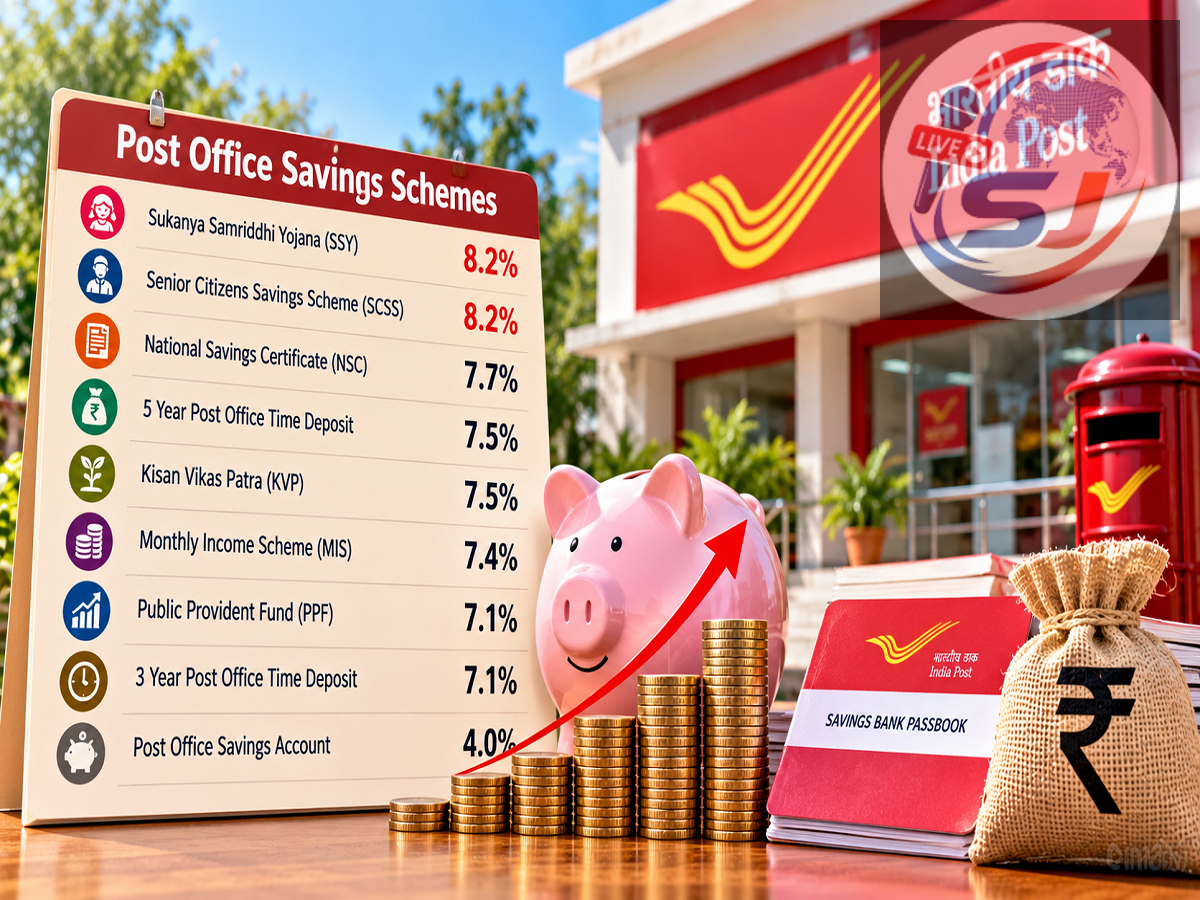
Post Office Small Savings Interest Rates: Investors looking for government-backed savings options have several choices available through Post Office schemes, ranging from regular savings accounts and fixed deposits to long-term plans such as the Public Provident Fund (PPF) and Sukanya Samriddhi Yojana (SSY).
For the October-December 2026 quarter (Q3 FY 2026-27), the government has kept interest rates on small savings schemes unchanged. Depending on the scheme, investors can currently earn interest ranging from 4% to 8.2% per annum.
Some schemes focus on regular income, while others are designed for retirement, children's financial goals or long-term wealth accumulation. Tax treatment, investment limits and maturity periods also differ considerably.
Here is a closer look at nine popular Post Office savings options and their key features.
1. Post Office Savings Account – 4% Interest
The Post Office Savings Account is one of the simplest options for people looking for a basic government-backed savings facility.
The account currently offers an interest rate of 4% per annum.
An account can be opened with a minimum amount of ₹500, while there is no prescribed maximum balance limit.
Eligible taxpayers can also claim tax benefits on savings-account interest under applicable provisions of the Income Tax Act. The benefit depends on the taxpayer's category and the tax regime and provisions applicable to them.
2. Post Office Time Deposit – Up to 7.5%
Post Office Time Deposit works in a manner similar to a bank fixed deposit. Investors can select different maturity periods depending on their financial requirements.
The applicable annual interest rates are:
1-year Time Deposit: 6.9%
2-year Time Deposit: 7.0%
3-year Time Deposit: 7.1%
5-year Time Deposit: 7.5%
The minimum investment is ₹1,000.
Among these options, the five-year Post Office Time Deposit qualifies for tax benefits under Section 80C, subject to the applicable overall deduction limit and tax rules.
3. Post Office 5-Year Recurring Deposit – 6.7%
For investors who prefer saving a fixed amount every month instead of investing a large lump sum, the Post Office Recurring Deposit (RD) is another option.
The five-year RD currently carries an annual interest rate of 6.7%, compounded quarterly.
Customers can begin with as little as ₹100 per month.
For example, someone depositing ₹5,000 every month would contribute a total of ₹3 lakh over five years. Based on the assumed rate and calculation in the example, the maturity value could be around ₹3.57 lakh, though the actual amount should be verified using the applicable Post Office calculation method.
The scheme also provides a loan facility subject to prescribed conditions after the account has completed the required period.
4. Post Office Monthly Income Scheme – 7.4%
The Post Office Monthly Income Scheme (POMIS) is designed for investors seeking regular income from a lump-sum investment.
It currently offers 7.4% annual interest, which is paid monthly. The scheme has a maturity period of five years.
The maximum investment is ₹9 lakh for an individual account and ₹15 lakh for a joint account.
At a 7.4% annual rate, a ₹9 lakh investment generates interest of around ₹5,550 per month. A ₹15 lakh investment would generate approximately ₹9,250 per month, subject to scheme rules.
5. Senior Citizen Savings Scheme – 8.2%
The Senior Citizen Savings Scheme (SCSS) is among the highest-interest government-backed small savings options.
It currently offers 8.2% per annum, with interest generally paid quarterly.
Eligible senior citizens can invest from ₹1,000 up to ₹30 lakh. The standard maturity period is five years, subject to the extension rules available under the scheme.
If ₹30 lakh is invested at an annual rate of 8.2%, the annual interest works out to ₹2.46 lakh, equivalent to ₹61,500 per quarter.
Eligible investments can also qualify for Section 80C benefits, subject to prevailing tax rules and limits.
6. Sukanya Samriddhi Yojana – 8.2%
Sukanya Samriddhi Yojana is specifically designed to help families build a long-term financial corpus for a girl child.
The scheme currently offers 8.2% annual interest with annual compounding.
An account can generally be opened for an eligible girl child before she reaches the prescribed age limit. Annual deposits can range from ₹250 to ₹1.5 lakh.
If the maximum ₹1.5 lakh is invested every year for 15 years and the current interest rate is assumed throughout the calculation, the maturity corpus can reach roughly ₹69.8 lakh over the scheme's full tenure.
Actual maturity proceeds will depend on the interest rates declared by the government during future quarters.
The scheme also offers tax advantages under the applicable provisions, making it a popular long-term savings option for eligible families.
7. National Savings Certificate – 7.7%
The National Savings Certificate (NSC) currently offers an annual interest rate of 7.7%, compounded annually and payable according to the scheme's maturity rules.
Its maturity period is five years.
For illustration, an investment of ₹1 lakh at the stated rate can grow to approximately ₹1.45 lakh after five years, subject to the official calculation method.
Eligible NSC investments can qualify for a deduction under Section 80C within the applicable overall limit.
8. Public Provident Fund – 7.1%
Public Provident Fund remains one of India's best-known long-term small savings schemes.
PPF currently carries an interest rate of 7.1% per annum, with interest compounded annually.
The standard tenure is 15 years, after which the account can be extended in blocks of five years under applicable rules.
Investors need to contribute at least ₹500 per financial year, while the maximum permitted annual investment is ₹1.5 lakh.
If an investor contributes ₹1.5 lakh every year for 15 years, the total principal contribution would be ₹22.5 lakh. Assuming the current 7.1% rate for the entire period, the maturity corpus could be around ₹40.68 lakh, depending on the timing of deposits and applicable interest calculations.
PPF also carries significant tax benefits under prevailing rules.
9. Kisan Vikas Patra – 7.5%
Kisan Vikas Patra (KVP) is designed for investors looking for a long-term government-backed savings instrument with a predetermined maturity structure.
The scheme currently offers 7.5% annual interest.
At this rate, the invested amount doubles over the prescribed maturity period of approximately 115 months, or 9 years and 7 months.
For example, an investment of ₹1 lakh would become ₹2 lakh at maturity, provided the applicable terms remain satisfied.
KVP also has premature-closure rules, and investors should check the official conditions before investing if they may require access to their money before maturity.
Which Post Office Scheme Offers the Highest Interest?
Among the schemes listed above, Senior Citizen Savings Scheme and Sukanya Samriddhi Yojana currently offer 8.2% per annum, while NSC offers 7.7% and the five-year Post Office Time Deposit and KVP offer 7.5%.
However, the highest interest rate alone does not determine which scheme is suitable for a particular investor.
SCSS is primarily meant for eligible senior citizens, while SSY is designed for a girl child's long-term financial needs. POMIS focuses on monthly income, whereas PPF is structured for long-term savings. Post Office RD, meanwhile, may suit people who prefer regular monthly contributions.
Investors should therefore compare eligibility, maturity period, liquidity, tax treatment, deposit limits and interest-payment structure before selecting a scheme.
Disclaimer: This article is for informational purposes only and should not be treated as personalised financial or tax advice. Interest rates and tax provisions can change. Investors should verify the latest rules and rates from official sources and consider their financial circumstances before investing.