
Post Office Scheme: Save ₹200 Daily and Build Over ₹4.28 Lakh—Check Interest and Maturity Calculation
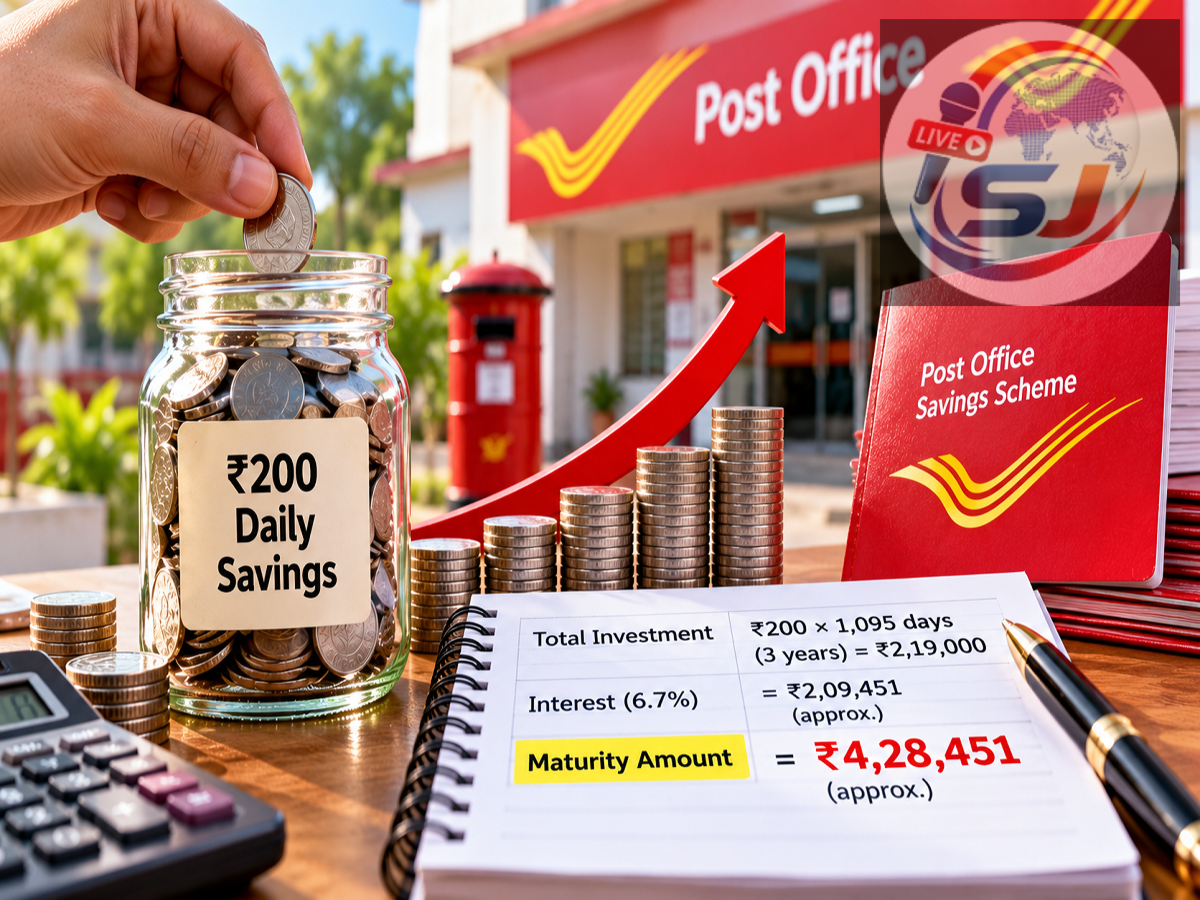
Post Office Savings Scheme 2026: Saving a small amount regularly can eventually create a sizeable corpus, and Post Office savings schemes remain a popular choice among people looking for government-backed investment options. One such option can help an investor build a corpus of more than ₹4.28 lakh by setting aside the equivalent of just ₹200 every day.
The scheme in focus offers an annual interest rate of 6.7%, according to the information provided. Instead of actually depositing money every day, an investor can convert the daily savings target into a monthly amount and make regular deposits according to the scheme's rules.
At ₹200 a day, the savings work out to roughly ₹6,000 per month. Over five years, the investor contributes ₹3.60 lakh from their own pocket. Interest earned over the investment period can then push the maturity corpus beyond ₹4.28 lakh.
Here's how the calculation works and what investors should understand before opening an account.
₹200 Daily Saving: How Much Will You Invest?
The first step is to convert the daily savings amount into a monthly contribution.
If you put aside ₹200 every day, the approximate monthly saving comes to:
₹200 × 30 days = ₹6,000 per month
Over one year, that amounts to approximately ₹72,000.
If the same saving habit is continued for five years, the total amount contributed becomes:
₹6,000 × 60 months = ₹3,60,000
The final corpus is higher because the deposits earn interest during the investment period.
How ₹3.60 Lakh Can Grow Beyond ₹4.28 Lakh
At an annual interest rate of 6.7%, regular monthly contributions can accumulate interest over time.
Based on the cited calculation, an investor saving approximately ₹6,000 every month for five years can build a maturity amount of around ₹4.28 lakh or more, depending on the precise deposit dates and interest-calculation rules.
| Particulars | Approximate Amount |
|---|---|
| Daily Saving Target | ₹200 |
| Monthly Deposit | ₹6,000 |
| Annual Contribution | ₹72,000 |
| Total Deposit in 5 Years | ₹3,60,000 |
| Interest Rate | 6.7% per annum |
| Approximate Maturity Corpus | Over ₹4.28 lakh |
The difference between the ₹3.60 lakh deposited and the final maturity value represents the interest accumulated over the five-year period.
The exact maturity amount can vary slightly according to the scheme's official interest calculation and the timing of monthly deposits.
Which Post Office Scheme Offers 6.7%?
The calculation relates to the Post Office 5-Year Recurring Deposit Account, commonly known as the Post Office RD.
A recurring deposit is designed for people who want to invest a fixed amount every month rather than putting a large lump sum into an account at once.
This makes it suitable for salaried individuals and other savers who prefer building their corpus gradually.
Instead of thinking about a ₹6,000 monthly commitment, someone can treat it as a daily savings target of ₹200 and set aside that amount from regular income.
Why Compounding Makes a Difference
The key reason ₹3.60 lakh in contributions can grow beyond ₹4 lakh is the interest accumulated on the deposits.
With an RD, each monthly instalment gets a different amount of time to earn interest. Money deposited early in the five-year period has more time to accumulate returns than deposits made near maturity.
This is why the calculation is different from simply applying 6.7% interest to ₹3.60 lakh for five full years. The entire ₹3.60 lakh is not deposited on the first day; it is contributed gradually through monthly instalments.
Small Daily Savings Can Become a Large Corpus
A ₹200 daily target may appear modest, but consistency changes the calculation considerably.
Saving ₹200 for one day gives you only ₹200. Maintaining the habit for approximately one month produces ₹6,000, while continuing for a year takes the contribution to around ₹72,000.
Over five years, regular monthly deposits total ₹3.60 lakh even before interest is considered.
This demonstrates why recurring deposits are often used for medium-term financial goals such as building an education fund, planning a major purchase or accumulating general savings.
Government-Backed Savings Option
Post Office small-savings schemes are backed by the Government of India, which is an important reason conservative savers consider them.
Unlike equity investments, returns on a Post Office RD do not depend directly on daily stock-market movements.
However, investors should not compare an RD and equity-oriented investments purely on the basis of risk. They serve different financial objectives and have different return characteristics.
The interest rate on Post Office small-savings schemes is also subject to periodic review by the government.
Don't Forget the Monthly Deposit Commitment
The ₹200 figure is best understood as a daily savings equivalent, not necessarily as a requirement to visit the Post Office and deposit ₹200 every day.
The RD operates through regular instalments according to its account rules.
Someone targeting ₹200 per day would therefore need to manage the money so that the required monthly instalment—approximately ₹6,000 in this example—is available on time.
Missing instalments can be subject to the rules applicable to the RD account, so consistency remains important.
Check the Latest Rate Before Opening the Account
The 6.7% rate used in this calculation is the stated interest rate for the scheme. Small-savings rates can be reviewed by the government periodically, so new investors should confirm the prevailing rate before opening an account.
The rate applicable to an existing deposit is governed by the relevant scheme rules.
Investors should also understand premature closure, missed instalment, maturity and extension provisions before committing to the five-year savings plan.
₹200 a Day Can Add Up Over Five Years
The biggest lesson from this calculation is the impact of disciplined saving.
Setting aside ₹200 per day is equivalent to roughly ₹6,000 per month. Maintaining that level for five years means contributing about ₹3.60 lakh.
With interest at the cited 6.7% annual rate, the corpus can rise to approximately ₹4.28 lakh or more, depending on the precise interest calculation.
For investors who want predictable, government-backed savings and prefer monthly contributions over a lump-sum investment, the Post Office Recurring Deposit can therefore be an option worth understanding.
Disclaimer: This article is intended only for informational purposes and does not constitute investment advice. Post Office small-savings interest rates are subject to government review. Maturity figures are illustrative and may vary depending on deposit dates and applicable calculation rules. Verify the latest interest rate and scheme conditions through official India Post or government sources before investing.