
Post Office RD Scheme 2026: Invest ₹6,000 Monthly and Get Around ₹4.28 Lakh in 5 Years, Check Calculation
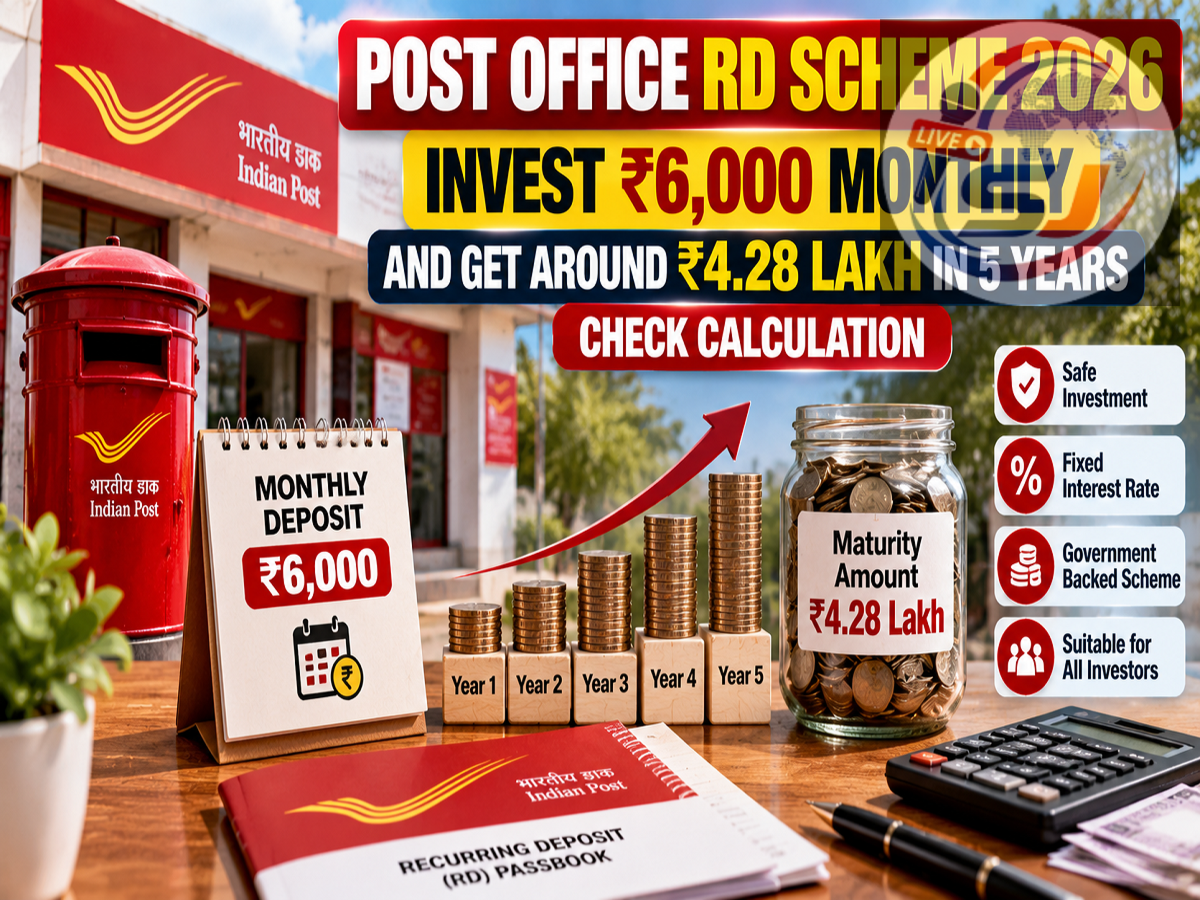
Post Office Recurring Deposit Scheme 2026: Building a substantial savings fund does not always require a large one-time investment. Setting aside a fixed amount every month can help individuals gradually accumulate money for future financial goals.
For people looking for a government-backed savings option that is not directly affected by stock market fluctuations, the Post Office Recurring Deposit (RD) Scheme may be worth considering.
Under this scheme, investors deposit a fixed amount every month for five years. With a monthly contribution of ₹6,000, the total deposit over 60 months reaches ₹3.60 lakh.
At an assumed annual interest rate of 6.7%, compounded quarterly, the maturity value could be approximately ₹4.28 lakh, including around ₹68,000 in interest.
The final amount depends on the applicable interest rate, deposit timing and scheme rules.
Post Office RD: How Much Will ₹6,000 Monthly Grow in Five Years?
Suppose an investor opens a Post Office RD account and deposits ₹6,000 every month without missing an instalment.
The calculation begins with the total amount contributed over five years.
Illustrative five-year investment
Monthly deposit
₹6,000
Total deposits
₹3,60,000
Estimated interest
₹68,000
Estimated maturity
₹4,28,000
Deposits: 84.1%
Interest: 15.9%
Rounded estimate based on 6.7% annual interest with quarterly compounding. Not an independently verified official maturity quotation.
The investor contributes ₹3.60 lakh from personal savings, while the remaining amount comes from accumulated interest.
Unlike a lump-sum fixed deposit, an RD earns interest on each monthly instalment for the period that instalment remains invested.
Consequently, the first deposit earns interest for longer than the final deposit.
What Is the Post Office Recurring Deposit Scheme?
The Post Office RD is a small savings scheme designed to encourage regular monthly deposits.
The account normally runs for five years, equivalent to 60 monthly instalments.
Investors select a monthly deposit amount when opening the account and continue contributing according to the scheme's payment schedule.
Its main features include a fixed deposit period, quarterly interest compounding and a low minimum monthly contribution.
The scheme is supported by the Government of India, making it different from market-linked investments such as equity mutual funds.
However, investors should still consider inflation, liquidity restrictions and taxation when evaluating their returns.
Minimum and Maximum Deposit Limits
The Post Office RD Scheme allows individuals to begin saving with a relatively small monthly amount.
The minimum monthly deposit is ₹100, with additional deposits permitted in multiples of ₹10.
There is no prescribed maximum monthly deposit limit.
This flexibility makes the scheme accessible to investors with different income levels.
For example, someone may choose ₹500 per month, while another investor may be comfortable contributing ₹6,000 or ₹10,000.
The important consideration is whether the selected monthly instalment can be maintained consistently throughout the five-year term.
Post Office RD Calculator: Compare Monthly Savings
The following interactive calculator uses an illustrative annual interest rate of 6.7% and quarterly compounding to estimate the value of 60 monthly deposits.
Monthly RD deposit (₹)
Assumed annual interest rate
6.7%
Total amount deposited
₹3,60,000
Estimated maturity value
₹4,28,195
Estimated interest earned
₹68,195
Illustrative calculation only. Official RD maturity calculations depend on the applicable rate, deposit dates and rounding conventions. Taxes are not deducted.
How Much Can Different Monthly Deposits Generate?
Using a 6.7% annual interest assumption, the approximate results for different monthly deposits are:
| Monthly Deposit |
Total Investment in 5 Years |
Approximate Maturity Value |
|---|---|---|
| ₹500 |
₹30,000 |
₹35,700 |
| ₹1,000 |
₹60,000 |
₹71,400 |
| ₹2,000 |
₹1,20,000 |
₹1,42,800 |
| ₹3,000 |
₹1,80,000 |
₹2,14,200 |
| ₹5,000 |
₹3,00,000 |
₹3,57,000 |
| ₹6,000 |
₹3,60,000 |
₹4,28,400 |
| ₹10,000 |
₹6,00,000 |
₹7,14,000 |
These are rounded estimates. They are not guaranteed quotations for accounts opened at different interest rates.
What Happens If You Miss an RD Instalment?
Regular monthly deposits are an important requirement of the Post Office RD Scheme.
If an account holder fails to deposit an instalment by the prescribed deadline, a default charge may apply.
Repeated missed payments can also affect the account's status.
Under the applicable scheme rules, account holders may be allowed to regularise defaults by paying the overdue instalments and relevant charges.
However, the permitted number of defaults and the procedure for restoring an account are governed by Post Office rules.
Investors should therefore select a contribution that comfortably fits their monthly budget.
Can You Withdraw Post Office RD Money Before Five Years?
The Post Office RD Scheme is intended for a five-year savings period, but premature closure may be permitted under specified conditions.
Generally, an RD account may be closed prematurely after completing three years, subject to the applicable rules.
However, the interest payable on premature closure can be lower than the amount that would have been earned by maintaining the account until maturity.
The scheme also provides a loan facility against the RD balance after meeting prescribed eligibility conditions.
Because premature closure and borrowing involve restrictions, investors should review the latest rules before using the scheme for money that may be required at short notice.
Is Post Office RD Better Than a Bank FD?
Both recurring deposits and fixed deposits can help investors save money without direct stock market exposure, but they serve different purposes.
| Feature |
Post Office RD |
Bank Fixed Deposit |
|---|---|---|
| Deposit pattern |
Fixed monthly instalments |
Usually a lump-sum deposit |
| Standard tenure |
5 years |
Varies by bank and product |
| Interest |
Government-notified small savings rate |
Rate offered by the bank |
| Compounding |
Quarterly |
Depends on FD type |
| Premature withdrawal |
Subject to scheme restrictions |
Subject to bank rules |
| Suitable for |
Building savings gradually |
Investing an existing lump sum |
A Post Office RD may be more convenient for someone who receives a monthly salary and wants to save a fixed amount regularly.
A bank FD may be more suitable for an individual who already has a lump sum available.
Neither option should be selected solely on the basis of the advertised interest rate.
Is Post Office RD Interest Taxable?
Interest earned on a Post Office Recurring Deposit is generally taxable according to the investor's applicable income-tax rules.
The exact tax liability depends on total income, the applicable tax regime and other relevant provisions.
Investors should not assume that the entire interest earned from the scheme is automatically tax-free.
Tax treatment can affect the effective return, particularly for individuals in higher income-tax brackets.
Who Should Consider a Post Office RD?
The scheme may be useful for salaried employees, small business owners and other individuals who want to build savings through regular contributions.
It can also help people prepare for planned expenses, such as education costs, family events or a future purchase.
However, investors should maintain a separate emergency fund before committing money to a product with withdrawal restrictions.
The RD scheme may be less suitable for those seeking high long-term growth or requiring immediate access to their savings.
Post Office RD Scheme 2026: Final Takeaway
The Post Office Recurring Deposit Scheme offers a structured way to accumulate savings over five years.
By depositing ₹6,000 every month, an investor contributes ₹3.60 lakh over 60 months.
At an assumed annual interest rate of 6.7%, the estimated maturity amount is around ₹4.28 lakh, including approximately ₹68,000 in interest.
The main advantage is disciplined saving through manageable monthly instalments rather than the need for a large initial investment.
Before opening an account, investors should verify the officially notified interest rate for the relevant quarter, understand premature withdrawal conditions and consider the tax implications.
Disclaimer: All maturity figures are illustrative and based on an assumed annual interest rate of 6.7%. Actual returns depend on the interest rate applicable when the account is opened, deposit timing and official Post Office RD rules.