
Post Office KVP Scheme: How ₹5 Lakh Can Grow to ₹10 Lakh With Government-Backed Returns
Investors looking for relatively predictable returns without exposure to stock-market volatility often consider government-backed small savings schemes. One such option is Kisan Vikas Patra (KVP), available through post offices across India.
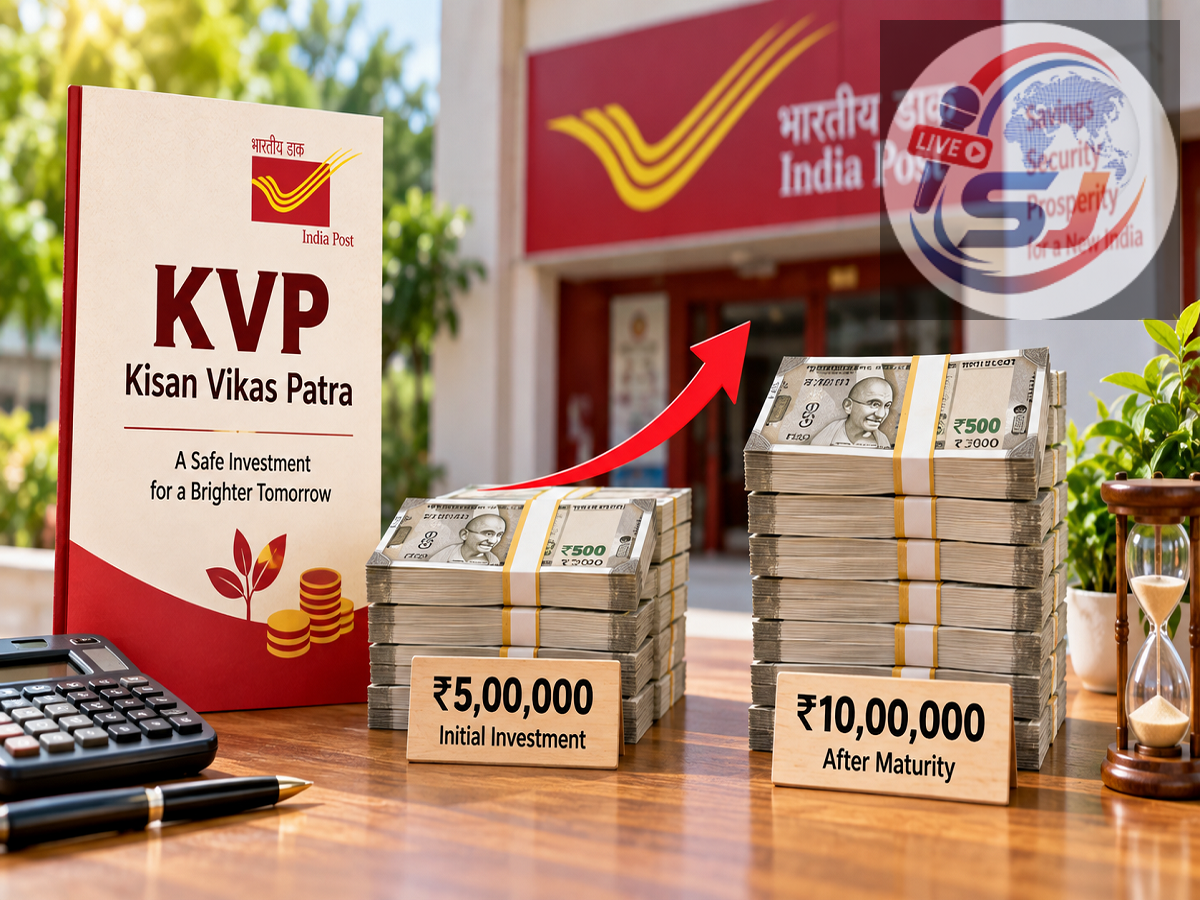
The biggest attraction of KVP is its straightforward structure: money invested in the scheme grows at a government-notified interest rate, and at the current rate, the investment is designed to double over its maturity period. For example, an investment of ₹5 lakh would become ₹10 lakh at maturity, subject to the interest rate and maturity period applicable when the account is opened.
KVP is particularly relevant for investors who prefer capital security and can keep their money invested for several years. However, before investing, it is important to understand the interest rate, maturity period, taxation and premature-withdrawal conditions rather than choosing the scheme only because of its “money doubling” feature.
What Is Kisan Vikas Patra?
Kisan Vikas Patra is a small savings scheme backed by the Government of India. Despite the word “Kisan” in its name, the scheme is not restricted to farmers. Eligible individuals can invest in KVP through designated post offices.
The government reviews interest rates on small savings schemes every quarter. For the July-September 2026 quarter, KVP carries an annual interest rate of 7.5%, compounded annually, according to the rates notified for small savings schemes.
At this rate, the invested amount doubles in approximately 115 months, or 9 years and 7 months.
This means investors should consider the interest rate applicable at the time they purchase KVP, as rates notified for new investments may change in future quarters.
How ₹5 Lakh Can Become ₹10 Lakh
The calculation is simple for someone investing ₹5 lakh at the current applicable KVP terms.
An investment of ₹5,00,000 would grow to approximately ₹10,00,000 at maturity after the prescribed doubling period. Similarly, ₹1 lakh would become ₹2 lakh, while ₹10 lakh would grow to ₹20 lakh, provided the investments are held until their respective maturity dates under the applicable terms.
| Initial Investment | Amount at Maturity |
|---|---|
| ₹1 lakh | ₹2 lakh |
| ₹2 lakh | ₹4 lakh |
| ₹5 lakh | ₹10 lakh |
| ₹10 lakh | ₹20 lakh |
The doubling does not happen through a special bonus. It results from the compounding of interest over the scheme’s maturity period.
Is There a Maximum Investment Limit?
KVP has a relatively accessible entry point. An account can be opened with a minimum investment of ₹1,000, and additional investments can generally be made in multiples of ₹100.
There is no prescribed maximum investment ceiling under the scheme. This makes KVP an option for people looking to invest larger lump-sum amounts in a government-backed savings product.
However, investors should remember that larger investments may be subject to documentation requirements. Investment in KVP should also be made from legitimate, properly accounted-for income, and applicable KYC requirements must be completed.
Who Can Open a KVP Account?
An adult Indian resident can open a KVP account individually. The scheme also permits joint accounts, subject to the applicable rules.
An adult can open an account on behalf of a minor, while eligible minors above the prescribed age may also be permitted to hold an account in their own name under the small savings rules.
This flexibility can make KVP useful for families saving toward long-term financial requirements, provided the investment horizon matches the scheme’s maturity structure.
Can You Withdraw KVP Money Before Maturity?
Although KVP is designed as a long-term investment, premature closure is permitted in specified circumstances.
In general, the scheme has a lock-in period of two years and six months. After this period, premature closure can be allowed according to the applicable rules and the amount payable will depend on how long the investment has been held.
There are also certain exceptional circumstances under which premature closure may be permitted earlier, such as the death of an account holder in eligible cases or pursuant to an order by a court.
Investors who may need immediate access to their savings should therefore examine the withdrawal conditions carefully before putting a large amount into KVP.
Is KVP Interest Tax-Free?
This is one area where investors need to be careful.
KVP should not be confused with tax-saving products such as the Public Provident Fund (PPF). Interest earned on KVP is taxable according to the investor’s applicable income-tax rules.
Investment in KVP also does not generally provide the Section 80C tax deduction that is available with certain other eligible savings products.
Therefore, the maturity amount may look attractive, but investors should evaluate the post-tax return based on their individual tax position.
Why Do Conservative Investors Consider KVP?
KVP’s appeal comes from its combination of government backing, a predetermined maturity structure and the absence of direct stock-market exposure.
Unlike equity or market-linked mutual funds, KVP returns do not fluctuate daily with financial markets. The interest rate applicable to the investment determines how the money grows over the specified period.
That does not mean KVP is automatically suitable for every investor. Someone seeking higher long-term growth and willing to accept market risk may consider other investment categories, while a person requiring regular income may prefer a product specifically designed for periodic payouts.
KVP is primarily suited to investors who value predictability and can leave a lump-sum investment untouched for a relatively long period.
What to Check Before Investing
Before opening a Kisan Vikas Patra account, investors should verify the latest interest rate and maturity period through India Post or the government’s small-savings notification, because these rates are reviewed quarterly.
At the current 7.5% annual rate, KVP offers a simple proposition: an eligible investment can double over approximately 115 months. Thus, ₹5 lakh can grow to ₹10 lakh if held until maturity under the applicable terms.
The government backing makes KVP a relatively low-credit-risk savings option, but investors should still consider liquidity requirements, taxation and their overall financial goals before committing money for nearly a decade.