
Post Office FD: What ₹5 Lakh Can Grow to in 1, 3 and 5 Years at Current Interest Rates
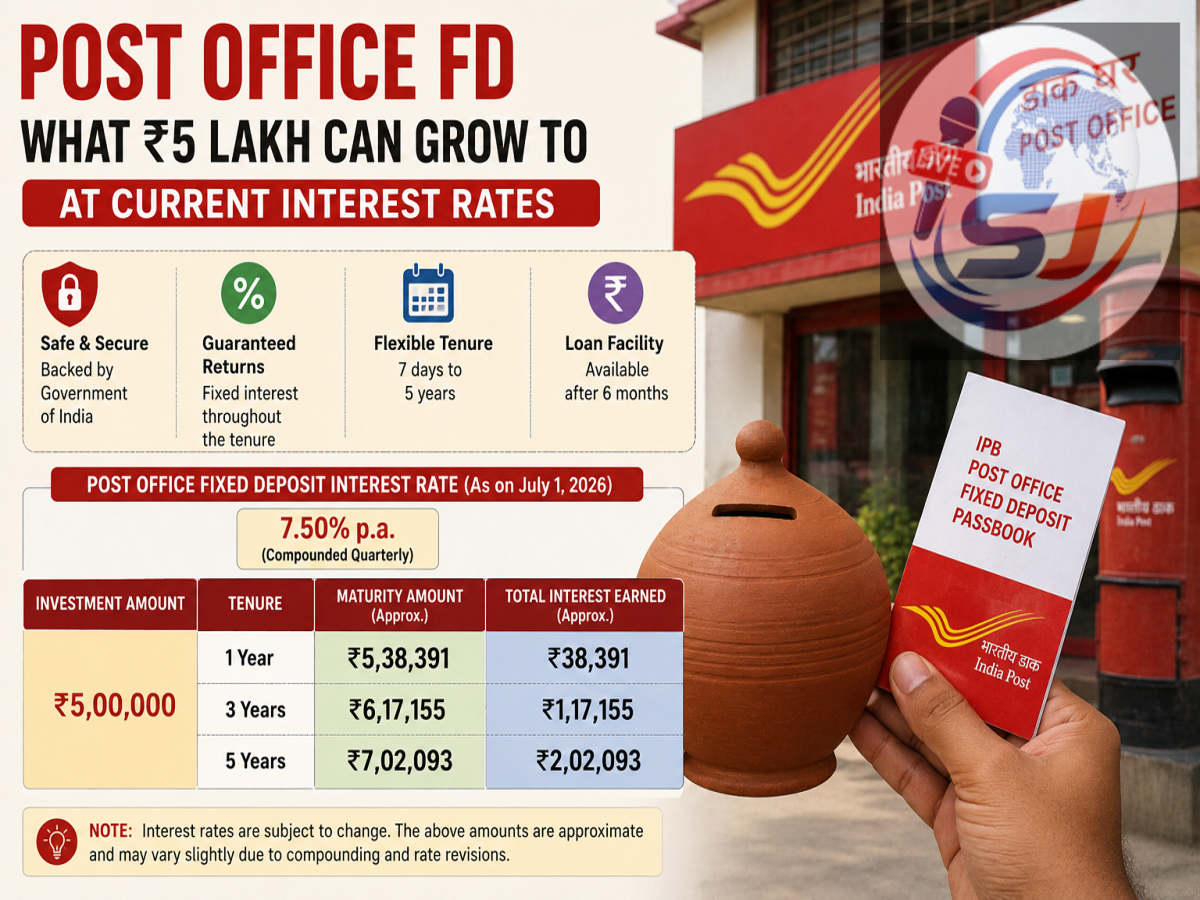
For investors looking for a government-backed savings option with predictable returns, the Post Office Time Deposit Account remains a popular choice. Often referred to as the Post Office FD, the scheme allows investors to lock in money for different periods and earn interest at a predetermined rate.
A lump-sum investment of ₹5 lakh, for example, can generate a sizeable interest income depending on whether the money is kept for one year, three years or five years.
The longer tenure can be particularly attractive because the five-year Post Office Time Deposit offers a higher interest rate and also qualifies for tax benefits under Section 80C of the Income Tax Act, subject to applicable tax rules.
So, how much could ₹5 lakh become at maturity? Here is a closer look at the calculations.
What Is a Post Office Time Deposit?
The Post Office Time Deposit is a small-savings scheme that works broadly like a fixed deposit offered by a bank.
An investor deposits a lump sum for a predetermined tenure and earns interest according to the rate applicable when the account is opened.
Time Deposit accounts are available for four different maturity periods:
-
1 year
-
2 years
-
3 years
-
5 years
The interest rate differs according to the selected tenure. Since the scheme operates within the government's small-savings framework, it appeals particularly to conservative investors who prioritize capital safety and predictable returns.
₹5 Lakh Investment for One Year
Suppose an investor deposits ₹5,00,000 in a one-year Post Office Time Deposit.
At an annual interest rate of around 6.9%, the investment could generate approximately ₹35,000 in interest over the period, subject to the scheme's applicable interest calculation method.
This means the overall value attributable to the principal and interest would be around:
Initial investment: ₹5,00,000
Approximate interest: ₹35,000
Approximate value after one year: ₹5.35 lakh
The one-year option may suit investors who do not want to lock their money away for an extended period but still want a fixed return.
What Could ₹5 Lakh Become in Three Years?
The three-year Post Office Time Deposit carries a comparatively higher interest rate.
At an annual rate of around 7.1%, ₹5 lakh invested for three years can accumulate significantly more interest than the one-year option.
With quarterly compounding taken into account, the investment could grow to approximately ₹6.17 lakh by the end of three years.
That would mean an overall interest gain of roughly:
Investment amount: ₹5,00,000
Estimated interest earned: around ₹1.17 lakh
Estimated maturity value: around ₹6.17 lakh
Actual maturity proceeds should be confirmed using the applicable Post Office calculation because interest treatment and rounding can affect the final amount.
Five-Year Post Office FD Can Generate a Bigger Return
The five-year Time Deposit currently offers one of the more attractive rates within the Post Office TD structure.
At an annual interest rate of approximately 7.5%, a ₹5 lakh investment held for five years could grow to roughly ₹7.25 lakh, based on quarterly compounding.
The calculation works out approximately as follows:
Principal: ₹5,00,000
Estimated interest: around ₹2.25 lakh
Estimated maturity value: around ₹7.25 lakh
In other words, simply keeping ₹5 lakh invested for the full five-year tenure could potentially generate more than ₹2 lakh in interest.
This illustrates the impact that a longer investment period and compounding can have on fixed-income returns.
₹5 Lakh Post Office FD: Comparing 1, 3 and 5 Years
The difference becomes easier to understand when the three tenures are compared.
| Investment Period | Approx. Interest Rate | Initial Investment | Approx. Value |
|---|---|---|---|
| 1 Year | 6.9% | ₹5,00,000 | ₹5.35 lakh |
| 3 Years | 7.1% | ₹5,00,000 | ₹6.17 lakh |
| 5 Years | 7.5% | ₹5,00,000 | ₹7.25 lakh |
These are indicative calculations based on the stated interest rates. The exact amount received should be verified at the time of investment.
Five-Year Deposit Offers an Additional Tax Advantage
Another important feature separates the five-year Post Office Time Deposit from shorter tenures.
Investment in a qualifying five-year Time Deposit can be eligible for deduction under Section 80C, subject to the overall annual limit and applicable income-tax regime and rules.
The shorter one-, two- and three-year Time Deposits do not receive the same Section 80C treatment.
This means the five-year option can potentially serve two purposes for eligible taxpayers: building savings through fixed returns and providing a tax deduction on the qualifying investment.
However, the interest earned is not automatically tax-free. Investors should consider their individual tax position before making a decision.
Why Investors Consider Post Office Fixed Deposits
One of the biggest attractions of Post Office savings products is their government backing.
Unlike market-linked investments, returns on a Time Deposit do not fluctuate daily with stock-market movements. The applicable interest rate is known when the investment is made, providing greater predictability.
This can make the scheme suitable for conservative investors, retirees or individuals who want a fixed-income component in their portfolio.
However, predictable returns come with a trade-off. Fixed deposits generally do not offer the same long-term growth potential as equity-based investments, and inflation can reduce the purchasing power of the returns over time.
Interest Rates Can Change for New Investments
Investors should remember that small-savings interest rates are reviewed periodically by the government.
Therefore, rates available for a new Post Office Time Deposit in a future quarter may be different from those available today.
Once an account is opened, the rate applicable to that deposit is generally determined according to the scheme's prevailing rules. Investors planning to put a substantial amount into the scheme should verify the latest rate before opening the account.
Is a Five-Year Post Office FD Worth Considering?
For someone investing ₹5 lakh, choosing the tenure depends largely on when the money will be needed.
A one-year deposit provides greater flexibility and a shorter commitment. A three-year deposit offers more time for the investment to accumulate interest, while the five-year option provides a higher rate under the figures considered here and can generate a substantially larger total return.
At approximately 7.5%, ₹5 lakh could grow to around ₹7.25 lakh over five years, producing roughly ₹2.25 lakh in interest.
Investors should nevertheless consider liquidity requirements, taxation, inflation and alternative investment opportunities before locking money away for several years.
For people seeking a relatively simple, government-backed investment with predictable returns, the Post Office Time Deposit remains an option worth evaluating.