
PMAY-G 2026: Rural Families Can Get Help for a Pucca House, Check Eligibility, Gram Sabha Process and List
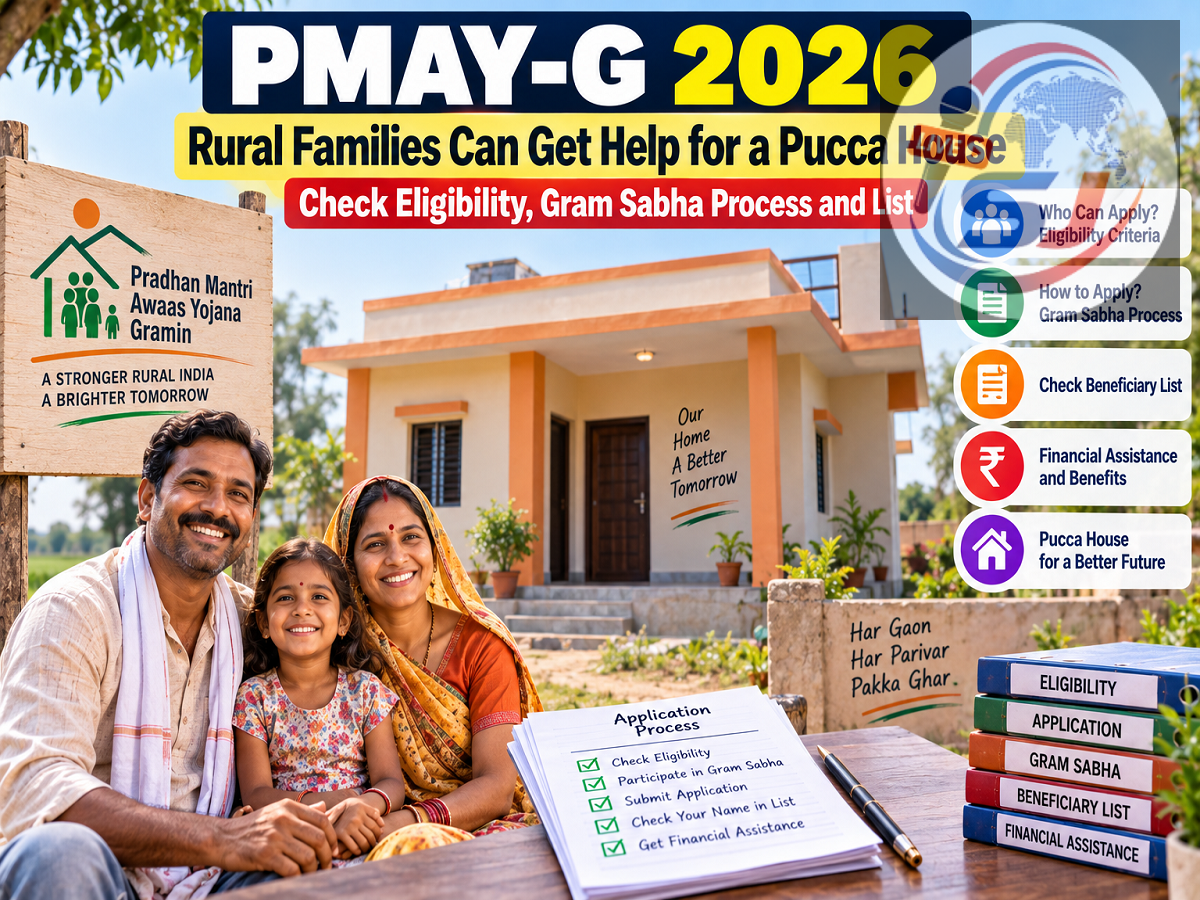
For families living in rural India without a permanent house, the Pradhan Mantri Awaas Yojana-Gramin (PMAY-G) provides financial assistance for constructing a pucca home, subject to eligibility and verification.
The scheme is primarily intended for eligible houseless rural households and families living in inadequate kutcha housing. Financial assistance is released through the prescribed government process and transferred to beneficiaries through Direct Benefit Transfer (DBT).
However, PMAY-G should not be treated as a scheme where anyone can simply submit an online form and automatically receive money. Identification, survey data, eligibility conditions, local verification and the Gram Sabha process play an important role in determining beneficiaries.
Here is what rural households should know about PMAY-G assistance, eligibility, documents and checking the beneficiary list.
How Much Financial Assistance Is Available Under PMAY-G?
The level of housing assistance depends on the geographical category of the area.
Under the scheme structure, eligible beneficiaries in plain areas can receive ₹1.20 lakh for construction of a house.
For eligible beneficiaries in hilly states, difficult areas and specified regions, the housing assistance can be ₹1.30 lakh.
The money is generally released in instalments linked to different stages of construction rather than being paid as one lump sum at the beginning.
The exact number and timing of instalments can depend on implementation arrangements followed by the state or Union Territory.
PMAY-G Benefit Can Be Combined With Other Support
Housing assistance is not necessarily the only government support available to an eligible PMAY-G beneficiary.
The programme provides for convergence with other government schemes.
Eligible households can receive assistance for construction of a toilet through the applicable sanitation programme, including convergence with the Swachh Bharat Mission-Gramin (SBM-G).
Beneficiaries may also receive wage support for house construction through MGNREGS, subject to applicable rules.
Other facilities such as electricity, drinking water and LPG may be provided through convergence with relevant government schemes where the beneficiary satisfies their respective eligibility conditions.
This does not mean every PMAY-G beneficiary automatically receives every other benefit. Each linked scheme has its own conditions.
Who Can Get a House Under PMAY-G?
PMAY-G is designed to prioritise households that genuinely need housing support.
Broadly, eligible beneficiaries include rural families that are houseless or live in specified inadequate kutcha housing and satisfy the scheme's selection criteria.
Identification has historically been linked to deprivation and housing information from government datasets, followed by verification and prioritisation through the prescribed process.
Eligibility is therefore not determined simply by submitting Aadhaar and bank details.
The household must satisfy the applicable PMAY-G criteria and must not fall under specified exclusion conditions.
Some Households Can Be Excluded
PMAY-G contains exclusion criteria intended to prevent relatively better-off households from receiving assistance meant for poorer rural families.
Factors considered under the applicable framework can include ownership of specified motorised vehicles or agricultural equipment, government employment, income-tax status and other indicators of economic status.
The detailed eligibility and exclusion rules should be checked against the current PMAY-G guidelines because individual circumstances can differ.
Having one particular asset does not always allow a conclusion to be drawn without considering the exact scheme provision applicable to that household.
Gram Sabha Plays an Important Role
The Gram Sabha is an important part of the beneficiary-selection and verification process.
Potential beneficiaries are identified and prioritised according to the prescribed PMAY-G procedure. The list is then subject to verification at the local level.
This helps determine whether the household actually meets the housing and eligibility criteria.
Residents who believe they are eligible but whose names are missing should contact their Gram Panchayat, Panchayat Secretary, Block Development Office or the designated rural housing official to understand the applicable survey, verification or grievance procedure.
Merely asking the village head to add a name does not automatically make a household eligible for PMAY-G assistance.
Can You Apply for PMAY-G Online Yourself?
This is an area where misleading information is common.
PMAY-G does not work like many commercial services where any person can visit a website, complete a public application form and immediately register themselves as an approved beneficiary.
Beneficiary identification and registration are carried out through the authorised government process.
Where a survey or self-survey facility is officially opened for identifying additional eligible households, residents should use only the government-approved platform or obtain assistance from authorised local officials.
People should be cautious of websites or agents promising a guaranteed PMAY-G house in exchange for money.
What Documents May Be Required?
Documents and information required can vary according to the stage of verification, but beneficiaries may be asked to provide identification and banking details.
These can include Aadhaar details, bank-account information and MGNREGA job-card information, where applicable.
A mobile number and other household details may also be required.
Officials may verify the existing housing condition as part of the beneficiary-selection and construction-monitoring process.
Applicants should provide documents only through authorised government officials or official digital platforms.
Why Bank Details Are Important
PMAY-G housing assistance is transferred through the prescribed DBT mechanism.
Therefore, accurate and active bank-account information is important.
Beneficiaries should make sure that the name and account details recorded with the authorities are correct and that the account remains operational.
If a payment is delayed, the beneficiary should first check the official payment or instalment status rather than assuming that a middleman is required to release the money.
No one should pay an unofficial fee to an individual promising to speed up a government instalment.
Geo-Tagging Is Used to Track Construction
Technology is an important part of PMAY-G implementation.
Housing progress can be recorded through the government's digital systems, including geo-tagged photographs at prescribed stages.
This allows authorities to verify construction progress before subsequent assistance is released.
It also helps improve monitoring and reduce the possibility of payments being released for houses that have not actually reached the required construction stage.
Beneficiaries should therefore cooperate with authorised officials when legitimate construction-stage verification is required.
How to Check the PMAY-G Beneficiary List
Residents can check their status through the official PMAY-G information system or obtain details through the Gram Panchayat and other authorised local offices.
Depending on the online service currently available, beneficiaries may be able to search using registration information or navigate through state, district, block and Gram Panchayat details.
The information displayed can include beneficiary status, housing progress or payment-related details.
If the name does not appear, the resident should approach the relevant Panchayat or Block-level authority to understand whether the household has been surveyed, found ineligible, placed on a waiting list or requires further verification.
Do Not Pay Anyone for a Guaranteed PMAY-G House
Eligible rural residents should be alert to fraud involving housing schemes.
Messages claiming that a PMAY-G house has been approved after paying a “registration fee” or “file charge” should be treated with suspicion.
Do not share OTPs, banking passwords, UPI PINs or other confidential financial credentials with anyone claiming to be an agent for the housing scheme.
Similarly, avoid unofficial websites that collect Aadhaar and bank details while promising immediate approval.
What Rural Families Should Remember
PMAY-G provides important housing assistance to eligible rural families that are houseless or live in inadequate kutcha homes. Under the scheme structure, assistance is ₹1.20 lakh in plain areas and ₹1.30 lakh in specified hilly and difficult areas, along with possible convergence with sanitation, MGNREGS and other schemes.
But receiving assistance depends on beneficiary identification, eligibility, verification and the prescribed government process.
Families who believe they qualify should contact their Gram Panchayat or designated rural housing authority, verify their status through official channels and check the beneficiary list rather than relying on private agents.
Most importantly, being poor or living in a kutcha house does not by itself guarantee immediate approval. The household must satisfy the applicable PMAY-G eligibility and prioritisation criteria before financial assistance can be sanctioned.