
PM Surya Ghar Yojana: Installing a 5 kW Solar System? Here’s How Much Subsidy You Can Get
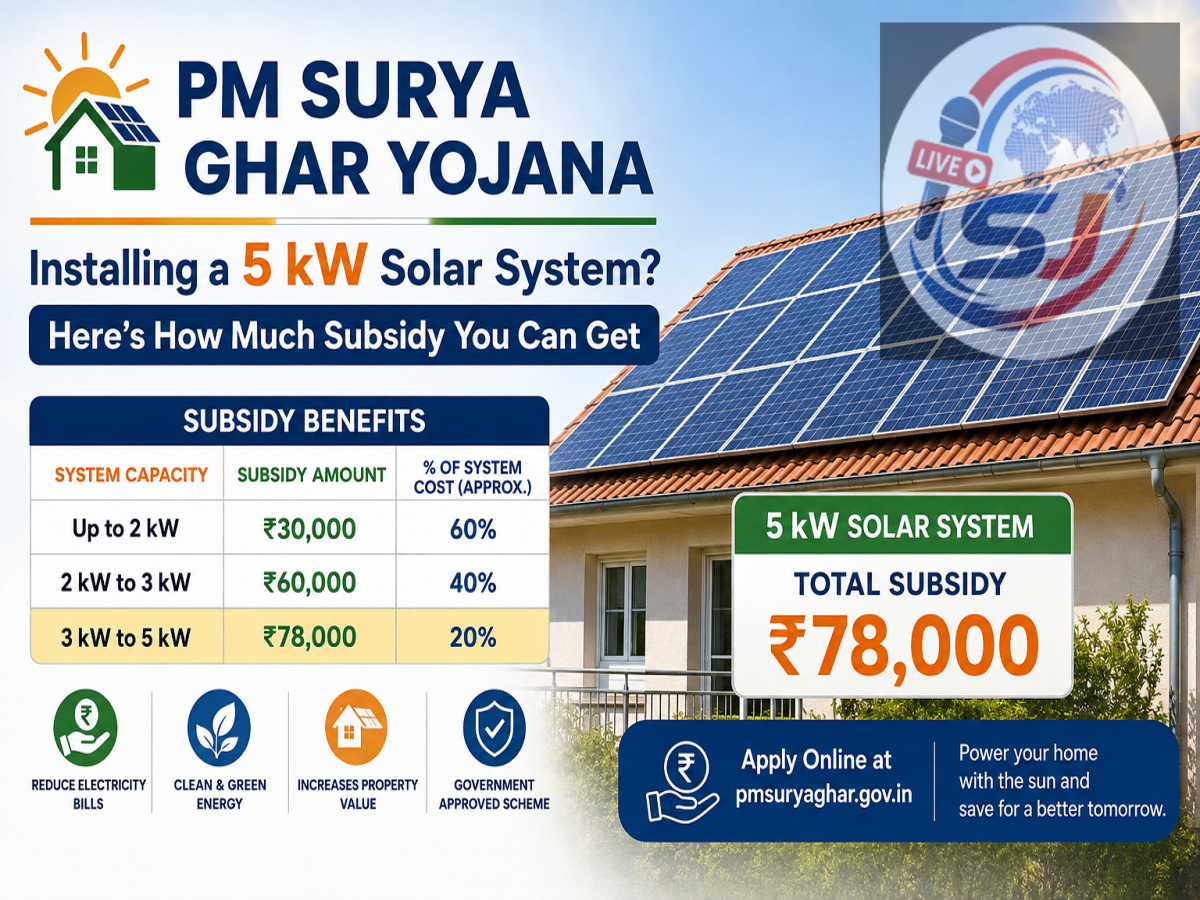
PM Surya Ghar Subsidy 2026: Planning to install rooftop solar panels to reduce your monthly electricity expenses? The PM Surya Ghar: Muft Bijli Yojana can significantly lower the initial installation cost by providing central financial assistance to eligible residential consumers.
The scheme was launched in February 2024 with the objective of expanding rooftop solar across one crore households. It is popularly associated with the government's goal of enabling households to generate enough solar power to receive the benefit of up to 300 units of electricity per month, depending on their system generation and electricity consumption.
But there is an important rule that consumers should understand before installing a larger system. You can install a 5 kW or even higher-capacity rooftop solar plant, but the central subsidy does not keep increasing with the size of the system. Under the standard residential category, financial assistance is capped at 3 kW.
So, how much subsidy will you receive if you install a 5 kW solar system? Here's the calculation.
How Much Subsidy Is Available Under PM Surya Ghar?
Under the scheme's standard subsidy structure for residential consumers, financial assistance is linked to the capacity of the rooftop solar system.
For the first 2 kW, eligible households can receive ₹30,000 per kW. For the next 1 kW, an additional ₹18,000 is available. No additional central financial assistance is provided for capacity beyond 3 kW.
This means the standard subsidy works like this:
| Rooftop Solar Capacity | Central Subsidy |
|---|---|
| 1 kW | ₹30,000 |
| 2 kW | ₹60,000 |
| 3 kW | ₹78,000 |
| 4 kW | ₹78,000 |
| 5 kW | ₹78,000 |
| Above 5 kW | ₹78,000 maximum under the standard household category |
Therefore, if you install a 5 kW rooftop solar system, the central subsidy is ₹78,000, subject to scheme eligibility and applicable rules.
Why Doesn't a 5 kW System Get a Bigger Subsidy?
This is where some consumers can become confused.
The government allows households to install rooftop solar systems larger than 3 kW, but the central subsidy for an individual residential consumer is capped at the amount applicable to 3 kW.
For example, the subsidy calculation for a 3 kW or larger eligible system is:
First 2 kW: ₹30,000 × 2 = ₹60,000
Next 1 kW: ₹18,000 × 1 = ₹18,000
Total central subsidy: ₹78,000
If you install another 2 kW and increase the total system capacity to 5 kW, you will generally have to bear the additional installation cost yourself because no further central subsidy is available for capacity beyond 3 kW.
Who Should Consider a 5 kW Solar System?
A 5 kW rooftop solar plant may be suitable for households with comparatively high electricity consumption.
For instance, homes using several air conditioners, refrigerators, water pumps, geysers and other high-power appliances may have electricity requirements that justify a larger solar installation.
The right capacity, however, should not be selected simply because a higher-capacity system is available. Consumers should examine their historical electricity consumption, available rooftop area, local solar conditions and expected future requirements.
Households consuming up to around 300 units a month may find a 2-3 kW system more aligned with the scheme's standard capacity guidance. Official government information indicates that households consuming 150-300 units per month may typically consider a 2-3 kW system, while those consuming more than 300 units may need a system above 3 kW.
Does the Scheme Really Provide 300 Units of Free Electricity?
The phrase "300 units free electricity" needs to be understood correctly.
PM Surya Ghar is primarily a rooftop solar programme. The government subsidises the installation of solar panels, enabling households to generate electricity on their own rooftops. The benefit on the electricity bill consequently depends on how much solar electricity the system produces, how much the household consumes and applicable net-metering arrangements.
The original Cabinet approval targeted rooftop solar for one crore households with the objective of enabling households to receive up to 300 units of free electricity every month.
It should therefore not be interpreted as an unconditional 300-unit waiver for every electricity consumer regardless of solar generation.
Who Can Apply for PM Surya Ghar Yojana?
The scheme is available to residential consumers across India who meet its conditions.
According to the Ministry of New and Renewable Energy, residential consumers, including those in rural areas, with a grid-connected electricity connection from their local DISCOM can apply for rooftop solar benefits through the scheme's National Portal.
Applicants need to follow the prescribed process, which generally involves registration, selecting the relevant electricity distribution company, submitting consumer details, obtaining the required approvals and installing the rooftop solar system through an eligible vendor.
Consumers should ensure that the system and installation comply with the scheme's requirements before expecting subsidy payment.
How to Apply for the Rooftop Solar Subsidy
Consumers interested in the scheme can apply through the official PM Surya Ghar National Portal.
PM Surya Ghar: Muft Bijli Yojana official portal
The portal allows households to apply for the subsidy and access information useful for selecting a rooftop solar system and vendor. Official government guidance also highlights tools such as system-size information, vendor details and benefits calculations.
Consumers should avoid unofficial websites or people promising guaranteed subsidies in exchange for advance payments.
Low-Interest Loans Can Reduce the Upfront Burden
The cost remaining after subsidy can still be significant, especially when installing a larger system such as 5 kW.
The government has therefore introduced financing support alongside the subsidy programme. In a July 2026 update, the Ministry of New and Renewable Energy said collateral-free financing through nationalised banks was available at a concessional rate linked to the repo rate plus 50 basis points. The stated rate at that time was 5.75% per annum, with a tenure of 10 years, under the applicable financing provisions.
Borrowers should check the latest interest rate, eligibility conditions and repayment terms directly with the participating lender before applying.
Nearly 48 Lakh Households Had Benefited by July 2026
PM Surya Ghar has expanded rapidly since its introduction.
According to government data released on July 28, 2026, 39,72,447 rooftop solar systems had been installed under the programme as of July 22, benefiting 48,02,717 households across India, including rural households.
The government also reported that more than 18.93 lakh households had recorded zero electricity bills during some months, depending on their electricity consumption and solar generation.
5 kW Solar Subsidy: Remember the ₹78,000 Limit
The most important point for anyone considering a 5 kW rooftop solar plant is that system capacity and subsidised capacity are not the same thing.
An eligible residential consumer can install a 5 kW system, but the standard central financial assistance is capped at 3 kW. That means the subsidy works out to ₹60,000 for the first 2 kW plus ₹18,000 for the third kW, taking the maximum central support to ₹78,000.
Before installing solar panels, households should compare their monthly electricity consumption with the proposed system capacity and obtain installation-cost estimates from eligible vendors. A properly sized rooftop system can help lower electricity bills for years, but choosing the capacity according to actual consumption is just as important as calculating the subsidy.