
PM Surya Ghar Yojana 2026: Get Up to ₹78,000 Solar Subsidy, Government Targets Faster Installations
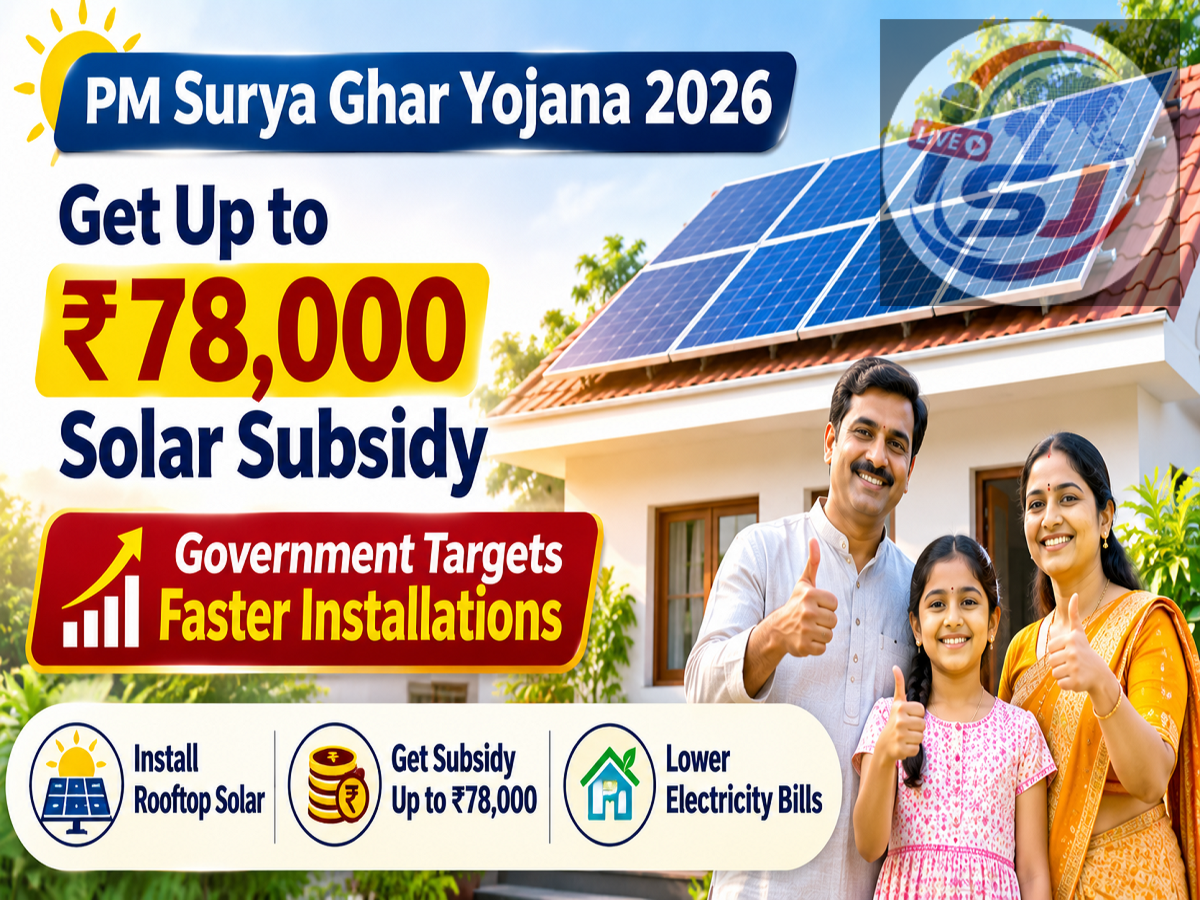
PM Surya Ghar Muft Bijli Yojana 2026: The Central Government has shared a major update on its popular rooftop solar scheme, which aims to help households reduce electricity expenses while promoting clean energy. Under the PM Surya Ghar Muft Bijli Yojana, eligible residential consumers can receive financial assistance of up to ₹78,000 for installing rooftop solar systems.
The scheme aims to enable households to generate electricity equivalent to up to 300 units per month, depending on the capacity and performance of their solar installation.
Union Minister for New and Renewable Energy Pralhad Joshi has revealed that the programme is expanding rapidly. Currently, around one lakh rooftop solar systems are being installed every six days, and the government expects to achieve the same number of installations within four to five days in the coming weeks.
The initiative is part of India's broader efforts to increase renewable energy generation, reduce dependence on conventional electricity sources and make solar power more affordable for ordinary households.
PM Surya Ghar Yojana 2026: Government Announces Major Progress
The PM Surya Ghar Muft Bijli Yojana was launched on February 13, 2024, with an approved financial outlay of ₹75,021 crore.
The programme aims to support rooftop solar installations for one crore households across the country.
Speaking at the Bharat Renewable Energy Summit 2026, Pralhad Joshi highlighted the increasing pace of solar installations.
He explained that improvements in implementation procedures and coordination have helped accelerate the programme.
According to the minister, the government is working towards installing one lakh rooftop solar systems every four to five days, compared with the current pace of approximately six days.
The programme's target is to cover one crore households by March 31, 2027.
How Much Subsidy Is Available Under PM Surya Ghar Yojana?
One of the biggest attractions of the scheme is the Central Government subsidy available for residential rooftop solar installations.
The subsidy depends on the installed capacity of the solar system.
| Rooftop Solar Capacity |
Central Government Subsidy |
|---|---|
| 1 kW |
₹30,000 |
| 2 kW |
₹60,000 |
| 3 kW |
₹78,000 |
| Above 3 kW |
₹78,000 maximum |
For eligible residential installations, the subsidy is calculated at ₹30,000 per kW for the first 2 kW and ₹18,000 for the additional 1 kW.
The maximum standard central subsidy is capped at ₹78,000, even if a household installs a system larger than 3 kW.
These subsidy rates are outlined in the government's approved scheme framework.
Can Households Really Get 300 Units of Free Electricity Every Month?
The PM Surya Ghar scheme is designed to help households generate electricity using solar panels installed on their rooftops.
According to government estimates, a 3 kW rooftop solar system can generate more than 300 units of electricity per month on average under suitable conditions.
However, the actual amount of electricity produced depends on several factors, including sunlight availability, weather conditions, panel efficiency and installation quality.
The term "300 units of free electricity" refers to the scheme's intended benefit from rooftop solar generation. It does not mean that every registered household automatically receives 300 free units from its electricity distribution company.
Consumers may still receive an electricity bill depending on their consumption, solar generation, fixed charges and applicable state regulations.
More Than 55 Lakh Rooftop Solar Systems Installed
The latest figures indicate significant progress under the programme.
According to data reported from the National Portal for Rooftop Solar, more than 88.3 lakh applications had been received by November 2, 2026.
Over 55.3 lakh rooftop solar systems had been installed, while more than 65.4 lakh households were reported as benefiting from the initiative.
The government has also highlighted the financial benefits of solar power.
Pralhad Joshi stated that approximately 21 lakh households covered by the programme had received zero electricity bills.
Additionally, beneficiaries selling surplus solar electricity to distribution companies had collectively received around ₹700 crore, according to the minister.
Who Is Eligible for PM Surya Ghar Muft Bijli Yojana?
The programme primarily targets residential electricity consumers who want to install rooftop solar systems.
Applicants generally need to meet the following requirements:
-
Be an Indian residential electricity consumer.
-
Have a suitable rooftop or access to an eligible residential rooftop.
-
Possess a valid electricity connection and consumer number.
-
Meet the technical requirements specified by the local electricity distribution company.
-
Follow the scheme's installation and subsidy guidelines.
Applicants should also check whether they have previously received government assistance for the same rooftop solar installation, as subsidy eligibility is subject to programme rules.
How to Apply Online for PM Surya Ghar Yojana 2026
Eligible consumers can apply through the official National Portal.
-
Visit the official website at pmsuryaghar.gov.in.
-
Choose the registration option for residential rooftop solar.
-
Select your state and electricity distribution company.
-
Enter your electricity consumer number, mobile number and other required details.
-
Complete registration and submit the rooftop solar application.
-
Obtain the required approval and select an eligible registered vendor.
-
Complete the solar installation and the required inspection, metering and commissioning formalities.
-
Submit the necessary bank details and subsidy claim information through the portal.
The subsidy is processed after the installation satisfies the applicable requirements. Consumers should avoid making payments to unauthorised agents promising guaranteed or instant subsidy approval.
Can Consumers Earn Money by Selling Extra Solar Electricity?
Another potential advantage of rooftop solar systems is the opportunity to export surplus electricity to the distribution grid.
When solar generation exceeds household consumption, eligible consumers may receive credits or payments according to their state's net-metering or other applicable arrangements.
However, the amount earned depends on local electricity regulations, the tariff applicable to exported electricity and the quantity of surplus power generated.
Therefore, additional income from rooftop solar is possible but not guaranteed.
Why Is the Government Accelerating Solar Installations?
The faster rollout of PM Surya Ghar is expected to support India's clean-energy transition while helping households reduce electricity expenses.
Rooftop solar systems allow consumers to generate electricity closer to where it is used, potentially reducing dependence on conventional grid supply during daylight hours.
The programme also supports employment opportunities in solar panel manufacturing, installation, maintenance and related technical services.
However, consumers should evaluate installation costs, rooftop suitability, maintenance requirements and expected electricity savings before making an investment.
Conclusion
The PM Surya Ghar Muft Bijli Yojana is expanding rapidly, with the government aiming to reduce the time required for every one lakh rooftop solar installations from six days to four or five days.
Eligible households can receive a central subsidy of up to ₹78,000 for rooftop solar systems, while the programme aims to enable electricity generation equivalent to up to 300 units per month.
With the target of reaching one crore households by March 2027, the initiative remains a major part of India's residential solar expansion.
Consumers interested in applying should visit the official PM Surya Ghar portal, check their eligibility and compare installation costs before proceeding.