
PM-KISAN Eligibility Rules: Who Can Get ₹6,000 a Year and Who Is Excluded From the Scheme?
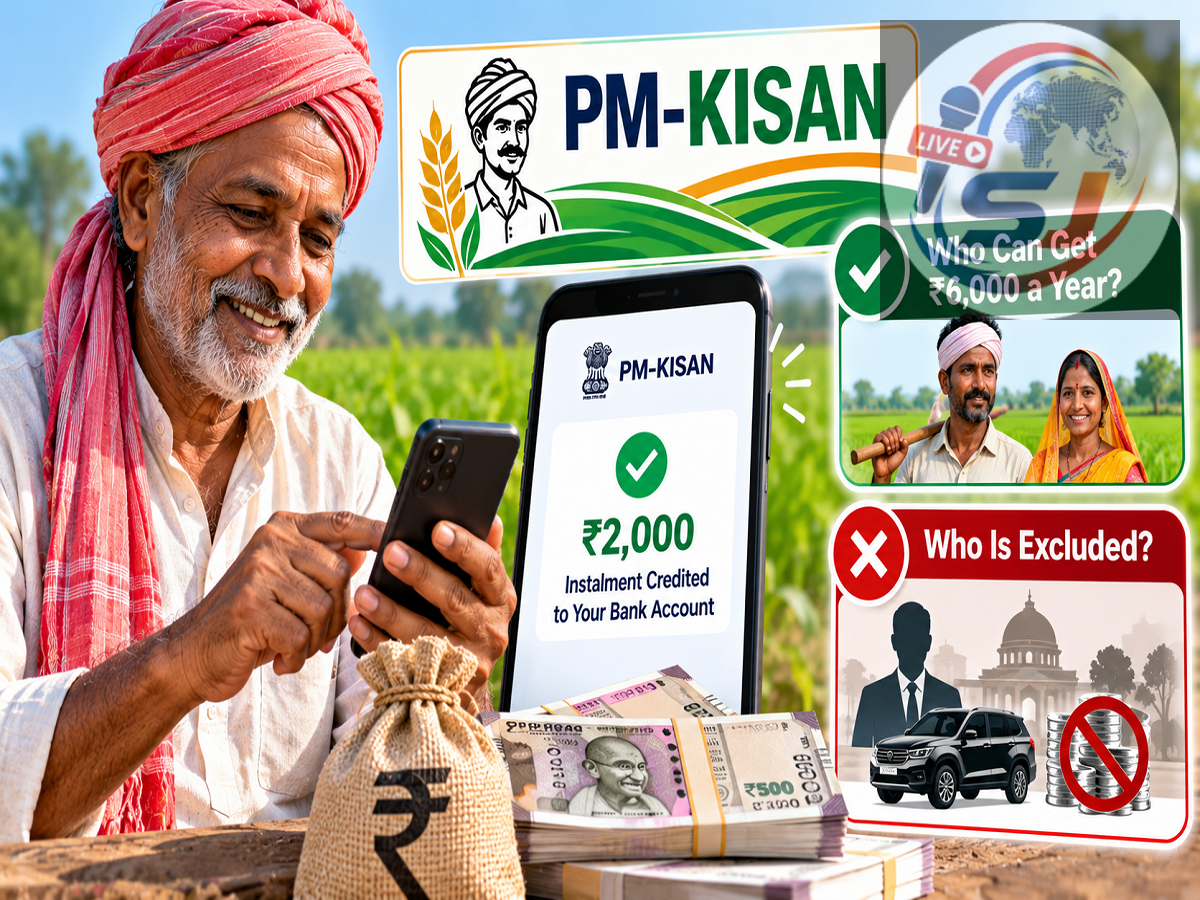
The Pradhan Mantri Kisan Samman Nidhi (PM-KISAN) is one of the Central government's major income-support schemes for eligible farmer families. Under the programme, qualifying beneficiaries receive ₹6,000 a year, transferred directly to their bank accounts through Direct Benefit Transfer (DBT).
The annual assistance is divided into three instalments of ₹2,000 each. However, owning or cultivating agricultural land does not automatically mean that every person qualifies for the payment.
Eligibility is determined under the scheme's rules, and several categories of landholders are specifically excluded. Farmers also need to ensure that requirements such as Aadhaar-based e-KYC and land-record verification are completed wherever applicable.
Here is a detailed look at who can receive PM-KISAN benefits, who is excluded and what farmers should check to avoid payment-related problems.
When Was PM-KISAN Introduced?
PM-KISAN was made effective from December 1, 2018.
It is a Central Sector Scheme, which means the financial responsibility for the scheme is borne by the Central government rather than being shared with state governments.
Eligible farmer families receive ₹6,000 during a year through three instalments:
| Instalment | Amount |
|---|---|
| First instalment | ₹2,000 |
| Second instalment | ₹2,000 |
| Third instalment | ₹2,000 |
| Total annual assistance | ₹6,000 |
Payments are made through DBT to eligible beneficiaries' bank accounts.
Who Is Considered a Farmer Family Under PM-KISAN?
For PM-KISAN purposes, a farmer family generally consists of the husband, wife and minor children who satisfy the applicable landholding and eligibility conditions.
Cultivable land recorded in the relevant state or Union Territory land records plays an important role in determining eligibility.
Beneficiary identification and verification are carried out with the involvement of the respective state and Union Territory administrations.
This makes accurate land records particularly important. If ownership or beneficiary information in government records is incomplete or incorrect, the payment may face verification issues.
Why Is PM-KISAN e-KYC Important?
Aadhaar-based e-KYC is a key verification requirement under PM-KISAN.
The process helps authenticate beneficiaries and reduce the possibility of payments being made against incorrect, duplicate or otherwise ineligible records.
Farmers should therefore make sure that their e-KYC status is complete and that their Aadhaar information is correctly reflected in the scheme's records.
The government has also introduced digital facilities, including face-authentication-based e-KYC, to make verification easier for beneficiaries.
Depending on the available facility, farmers may be able to complete authentication through supported digital channels instead of relying entirely on a physical visit.
Land Seeding Is Another Important Check
Completing e-KYC alone may not resolve every payment problem.
The beneficiary's land details also need to satisfy the scheme's verification requirements.
Land seeding essentially helps connect the beneficiary's PM-KISAN record with the relevant land information available to the government.
If the land-verification status is incomplete or there is a mismatch in records, an instalment may not be released even when other information appears correct.
Farmers waiting for a payment should therefore check both their e-KYC and land-related status.
How to Check PM-KISAN Status
The PM-KISAN system provides a Know Your Status facility that beneficiaries can use to review available information associated with their record.
Farmers can use the official PM-KISAN platform and follow the displayed authentication process to check their status.
Depending on the information available in the system, the status can help identify issues involving eligibility, payment, e-KYC or land verification.
Beneficiaries should use only official government channels and avoid websites or applications that imitate the PM-KISAN portal.
Who Is Not Eligible for PM-KISAN?
PM-KISAN has a defined exclusion framework. This means that some landholding families may still be ineligible even if agricultural land is recorded in their names.
Among the excluded categories are institutional landholders.
Certain farmer families in which one or more members belong to specified higher economic or professional categories can also be excluded.
These include certain present or former holders of constitutional posts, ministers and elected representatives covered by the scheme's exclusion criteria.
Specified serving or retired officers and employees of Central or state governments, public-sector organisations and certain autonomous institutions may also fall within the exclusion rules, subject to the scheme's detailed conditions and exceptions.
Can Pensioners Receive PM-KISAN?
Pension status can also affect eligibility in specified cases.
Certain retired pensioners receiving a monthly pension above the limit prescribed under PM-KISAN's exclusion rules are not eligible, subject to the exceptions provided by the scheme.
Farmers should therefore refer to the complete official exclusion criteria rather than assuming that every pensioner is either automatically eligible or automatically disqualified.
Income-Tax Payers Are Excluded
Income-tax status is another important eligibility condition.
Under the PM-KISAN exclusion rules, farmer families in which a member falls within the prescribed income-tax payer category are excluded from receiving the benefit.
This condition is important because land ownership alone does not override the scheme's exclusion criteria.
Certain Professionals Can Also Be Excluded
PM-KISAN also lists certain professional categories in its exclusion criteria when they meet the prescribed conditions and are carrying out their profession.
These can include professionals such as:
-
Doctors
-
Engineers
-
Lawyers
-
Chartered accountants
-
Architects
Farmers should consult the current official PM-KISAN guidelines for the precise scope of these exclusions.
What Should Farmers Check If Their ₹2,000 Instalment Is Stuck?
A delayed instalment does not automatically mean that a beneficiary has been permanently removed from PM-KISAN.
Several verification-related problems can interrupt payment.
Farmers should check whether their e-KYC has been completed, whether their land record has been properly seeded or verified, and whether the relevant bank and Aadhaar details are correct.
They should also review their beneficiary status to determine whether an eligibility or exclusion-related issue has been flagged.
Correcting the underlying problem is more useful than repeatedly submitting new applications.
PM-KISAN's 23rd Instalment
According to the information supplied in the report, the 23rd PM-KISAN instalment was released on June 20, 2026, from Tarakeswar in West Bengal's Hooghly district.
The report states that more than 9.44 crore farmers were covered under the 23rd instalment.
It also states that the preceding 22nd instalment was released on March 13, 2026.
Each eligible beneficiary receives ₹2,000 per instalment, subject to meeting the scheme's conditions and successful verification.
PM-KISAN at a Glance
| Key Point | PM-KISAN Rule |
|---|---|
| Type of scheme | Central Sector Scheme |
| Effective from | December 1, 2018 |
| Annual assistance | ₹6,000 |
| Number of instalments | 3 |
| Amount per instalment | ₹2,000 |
| Payment method | Direct Benefit Transfer |
| e-KYC | Important beneficiary-verification requirement |
| Land verification | Required under applicable scheme process |
| Income-tax payer exclusion | Applies under prescribed criteria |
Be Careful of PM-KISAN Fraud
Farmers should be particularly careful when receiving messages claiming that their ₹2,000 instalment has been blocked.
Fraudsters may send fake PM-KISAN links through WhatsApp or SMS and ask beneficiaries to update Aadhaar or banking details.
Do not install an unknown APK file or application sent through a message.
Most importantly, you do not need to enter a UPI PIN to receive a DBT payment. Never disclose your UPI PIN, ATM PIN, card CVV, internet-banking password or OTP to anyone claiming that these details are required to release a PM-KISAN instalment.
What Farmers Should Do Before the Next Instalment
Eligible beneficiaries should periodically review their PM-KISAN records instead of waiting until an instalment is due.
Check your e-KYC status, land verification, beneficiary information and bank details through authorised channels. If the system shows an error, contact the appropriate government authority or authorised assistance centre to get it corrected.
Remember that PM-KISAN provides ₹6,000 annually in three ₹2,000 instalments, but payments are subject to eligibility and successful verification.
Land ownership by itself does not guarantee the benefit. The applicant must meet the scheme's eligibility requirements and must not fall within the applicable exclusion categories.
Note: PM-KISAN eligibility, exclusion conditions, verification procedures and payment schedules can be updated by the government. Farmers should check the official PM-KISAN portal or authorised government channels for the latest information before taking action.