
Personal Loan Rates October 2026: Compare Interest Rates of 10 Banks and Calculate EMI on ₹10 Lakh
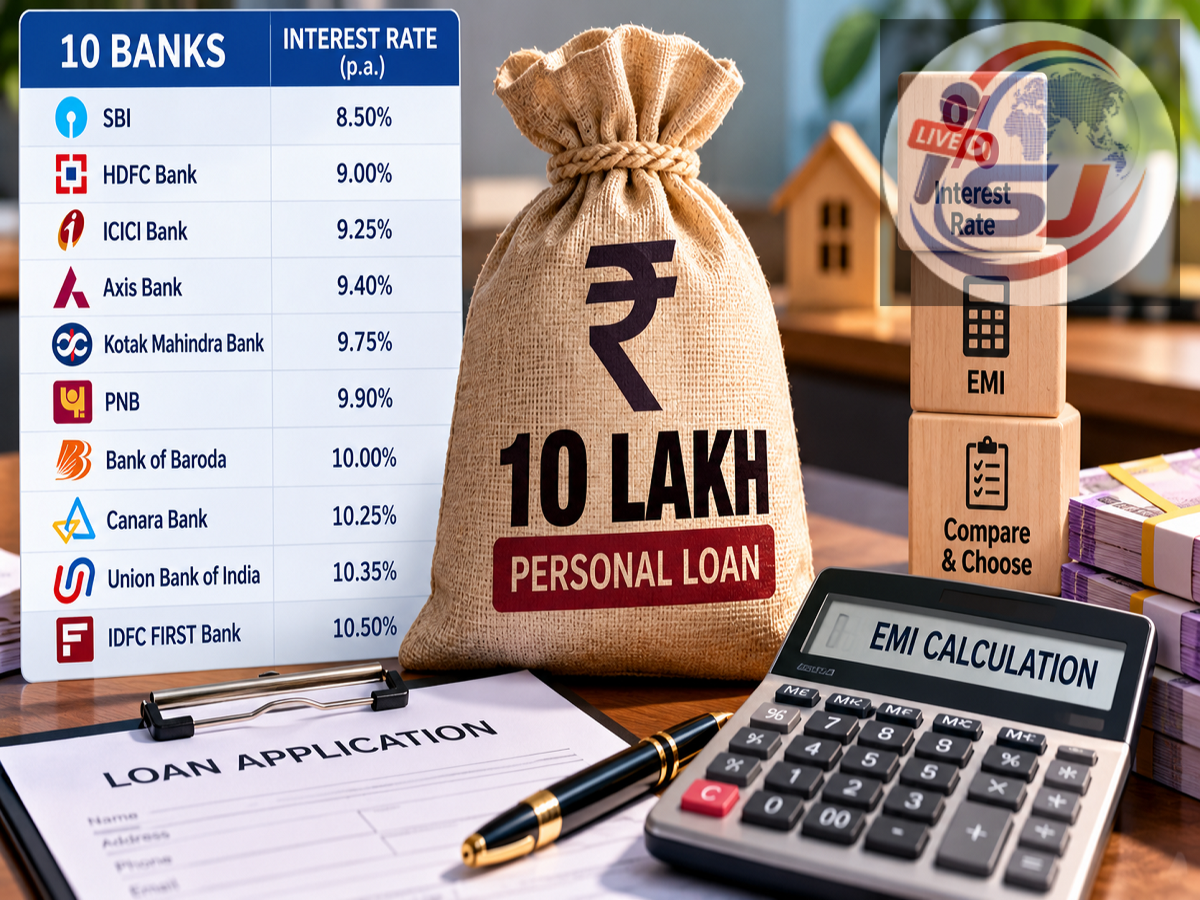
Personal Loan Interest Rates October 2026: If you are planning to take a personal loan to meet an urgent financial requirement, comparing interest rates offered by different banks can help you reduce your borrowing costs. Whether the money is needed for medical treatment, education, a wedding, home renovation, or another personal expense, choosing the right lender can make a significant difference to your monthly budget.
According to the reported October 2026 interest rate listings, several leading Indian banks are offering personal loans with advertised starting interest rates below 10% per annum. Axis Bank and Union Bank of India have the lowest listed starting rates at 8.90%, followed by Indian Bank at 9.00%.
Meanwhile, major private-sector lenders such as HDFC Bank, ICICI Bank, and IDFC FIRST Bank have reported starting rates of 9.99% annually.
However, borrowers should remember that advertised starting rates are not necessarily available to everyone. Banks consider credit scores, monthly income, employment stability, and existing debt obligations before deciding the final interest rate.
Here is a detailed comparison of personal loan rates, estimated EMIs, eligibility factors, and important precautions borrowers should take before applying.
Personal Loan Interest Rates in October 2026: Check the Bank-Wise List
The following table shows the reported starting annual interest rates offered by 10 major Indian banks during October 2026.
| Bank Name |
Starting Interest Rate (Per Annum) |
|---|---|
| Axis Bank |
8.90% |
| Union Bank of India |
8.90% |
| Indian Bank |
9.00% |
| Punjab & Sind Bank |
9.65% |
| Canara Bank |
9.70% |
| Bank of Maharashtra |
9.75% |
| UCO Bank |
9.95% |
| HDFC Bank |
9.99% |
| ICICI Bank |
9.99% |
| IDFC FIRST Bank |
9.99% |
Note: These are advertised starting rates from the supplied October 2026 listings, not independently verified live offers. Actual rates may differ depending on the applicant's profile and the lender's current policies.
Which Bank Has the Lowest Personal Loan Interest Rate?
Based on the reported comparison, Axis Bank and Union Bank of India have the lowest advertised starting rates of 8.90% per annum.
Indian Bank follows with a starting rate of 9.00%, while Punjab & Sind Bank is listed at 9.65%.
Canara Bank and Bank of Maharashtra have reported starting rates of 9.70% and 9.75%, respectively.
UCO Bank's starting rate stands at 9.95%, while HDFC Bank, ICICI Bank, and IDFC FIRST Bank are listed at 9.99%.
However, choosing a bank solely because it advertises the lowest interest rate may not always be the best financial decision.
Some lenders charge higher processing fees or have different repayment and foreclosure conditions. Borrowers should therefore compare the complete cost of the loan before selecting a lender.
₹10 Lakh Personal Loan EMI: How Much Will You Pay Every Month?
Suppose you need a personal loan of ₹10 lakh and plan to repay it over five years.
If the bank offers an annual interest rate of 8.90%, your estimated monthly EMI would be approximately ₹20,710.
At an annual interest rate of 10%, the monthly EMI would increase to approximately ₹21,247.
This means even a relatively small difference in interest rates can affect the total amount repaid over the loan tenure.
Here is an illustrative EMI comparison for a ₹10 lakh personal loan with a repayment period of five years.
| Annual Interest Rate |
Approximate Monthly EMI |
|---|---|
| 8.90% |
₹20,710 |
| 9.00% |
₹20,758 |
| 9.50% |
₹21,002 |
| 9.99% |
₹21,242 |
| 10.00% |
₹21,247 |
| 11.00% |
₹21,742 |
| 12.00% |
₹22,244 |
These calculations use the standard reducing-balance EMI method and exclude processing fees, insurance, and other additional charges.
Why Do Personal Loan Interest Rates Differ Between Customers?
Banks do not necessarily offer the same interest rate to every applicant.
Several factors influence loan eligibility and the final borrowing cost.
Credit Score and Repayment History
A borrower's credit score is one of the important indicators banks use to assess repayment behaviour.
Applicants with a strong credit history and a record of timely payments may have better chances of receiving competitive loan offers.
On the other hand, missed EMIs, unpaid credit card bills, or excessive outstanding debt may negatively affect eligibility.
Monthly Salary and Employment Stability
Banks also consider the applicant's income and employment situation.
A salaried employee with stable monthly earnings may qualify for different loan terms than someone with irregular income.
The lender may examine salary statements, employment history, and other financial documents before approving the application.
Existing Loans and Financial Commitments
If you are already paying EMIs on a home loan, vehicle loan, or another personal loan, the bank will consider those obligations.
Higher existing monthly repayments can reduce the amount of additional borrowing a lender is willing to approve.
Loan Amount and Repayment Period
The requested loan amount and repayment tenure can also influence the lender's decision.
A longer tenure generally reduces the monthly EMI but increases the total interest payable over the life of the loan.
Personal Loan Processing Fees: Check These Charges Before Applying
Interest rates are not the only expenses associated with personal loans.
Banks may also impose processing fees, late-payment penalties, and other charges depending on the loan agreement.
Some lenders may charge fees for early repayment or foreclosure, subject to applicable regulatory requirements and the loan's terms.
For example, a bank offering a lower interest rate but a higher processing fee might not necessarily provide the cheapest loan.
Borrowers should carefully examine the Key Facts Statement provided by the lender.
This document should help explain important loan terms, including the annual percentage rate, repayment obligations, and applicable charges.
Understanding the total cost before signing the agreement can help prevent unexpected financial pressure.
How to Increase Your Chances of Getting a Cheaper Personal Loan
Borrowers can improve their chances of receiving a competitive offer by maintaining healthy financial habits.
Paying existing EMIs and credit card bills on time can help establish a positive repayment record.
Avoiding unnecessary debt and keeping monthly financial obligations manageable may also improve eligibility.
It is advisable to compare offers from multiple banks instead of applying immediately after seeing an advertisement.
Existing customers may also check whether their bank has offered them a pre-approved personal loan.
However, pre-approved offers remain subject to the lender's applicable terms and verification requirements.
Should You Choose a Shorter or Longer Loan Tenure?
The repayment tenure plays a major role in determining both monthly affordability and total borrowing costs.
A shorter tenure usually means higher monthly EMIs but lower overall interest payments.
A longer tenure reduces the immediate monthly burden, although the borrower generally pays more interest over time.
For instance, someone with stable income and sufficient monthly savings may prefer a shorter repayment period.
However, a borrower with significant household responsibilities may need a longer tenure to avoid excessive pressure on monthly finances.
The right choice depends on income, essential expenses, emergency savings, and existing financial commitments.
Important Precautions Before Taking a Personal Loan
Before borrowing, calculate the exact amount you need rather than accepting the maximum amount offered by the bank.
Review your monthly household budget to determine whether the EMI can be paid comfortably.
It is also important to maintain emergency savings so that unexpected expenses do not disrupt loan repayments.
Avoid selecting a lender solely because of promotional claims about instant approval or unusually low interest rates.
Always verify the bank's official offer, repayment conditions, processing fees, and total repayment amount.
Borrowers should also be cautious about unfamiliar loan applications or agents requesting advance payments through personal accounts.
Final Takeaway
The reported personal loan interest rate comparison for October 2026 shows starting rates ranging from 8.90% to 9.99% across 10 major banks.
Axis Bank and Union Bank of India have the lowest listed starting rates at 8.90%, followed by Indian Bank at 9.00%.
For a ₹10 lakh loan repaid over five years, the estimated EMI is approximately ₹20,710 at 8.90% interest and ₹21,247 at 10%.
Before applying for a personal loan, compare the final interest rate, processing fees, repayment tenure, and total borrowing cost rather than relying only on advertised rates.
Selecting a loan that fits your repayment capacity can help you meet immediate financial needs without placing unnecessary pressure on your long-term finances.
Disclaimer: Interest rates mentioned in this article are based on the supplied October 2026 listings and may change. EMI calculations are illustrative. Actual loan offers depend on the lender's eligibility criteria, applicable charges, and borrower profile. Verify current rates and conditions directly with the bank before applying.