
PARIVARTAN Scheme 2026: Get Up to ₹10 Lakh in Benefits to Replace Old Trucks and Buses in Delhi-NCR; Check Eligibility
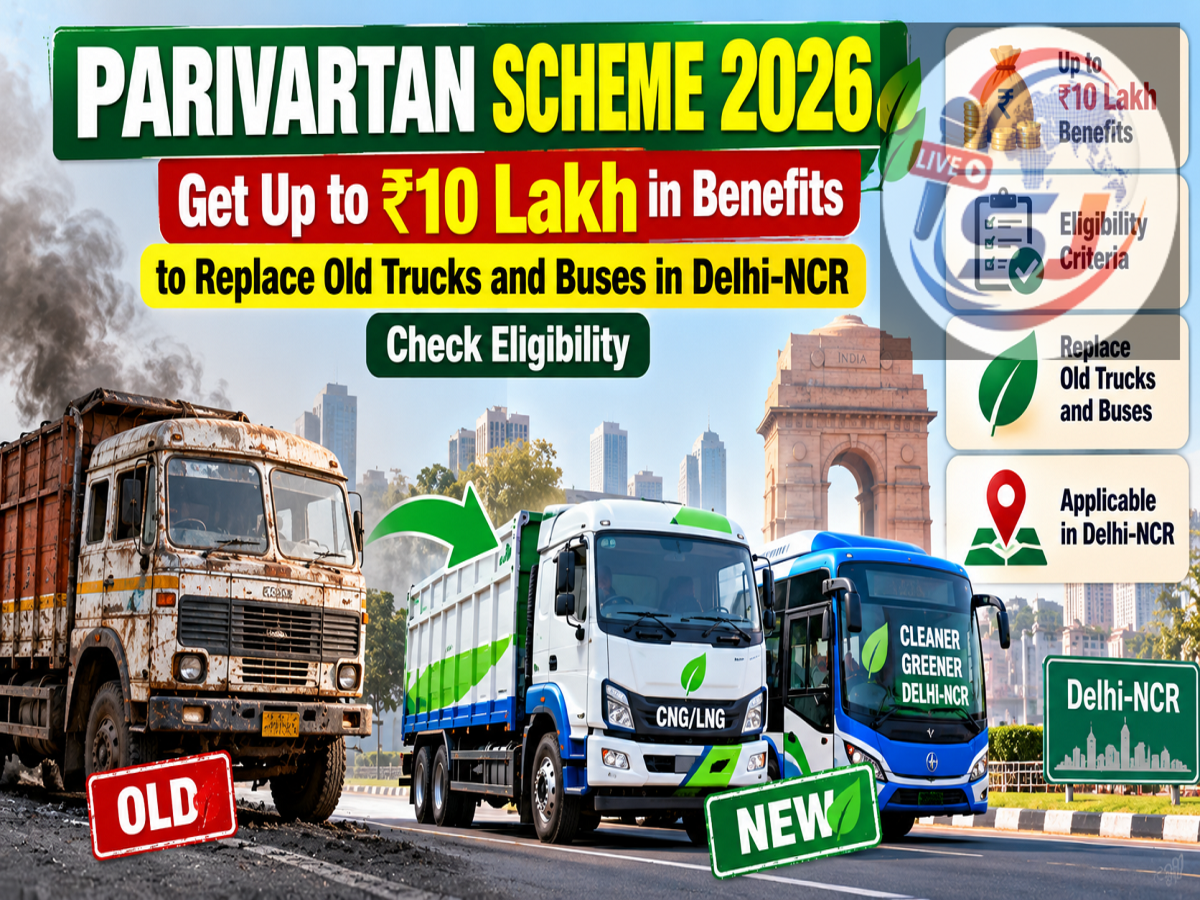
PARIVARTAN Scheme 2026: Owners of old commercial trucks and buses in Delhi-NCR may be eligible for financial incentives to replace their ageing vehicles with cleaner, modern alternatives under the PARIVARTAN scheme.
The initiative is intended to reduce transport-related air pollution by encouraging commercial vehicle owners to replace older BS-IV and earlier-emission-standard vehicles with BS-VI-compliant or electric vehicles.
According to an October 21, 2026 report, eligible vehicle owners may receive a combination of benefits, including motor vehicle tax concessions, registration fee waivers, loan interest subsidies, manufacturer discounts, electric vehicle incentives and fuel vouchers.
The report suggests that the combined financial benefit could reach ₹10 lakh in certain cases, depending on the vehicle category and the incentives available.
It also states that approximately 34,000 vehicle owners have benefited from the programme.
However, the maximum advertised benefit should not be treated as a guaranteed cash subsidy for every applicant. Individual incentives depend on eligibility, vehicle specifications and the applicable scheme conditions.
Here is a detailed explanation of the reported PARIVARTAN scheme benefits, eligibility criteria, vehicle categories, required documents and online application process.
What Is the PARIVARTAN Scheme?
PARIVARTAN stands for Programme for Accelerated Renewal and Incentivization of Vehicle Assets for Reducing Transport Air Pollution and Network Emissions.
The programme focuses on replacing older commercial vehicles operating in Delhi and the National Capital Region.
Older trucks and buses can contribute significantly to local air pollution, particularly when they operate with outdated emission-control technology.
The scheme seeks to encourage vehicle owners to shift towards cleaner alternatives through financial assistance and related incentives.
According to the report, the programme has a proposed financial outlay of ₹9,585 crore and aims to facilitate the replacement of more than two lakh older commercial vehicles.
These figures are reported scheme targets and should be distinguished from verified expenditure or completed vehicle replacements.
PARIVARTAN Scheme 2026: Key Details
| Particulars |
Reported Details |
|---|---|
| Scheme name |
PARIVARTAN |
| Main objective |
Replace older commercial vehicles with cleaner alternatives |
| Coverage |
Delhi-NCR |
| Target vehicles |
BS-IV and older eligible commercial vehicles |
| Replacement options |
Eligible BS-VI or electric vehicles |
| Reported programme outlay |
₹9,585 crore |
| Reported replacement target |
More than 2 lakh vehicles |
| Reported beneficiaries |
Approximately 34,000 |
| Potential combined benefit |
Up to ₹10 lakh in certain cases |
| Online portal |
parivartan.parivahan.gov.in |
What Benefits Are Available Under the Scheme?
The report describes several types of incentives designed to reduce the cost of replacing an older commercial vehicle.
These benefits may be particularly relevant for truck operators, bus owners and small transport businesses that face high upfront vehicle replacement costs.
1. Motor Vehicle Tax Concession
Eligible vehicle owners may receive relief from motor vehicle taxes when replacing their old commercial vehicles.
The concession reportedly depends on the rules applicable in the relevant state.
In some circumstances, the relief could be as high as 100%.
However, a full tax exemption should not be assumed for every vehicle or every location.
2. Registration Fee Waiver
The scheme reportedly includes relief from vehicle registration fees.
Eligible applicants may qualify for a waiver when registering their replacement vehicle.
The precise benefit will depend on the applicable registration rules and scheme conditions.
3. Loan Interest Subsidy
A major reported incentive is a 5% interest subsidy on eligible vehicle financing.
This could help reduce borrowing costs for transport operators purchasing a new truck or bus through a bank loan.
However, a 5% interest subsidy does not necessarily mean that every applicant's final loan interest rate will be reduced by exactly five percentage points for the entire loan tenure.
The calculation method, subsidy duration, eligible loan amount and participating lenders must be confirmed under the scheme's official guidelines.
4. Electric Vehicle Incentive
The programme reportedly offers one-time incentives for eligible electric commercial vehicles.
The incentive amount depends on the vehicle category and size.
5. Monthly Fuel Vouchers
For qualifying diesel or CNG replacement vehicles, the report mentions monthly fuel vouchers for a period of up to five years.
These vouchers could help reduce operating expenses for eligible transport operators.
6. Manufacturer Discount
Vehicle manufacturers may also provide additional discounts of up to 8% on eligible new vehicle purchases.
Such discounts would depend on the participating manufacturer, vehicle model and applicable programme arrangements.
PARIVARTAN Scheme: Vehicle-Wise Fuel Voucher Benefits
The reported fuel voucher amounts vary according to whether the vehicle falls into the light, medium or heavy commercial category.
| Vehicle Category |
Reported Monthly Fuel Voucher |
Maximum Over 5 Years* |
|---|---|---|
| LGV/LPV – Light goods or passenger vehicle |
₹1,200 |
₹72,000 |
| MGV/MPV – Medium goods or passenger vehicle |
₹2,500 |
₹1,50,000 |
| HGV/HPV – Heavy goods or passenger vehicle |
₹4,800 |
₹2,88,000 |
The five-year totals assume that the stated monthly benefit is provided continuously for 60 months. Actual entitlement may depend on programme conditions and continued eligibility.
For example, an eligible heavy commercial vehicle operator receiving ₹4,800 per month could potentially obtain fuel assistance worth ₹57,600 in one year.
Over five years, this would amount to ₹2.88 lakh.
However, the benefit should not be considered automatic until the applicant's eligibility and voucher terms are confirmed.
How Much Subsidy Is Available for Electric Trucks and Buses?
The report also provides a category-wise breakdown of proposed one-time incentives for electric commercial vehicles.
| Electric Vehicle Category |
Reported One-Time Incentive |
|---|---|
| LGV/LPV – Light commercial vehicle |
₹64,000 |
| MGV/MPV – Medium commercial vehicle |
₹1,28,000 |
| HGV/HPV – Heavy commercial vehicle |
₹2,56,000 |
An eligible operator replacing an older heavy truck with a qualifying electric vehicle could potentially receive a one-time incentive of ₹2.56 lakh.
Other benefits, such as registration fee relief or financing assistance, may also be relevant if permitted under the applicable guidelines.
Importantly, not all benefits are necessarily available together. Fuel vouchers for diesel or CNG vehicles and incentives for electric vehicles may apply to different replacement choices.
Can Vehicle Owners Really Save ₹10 Lakh?
The report mentions potential benefits of up to ₹10 lakh when various incentives are combined.
However, this is not a fixed subsidy amount payable to every applicant.
The total financial advantage could depend on several factors, including the replacement vehicle's price, tax treatment, loan eligibility, vehicle category and manufacturer discount.
For example, a heavy commercial vehicle may qualify for a larger incentive than a light goods vehicle.
Similarly, a business purchasing a vehicle through an eligible financing arrangement may receive different benefits from an operator paying the entire purchase price upfront.
Vehicle owners should request an itemised calculation of the benefits available to them before deciding to scrap an existing vehicle or purchase a replacement.
Who Is Eligible for the PARIVARTAN Scheme?
According to the report, the scheme is intended for owners of eligible older commercial vehicles registered in Delhi-NCR.
The reported eligibility conditions include:
-
The existing vehicle must be registered in Delhi-NCR.
-
It must fall under the BS-IV or an earlier eligible emission standard.
-
The vehicle should belong to an eligible commercial goods or passenger transport category.
-
BS-III vehicles are reportedly required to undergo scrapping under the applicable programme conditions.
-
The owner should not be classified as a bank loan defaulter under the relevant eligibility requirements.
-
The applicant must have a valid vehicle registration certificate.
-
Required identity, business and banking documents must be submitted.
Eligibility should be verified through the official scheme guidelines before making any financial commitment.
Which Vehicle Categories Are Covered?
The reported programme covers several classes of commercial vehicles.
| Category |
Meaning |
|---|---|
| LGV |
Light Goods Vehicle |
| MGV |
Medium Goods Vehicle |
| HGV |
Heavy Goods Vehicle |
| LPV |
Light Passenger Vehicle |
| MPV |
Medium Passenger Vehicle |
| HPV |
Heavy Passenger Vehicle |
These categories can include different types of goods carriers and passenger transport vehicles, depending on their classification.
The exact eligible vehicle models and weight or seating classifications should be checked against the programme's official requirements.
Private cars and two-wheelers should not be assumed eligible simply because they are old.
Is Scrapping the Old Truck or Bus Compulsory?
The report states that BS-III vehicles must be scrapped to qualify under the programme.
However, scrapping requirements may differ depending on the vehicle's emission standard, registration status and the relevant scheme conditions.
Vehicle owners should confirm whether they must use a Registered Vehicle Scrapping Facility and obtain a Certificate of Deposit or another prescribed document.
Scrapping a vehicle is generally irreversible.
Therefore, applicants should establish their eligibility and understand the required process before handing over their existing truck or bus.
Documents Required for PARIVARTAN Scheme Registration
Applicants may need the following documents or information:
| Document or Detail |
Purpose |
|---|---|
| Vehicle Registration Certificate (RC) |
Verification of existing vehicle |
| Registration number |
Identification of the old vehicle |
| Chassis number |
Vehicle authentication |
| Aadhaar card |
Individual identity verification, where applicable |
| PAN card |
Tax and applicant identification |
| Company CIN |
Corporate applicant identification, where applicable |
| Bank account details |
Verification and possible benefit disbursement |
| Contact information |
Application communication |
| Scrapping-related documents |
Where required under the programme |
Additional documents may be requested depending on whether the applicant is an individual owner, transport operator, partnership or registered company.
How to Apply Online for the PARIVARTAN Scheme
The report identifies the following website for scheme registration:
According to the application process described in the report, applicants can follow these steps.
-
Visit the portal. Open the reported PARIVARTAN website and review the eligibility instructions.
-
Select registration. Choose the relevant registration option if applications are currently being accepted.
-
Enter vehicle details. Provide the registration number, chassis number and other requested information.
-
Fill in contact information. Enter the owner's name, mobile number and other required details.
-
Complete identity verification. Submit the applicable Aadhaar, PAN or business identification information through the authorised process.
-
Review and submit. Check all information carefully before submitting the application and retain the acknowledgement, if generated.
The availability of online registration, required documents and subsequent approval steps should be confirmed directly on the official portal.
Applicants should avoid unofficial websites or agents promising guaranteed subsidies in exchange for advance payments.
Why Is the Scheme Important for Delhi-NCR?
Delhi-NCR frequently faces serious air pollution challenges, particularly during periods of unfavourable weather and increased particulate pollution.
Road transport is one of several contributors to emissions in the region.
Older commercial vehicles may produce higher emissions than newer vehicles equipped with improved pollution-control technology.
Replacing eligible older vehicles with compliant alternatives could help reduce emissions from the transport sector.
Electric commercial vehicles may also reduce tailpipe emissions, although their overall environmental impact depends on electricity generation, vehicle manufacturing and other factors.
The PARIVARTAN initiative, as described in the report, seeks to address the financial barriers that can discourage commercial operators from replacing older vehicles.
What Should Transport Operators Check Before Buying a New Vehicle?
Vehicle replacement can involve a substantial financial commitment.
A truck or bus owner should compare the purchase price, financing costs, operating expenses, maintenance requirements and expected service life of the new vehicle.
For electric vehicles, charging availability and operating range may be especially important.
For diesel and CNG vehicles, fuel costs and applicable emission restrictions should be considered.
Owners should also verify whether their existing vehicle meets the scheme's requirements and whether the proposed replacement model qualifies for the relevant incentives.
Most importantly, a reported subsidy should not be included in the final purchase budget until its eligibility conditions and approval process are clear.
PARIVARTAN Scheme 2026: Final Update
The PARIVARTAN scheme described in the October 21 report aims to encourage the replacement of older commercial trucks and buses in Delhi-NCR with cleaner vehicles.
Reported incentives include motor vehicle tax concessions, registration fee relief, financing assistance, electric vehicle incentives ranging from ₹64,000 to ₹2.56 lakh, and fuel vouchers of up to ₹4,800 per month for qualifying vehicles.
The report also mentions potential combined benefits of up to ₹10 lakh in certain circumstances.
However, these figures should not be treated as a guaranteed entitlement. Vehicle owners should verify the scheme's current operational status, eligibility rules, approved benefits and application process before purchasing or scrapping a vehicle.
Disclaimer: This article is an independently rewritten explanation of the supplied news report. The reported programme outlay, beneficiary count, subsidy amounts and application arrangements have not been independently verified against a current government notification. Readers should consult the official transport authorities and scheme guidelines before making financial decisions.