
PAN Card Rules 2026: Avoid These 3 Mistakes or Face a ₹10,000 Penalty Under Income Tax Rules
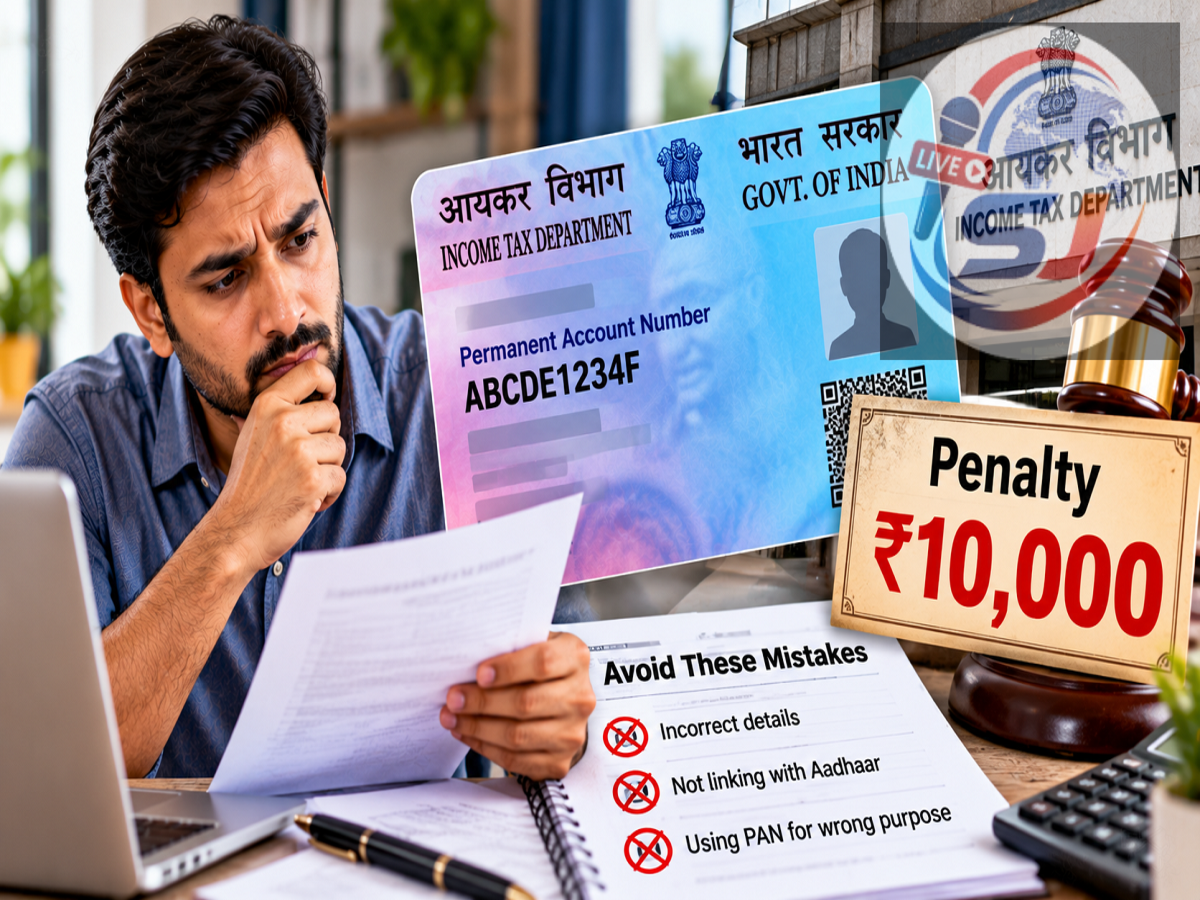
PAN Card Rules 2026: Having a Permanent Account Number (PAN) is important for banking, income tax filing and several financial transactions in India. However, simply obtaining a PAN card is not enough. Taxpayers must also follow the rules governing its use. Providing an incorrect PAN, failing to quote it where legally required or holding multiple PAN numbers can attract a penalty of ₹10,000 under Section 272B of the Income-tax Act, 1961, where applicable.
A PAN card is one of the most important financial identification documents in India. It helps the Income Tax Department track specified financial transactions and connect tax-related information with individual taxpayers.
Whether you are opening a bank account, investing in financial products or completing certain high-value transactions, PAN details may be required.
However, many people unknowingly make mistakes while using their PAN cards. These errors can lead to compliance issues and, in some cases, financial penalties.
According to a report published on October 8, 2026, taxpayers should be particularly careful about three common PAN-related mistakes that may result in a penalty.
1. Providing an Incorrect PAN Number During Financial Transactions
One of the most common mistakes is entering an incorrect PAN number while completing banking or financial transactions.
For example, a person may accidentally enter the wrong PAN while submitting information to a bank, financial institution or another organisation.
Under Section 272B of the Income-tax Act, 1961, quoting or intimating a PAN that is false, and which the person knows or believes to be false or does not believe to be true, can attract a penalty of ₹10,000.
However, an innocent typing mistake does not automatically mean that a ₹10,000 penalty will be imposed.
The circumstances of the error, applicable legal provisions and available defences matter.
How to avoid this mistake: Always double-check your PAN before submitting financial forms, income tax documents or other applications. If you discover an incorrect entry, contact the relevant institution to request a correction.
2. Not Providing PAN Where It Is Mandatory
Another important mistake is failing to quote or provide PAN details during transactions where the law specifically requires them.
PAN is mandatory for various specified financial activities, subject to applicable thresholds and exemptions.
Some common examples include:
-
Opening certain bank accounts.
-
Making specified high-value cash deposits.
-
Purchasing or selling immovable property above the prescribed threshold.
-
Investing in certain financial products.
-
Completing transactions that require PAN under income tax rules.
The requirements depend on the type and value of the transaction. Not every banking activity or financial purchase requires PAN.
Where PAN quotation is legally mandatory, failure to comply can attract penalties under the applicable provisions.
In certain situations, eligible individuals who do not have a PAN may be permitted to submit Form 60 instead, subject to the relevant rules.
Therefore, taxpayers should verify the PAN requirements before completing major financial transactions.
3. Holding More Than One PAN Number
The third major mistake involves possessing more than one PAN.
Under Indian income tax rules, a person is generally permitted to hold only one PAN number.
Sometimes, individuals accidentally obtain a second PAN after forgetting that they already have one. Others may apply for a fresh PAN after losing their physical card.
However, losing a PAN card does not mean that a person should apply for a completely new PAN number.
Instead, they should request a reprint or replacement card using their existing PAN.
Holding multiple PAN numbers can attract a penalty of ₹10,000 under Section 272B.
If you discover that more than one PAN has been allotted to you, take steps to surrender the additional PAN through the authorised process.
PAN Card Mistakes and Possible Penalties
| PAN-Related Mistake |
Possible Consequence |
|---|---|
| Knowingly quoting a false PAN |
₹10,000 penalty under applicable provisions |
| Failure to quote PAN where legally required |
₹10,000 penalty may apply |
| Holding multiple PAN numbers |
₹10,000 penalty may apply |
| Accidental PAN entry error |
Not automatically penalised; circumstances matter |
| PAN-Aadhaar linking non-compliance |
Separate consequences and applicable fees |
The ₹10,000 penalty is not necessarily imposed automatically whenever an error occurs. Legal conditions and procedural safeguards apply.
What Does Section 272B Say About PAN Penalties?
Section 272B of the Income-tax Act, 1961, provides for penalties relating to specified failures involving PAN requirements.
These include non-compliance with relevant PAN provisions, possession of multiple PAN numbers and certain instances of quoting false PAN information.
The provision prescribes a penalty of ₹10,000 for specified defaults.
However, taxpayers may have an opportunity to explain their circumstances before a penalty is imposed. Relief may also be available under applicable reasonable-cause provisions.
This means the Income Tax Department does not necessarily impose a penalty for every minor clerical error.
PAN 2.0: Why Taxpayers Should Be More Careful
The PAN 2.0 initiative is intended to modernise PAN-related services and improve the management of taxpayer identification information.
The system aims to provide more streamlined digital services, improved data consistency and stronger technology-based verification.
It may also support the identification of duplicate PAN records.
Importantly, PAN 2.0 does not mean that existing PAN holders must automatically apply for a new PAN number.
Existing valid PAN numbers continue to be used, and taxpayers should avoid applying for duplicate PANs unnecessarily.
Is PAN-Aadhaar Linking Mandatory in 2026?
PAN-Aadhaar linking is another important compliance requirement.
Under the applicable income tax provisions, individuals who are required to link their PAN with Aadhaar must complete the process to avoid their PAN becoming inoperative.
Certain categories of individuals are exempt from mandatory linking.
An inoperative PAN can create difficulties in financial transactions, tax processing and other PAN-related services. Higher tax deduction or collection rates may also apply in specified circumstances.
Eligible taxpayers seeking to make an inoperative PAN operative may need to complete the prescribed linking process and pay the applicable fee.
The PAN-Aadhaar linking fee is separate from the ₹10,000 penalty discussed under Section 272B.
How to Check PAN Details Online
Taxpayers can use the official Income Tax Department portal to access available PAN-related services.
-
Visit www.incometax.gov.in.
-
Navigate to the relevant PAN verification or PAN-Aadhaar linking service.
-
Enter the requested details.
-
Complete any required verification.
-
Review the displayed status and follow the official instructions if a correction is necessary.
For PAN corrections, reprints or surrender-related procedures, use authorised service channels rather than unknown websites or agents.
What Should You Do if You Have Two PAN Cards?
If you have accidentally received two different PAN numbers, do not continue using both.
Identify the PAN that should be retained, taking into account your existing tax records and financial accounts.
Then follow the authorised procedure for surrendering the additional PAN.
Where necessary, seek assistance from the Income Tax Department or a qualified tax professional to avoid complications involving past returns, bank accounts or investments.
Final Takeaway
PAN card holders should pay attention to three important rules: do not knowingly provide a false PAN, quote PAN wherever legally required and never hold multiple PAN numbers.
Violations covered by Section 272B of the Income-tax Act, 1961, can result in a ₹10,000 penalty, subject to the applicable legal conditions.
Taxpayers should also keep their PAN information accurate, check whether Aadhaar linking is required and use only official platforms for PAN-related services.
Disclaimer: This article explains the PAN penalty provisions discussed in the October 8, 2026 report. The applicability of provisions under the Income-tax Act, 1961, should be checked against the law governing the relevant tax period, including any changes introduced by the Income-tax Act, 2025.