
PAN Card Rules 2026: 5 Important Financial Transactions Requiring PAN, ₹10,000 Penalty Explained
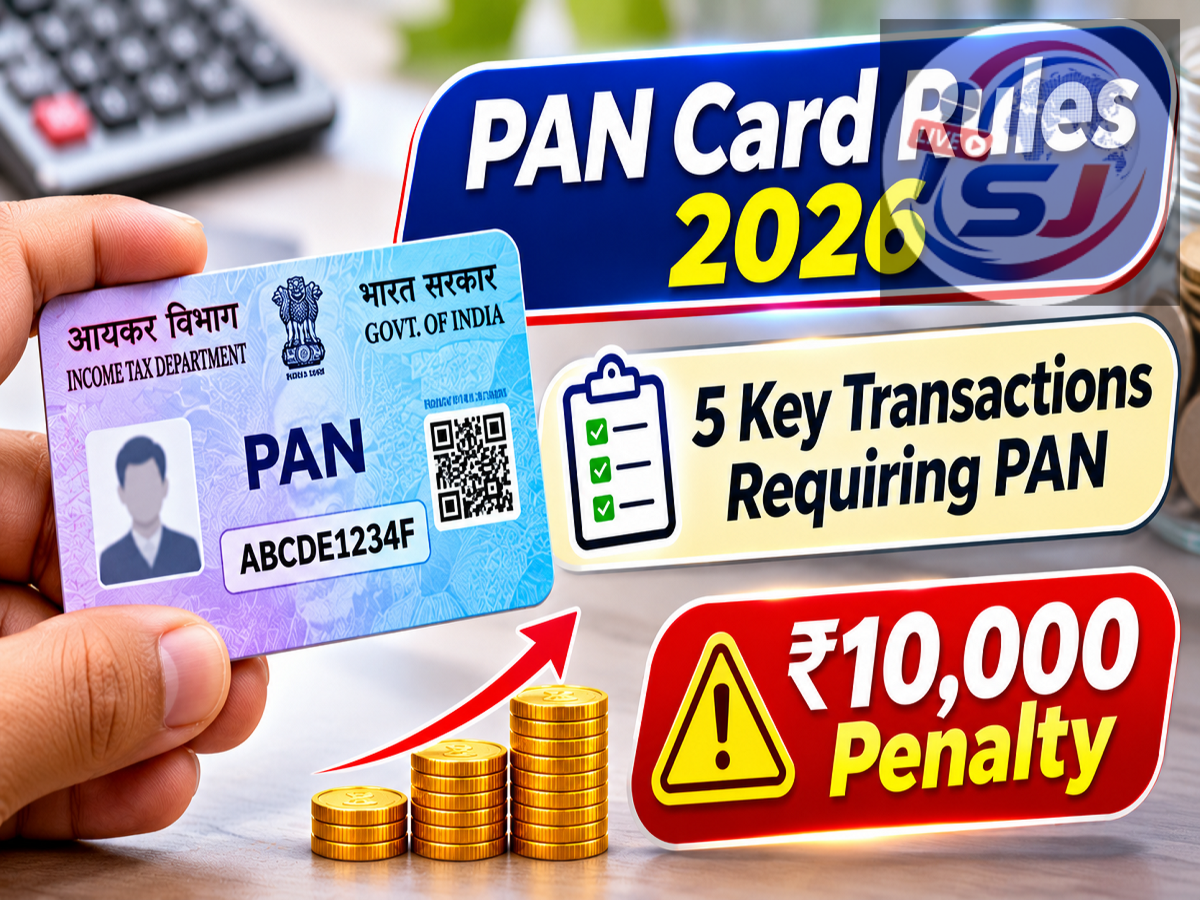
PAN Card Rules 2026: A Permanent Account Number (PAN) is one of the most important financial identification documents in India. Although it is commonly associated with filing income tax returns, PAN is also required for several banking, investment, property and other financial transactions.
Whether you are planning to purchase a house, buy a car, invest in shares or open a Demat account, understanding the applicable PAN requirements can help you avoid unnecessary complications.
Under Section 272B of the Income-tax Act, violations of prescribed PAN-related requirements, including quoting an incorrect PAN in certain circumstances, may attract a penalty of ₹10,000.
However, the penalty is not automatically imposed for every accidental typing error. Its applicability depends on the relevant legal provisions and circumstances.
Here are five important financial activities where PAN information may be required, along with the rules, penalties and precautions taxpayers should understand.
What Is a PAN Card and Why Is It Important?
PAN stands for Permanent Account Number. It is a unique ten-character alphanumeric identification number issued by the Income Tax Department.
The number helps authorities identify taxpayers and connect financial information reported by banks, employers, investment institutions and other entities.
PAN also plays an important role in monitoring specified financial transactions and matching tax-related information.
For example, when an individual earns interest, receives income subject to TDS or carries out certain investments, PAN information may be used to link those transactions with the taxpayer's records.
This makes it important to provide accurate PAN details wherever they are legally required.
1. Buying or Selling Property
PAN requirements can apply when purchasing or selling residential or commercial property.
Transactions involving houses, apartments, land, shops and other immovable properties may fall under the relevant reporting provisions.
Under the previously published Rule 114B framework, PAN quoting was required for specified immovable property transactions exceeding ₹10 lakh, including transactions valued above the prescribed stamp valuation threshold.
However, taxpayers should verify the rules applicable on the actual transaction date, particularly where new provisions or amendments have taken effect.
PAN details may also be requested during property registration and associated documentation.
Providing accurate information helps ensure that the transaction is correctly reflected in financial and tax records.
2. Purchasing Expensive Goods or Services
PAN may also be required for certain high-value purchases.
Under the published Rule 114B provisions, transactions involving the sale or purchase of goods or services exceeding ₹2 lakh per transaction were subject to PAN quoting requirements, subject to applicable exceptions.
Such transactions could include expensive jewellery, electronics and other high-value products.
However, taxpayers should distinguish between PAN requirements, cash transaction restrictions and financial reporting obligations.
These rules are not necessarily identical, and different monetary thresholds may apply.
Before making a large purchase, customers should confirm the applicable documentation requirements with the seller or a qualified tax professional.
3. Buying or Selling Shares of Unlisted Companies
PAN-related requirements can also apply to certain transactions involving shares of companies that are not listed on recognised stock exchanges.
These are commonly known as unlisted shares.
Unlike shares traded through regular stock market platforms, unlisted share transactions may involve different documentation, valuation and tax considerations.
Investors should understand the applicable PAN, reporting and capital gains tax requirements before completing such transactions.
Maintaining accurate records of the purchase price, sale consideration and transaction date is particularly important.
These details may be needed when calculating taxable gains or reporting investment income.
4. Purchasing a Car or Other Motor Vehicle
PAN information is another important consideration when buying a motor vehicle.
Under the previously published Rule 114B provisions, PAN was required for the purchase or sale of a motor vehicle other than a two-wheeled vehicle, irrespective of its value.
This means the requirement was not limited to expensive luxury cars.
However, customers should verify the current provisions applicable to their transaction, as reporting requirements and monetary thresholds may change through legislative amendments.
Vehicle dealers may request PAN information as part of the purchase documentation.
Customers should ensure that the PAN number is entered correctly on the relevant forms and invoices.
5. Opening a Demat Account and Investing in the Stock Market
PAN is an important requirement for investors entering the securities market.
Individuals opening a Demat account generally need to complete a Know Your Customer (KYC) process.
PAN is a key part of this verification procedure.
A Demat account allows investors to hold shares and other eligible securities electronically.
PAN-related requirements may also apply to mutual fund investments and other financial products.
Investors should ensure that the PAN information provided to brokers, depository participants and investment platforms matches their official records.
Incorrect details can create problems during account verification, transactions or compliance checks.
PAN Card Rules 2026: Important Financial Transactions
| Financial Activity | PAN Requirement |
|---|---|
| Property purchase or sale | Required for transactions meeting applicable thresholds |
| High-value goods or services | May be required under prescribed transaction limits |
| Unlisted share transactions | Applicable according to transaction type and rules |
| Car or motor vehicle purchase | Subject to prescribed motor vehicle provisions |
| Demat account opening | PAN is generally required for KYC compliance |
Important: The monetary thresholds and transaction categories must be checked against the provisions legally effective on the transaction date. Earlier Rule 114B requirements should not automatically be treated as the final position for every transaction in November 2026.
Can You Be Fined ₹10,000 for Quoting the Wrong PAN?
Section 272B of the Income-tax Act provides for penalties relating to certain failures to comply with PAN requirements.
A penalty of ₹10,000 may apply in specified circumstances, including certain cases involving incorrect PAN information or failure to comply with prescribed obligations.
However, this does not mean every minor typing mistake automatically results in a penalty.
The relevant statutory conditions, explanations and circumstances of the case must be considered.
Taxpayers should therefore review their PAN details carefully before submitting financial documents.
If an error is discovered, it is advisable to contact the relevant bank, employer, investment institution or reporting entity to request correction.
Incorrect PAN Can Create Problems With TDS Credit
Providing an incorrect PAN can cause difficulties beyond potential penalties.
For example, if tax has been deducted at source from an individual's income but the deductor reports an incorrect PAN, the TDS information may not be properly reflected in the intended taxpayer's records.
This can create a mismatch when filing an income tax return.
In some situations, the taxpayer may need to contact the employer, bank or other deductor and request a correction to the relevant TDS statement.
Such problems can delay the reconciliation of tax credits and may require additional documentation.
To identify discrepancies early, taxpayers should regularly review their Form 26AS and Annual Information Statement (AIS).
How Does the Income Tax Department Track Financial Transactions?
The Income Tax Department receives information about specified financial activities through several reporting mechanisms.
These include Tax Deducted at Source (TDS), Tax Collected at Source (TCS) and Statements of Financial Transactions (SFT).
Information received from reporting entities may also appear in a taxpayer's Annual Information Statement.
This allows individuals to review certain financial activities reported against their PAN.
If the information reported by financial institutions differs significantly from the details declared in a tax return, the department may seek clarification.
However, conducting a high-value transaction does not automatically indicate tax evasion or non-compliance.
The source of funds, applicable tax treatment and supporting records are relevant considerations.
How to Avoid PAN-Related Problems
Taxpayers can reduce the risk of errors by following a few important precautions.
-
Verify your PAN number: Double-check all ten characters before submitting financial documents.
-
Keep personal details updated: Ensure that your name and other relevant information are accurate in official PAN records.
-
Check PAN-Aadhaar linking: Confirm your linking status where the requirement applies.
-
Review tax records: Examine Form 26AS and AIS periodically to identify incorrect or missing information.
-
Correct discrepancies promptly: Contact the relevant institution if a transaction is reported against the wrong PAN.
-
Protect personal information: Avoid sharing PAN details through suspicious websites, messages or unknown intermediaries.
These precautions can help prevent unnecessary delays during financial transactions and income tax compliance.
Where Can You Verify PAN Rules?
Taxpayers should rely on official government sources when checking PAN requirements, penalties and transaction thresholds.
The Income Tax Department provides information about PAN services, income tax provisions and compliance requirements.
Official websites:
-
Income Tax Department: https://www.incometax.gov.in/
-
Income Tax Department information portal: https://www.incometaxindia.gov.in/
For significant property purchases, investments or other high-value transactions, professional advice may also be useful.
Final Update
PAN is much more than an identification number used for filing income tax returns.
It plays an important role in property transactions, vehicle purchases, securities investments and several other prescribed financial activities.
Providing incorrect PAN information or failing to comply with applicable requirements may result in legal complications, including a possible ₹10,000 penalty under the relevant provisions.
Incorrect PAN details can also affect TDS credit reconciliation and create mismatches in tax records.
The safest approach is to verify PAN information carefully and check the rules applicable to each transaction before completing it.
Official Reference: Income Tax Department, Government of India — published information concerning Rule 114B and Section 272B.
Disclaimer: This article is intended for general informational purposes. PAN requirements, monetary thresholds and penalty provisions may change under applicable tax legislation. Readers should verify the rules in force on the relevant transaction date.
Remove unsupported 2026 certaintyAdd a reader-friendly summary box