
NPS Rules 2026: Nomination Mandatory, Check PRAN Guidelines and 25% Partial Withdrawal Limit
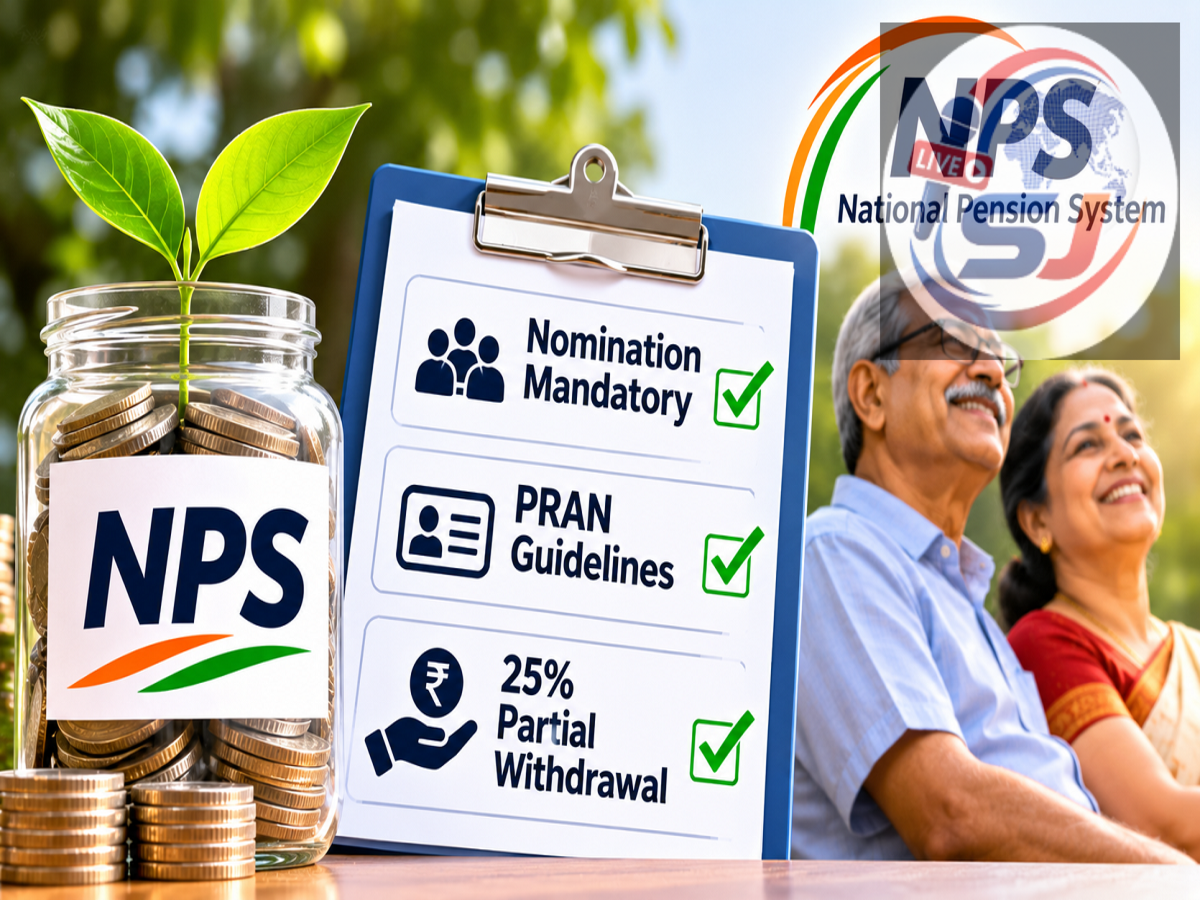
NPS Latest Update 2026: The National Pension System (NPS) is an important retirement savings scheme for government employees and other eligible subscribers in India. While many account holders regularly contribute towards their retirement savings, some may not be fully aware of the rules governing nomination, Permanent Retirement Account Numbers (PRAN) and partial withdrawals.
A recent set of Frequently Asked Questions (FAQs) issued by the Kendriya Vidyalaya Sangathan (KVS) for its teachers has brought attention to these essential NPS provisions.
According to a report published by Live Hindustan on November 17, 2026, the FAQs explain why every subscriber must maintain a unique PRAN, why nomination details are important and under what conditions money can be withdrawn before retirement.
The guidance is particularly useful for government employees who want to manage their retirement accounts efficiently and avoid difficulties when making claims or requesting withdrawals.
What Is the National Pension System?
The National Pension System is a retirement savings arrangement regulated by the Pension Fund Regulatory and Development Authority (PFRDA).
Under NPS, eligible subscribers make contributions towards a retirement corpus that is invested according to the applicable scheme and investment choices.
The accumulated retirement savings are intended to provide financial support after the subscriber stops working.
NPS is used by eligible central and state government employees and is also available to other categories of subscribers under the relevant rules.
Because it is designed primarily for long-term retirement savings, withdrawals are subject to specific conditions.
What Is PRAN and Why Is It Important?
Every NPS subscriber receives a unique identification number known as the Permanent Retirement Account Number, or PRAN.
This number serves as the permanent identity of the subscriber within the NPS framework.
One of the major advantages of PRAN is its portability.
If an employee changes departments, transfers to another location or moves between eligible organisations, the existing PRAN can continue to be used.
For example, an employee transferred from one central government department to another generally does not need to open a completely new NPS account with a different PRAN.
The existing account can continue under the applicable transfer and registration procedures.
This helps maintain continuity in retirement savings and makes it easier to track contributions.
Can One Person Have Two PRAN Numbers?
According to the KVS guidance discussed in the report, an NPS subscriber is permitted to maintain only one PRAN.
The number remains unique and permanent throughout the subscriber's participation in the system.
Employees should therefore avoid applying for another PRAN merely because they have changed jobs or departments.
Instead, they should contact the appropriate NPS nodal office or account service provider to complete the required account transfer or updating process.
Maintaining a single PRAN helps prevent duplication and reduces the risk of complications in contribution records.
Is Nomination Mandatory When Opening an NPS Account?
Yes. The KVS FAQs state that subscribers are required to provide nomination details when opening an NPS account.
A nominee is a person designated by the subscriber to receive or claim applicable benefits in the event of the account holder's death, subject to the relevant NPS rules.
Nomination is an important part of retirement account management because it helps identify the person or persons entitled to initiate the claim process.
Subscribers should provide accurate nominee details and keep the information updated.
Changes in family circumstances, such as marriage or other significant events, may make it necessary to review existing nominations.
The applicable rules governing family members and nomination eligibility should also be considered.
Can NPS Subscribers Register More Than One Nominee?
Yes. Subscribers may nominate more than one person, subject to the applicable nomination rules.
Where multiple nominees are permitted, the subscriber can specify the relevant share of benefits for each nominee according to the prescribed procedure.
For example, a subscriber may wish to nominate eligible family members rather than a single individual.
However, the nomination must comply with the rules applicable to the subscriber's account category.
It is advisable to verify nominee names, dates of birth, relationships and other required details carefully.
Incorrect or outdated information may create difficulties during the settlement process.
NPS Partial Withdrawal Rules: When Can You Withdraw Money?
NPS is primarily intended to build a retirement corpus, so subscribers cannot withdraw their entire savings whenever they wish.
However, partial withdrawal facilities are available under prescribed circumstances.
According to the KVS FAQs cited in the report, subscribers must satisfy certain conditions before applying for partial withdrawal.
These include a minimum membership period, a limit on the amount that can be withdrawn and restrictions on the number of withdrawals.
The rules highlighted in the report are particularly relevant to government employees covered by the KVS guidance.
Minimum Three Years of NPS Membership Required
The KVS guidance states that subscribers must complete at least three years of NPS membership before becoming eligible for the partial withdrawal facility described in the FAQs.
This means an employee who has recently joined the scheme cannot immediately withdraw a portion of the retirement savings under that provision.
The membership requirement is intended to preserve the long-term retirement purpose of the account.
Subscribers should check their original NPS registration date before submitting a withdrawal request.
How Much Money Can Be Withdrawn From NPS?
Under the rules explained in the report, an eligible subscriber may withdraw up to 25% of their own contributions, subject to the prescribed conditions.
This is an important distinction because the withdrawal limit is not calculated simply as 25% of the total NPS account balance.
The total account value may include contributions made by the employee, contributions made by the employer and investment returns.
The partial withdrawal ceiling described in the KVS FAQs relates to the subscriber's own contributions.
NPS Partial Withdrawal Calculation: Examples
| Subscriber's Own Contributions | Illustrative 25% Withdrawal Limit |
|---|---|
| ₹2,00,000 | ₹50,000 |
| ₹4,00,000 | ₹1,00,000 |
| ₹6,00,000 | ₹1,50,000 |
| ₹8,00,000 | ₹2,00,000 |
| ₹10,00,000 | ₹2,50,000 |
| ₹12,00,000 | ₹3,00,000 |
These figures are mathematical illustrations rather than guaranteed withdrawal entitlements.
The actual permissible amount depends on the subscriber's eligible contribution record, applicable rules and previous withdrawals.
How Many Times Can You Withdraw Money From NPS?
According to the KVS FAQs cited by Live Hindustan, eligible subscribers may use the partial withdrawal facility up to three times during their NPS membership.
This limit applies to the partial withdrawal arrangement described in the report.
It should not be confused with retirement withdrawals, final exits or other separately regulated NPS transactions.
Subscribers who have already used the partial withdrawal facility should check their account history before applying again.
The report does not establish that every type of NPS withdrawal is restricted to three occasions.
Is a Self-Declaration Required for NPS Withdrawal?
The KVS guidance states that subscribers must submit a self-declaration when requesting a partial withdrawal.
According to the FAQs, separate supporting documents are not required under the procedure described.
However, applicants must still satisfy the applicable eligibility conditions and provide accurate information.
The permitted reasons for withdrawal and the processing requirements should be confirmed through the relevant NPS authority or nodal office.
A self-declaration does not mean that subscribers can withdraw money for any purpose without restriction.
NPS Rules 2026: Important Details at a Glance
| Rule | Details |
|---|---|
| Retirement scheme | National Pension System |
| Regulator | Pension Fund Regulatory and Development Authority |
| Account identification | Permanent Retirement Account Number |
| Number of PRANs permitted | One per subscriber |
| PRAN portability | Continues across eligible job or department changes |
| Nomination | Required at account opening under the cited guidance |
| Multiple nominees | Permitted subject to applicable rules |
| Minimum membership for partial withdrawal | Three years |
| Partial withdrawal ceiling | Up to 25% of eligible own contributions |
| Number of partial withdrawals | Up to three under the cited rules |
| Declaration requirement | Self-declaration |
| Main purpose | Long-term retirement savings |
Why Should Employees Keep Their Nominee Details Updated?
Nomination details can play an important role in the settlement of NPS benefits after a subscriber's death.
If the information is incomplete or outdated, family members may face additional documentation requirements or delays.
Subscribers should periodically review their account records and ensure that the nomination information reflects their current circumstances.
They should also verify that the information registered with the NPS account matches the details required under the relevant rules.
Employees who are uncertain about the procedure can contact their designated NPS nodal office or authorised account service provider.
What Should You Check Before Applying for Partial Withdrawal?
Before submitting a withdrawal request, subscribers should review their account information carefully.
They should confirm that the minimum membership requirement has been completed and that the requested withdrawal falls within the permissible limit.
It is also important to check the number of previous partial withdrawals and whether the intended purpose is permitted under the applicable regulations.
Subscribers should understand that withdrawing money before retirement reduces the amount remaining invested for future retirement needs.
Even when a withdrawal is permitted, its long-term financial impact deserves consideration.
Are These Rules Applicable to Every NPS Subscriber?
The rules discussed in the source article come from FAQs issued by KVS for its teachers.
Although several principles, such as PRAN uniqueness and nomination requirements, are relevant across NPS accounts, withdrawal and exit provisions can vary depending on subscriber category and the regulations applicable at the time.
Government-sector, corporate-sector and all-citizen NPS subscribers should verify the rules governing their own accounts.
Subscribers should also distinguish between partial withdrawals during the accumulation phase and withdrawals permitted at retirement or exit.
For the latest regulatory information, users can consult the official PFRDA website at https://www.pfrda.org.in.
Conclusion
The National Pension System provides an important framework for building retirement savings, but subscribers must understand the rules governing account identification, nomination and withdrawals.
According to the KVS FAQs highlighted in the November 17 report, each subscriber should maintain a single PRAN and provide the required nominee information.
The guidance also describes a partial withdrawal facility after three years of membership, allowing eligible subscribers to withdraw up to 25% of their own contributions on a limited number of occasions.
Employees should keep their PRAN and nomination records accurate, review withdrawal eligibility carefully and confirm the latest applicable rules before submitting any request.
Disclaimer: This article explains the NPS provisions described in the supplied KVS-related report. Actual nomination, withdrawal and exit conditions depend on the applicable PFRDA regulations and subscriber category. Readers should verify the latest rules with their NPS nodal office or authorised service provider before taking financial action.