
November 1 Rule Changes 2026: LPG Prices, GST, Highway Rules and Mobile Calling Updates
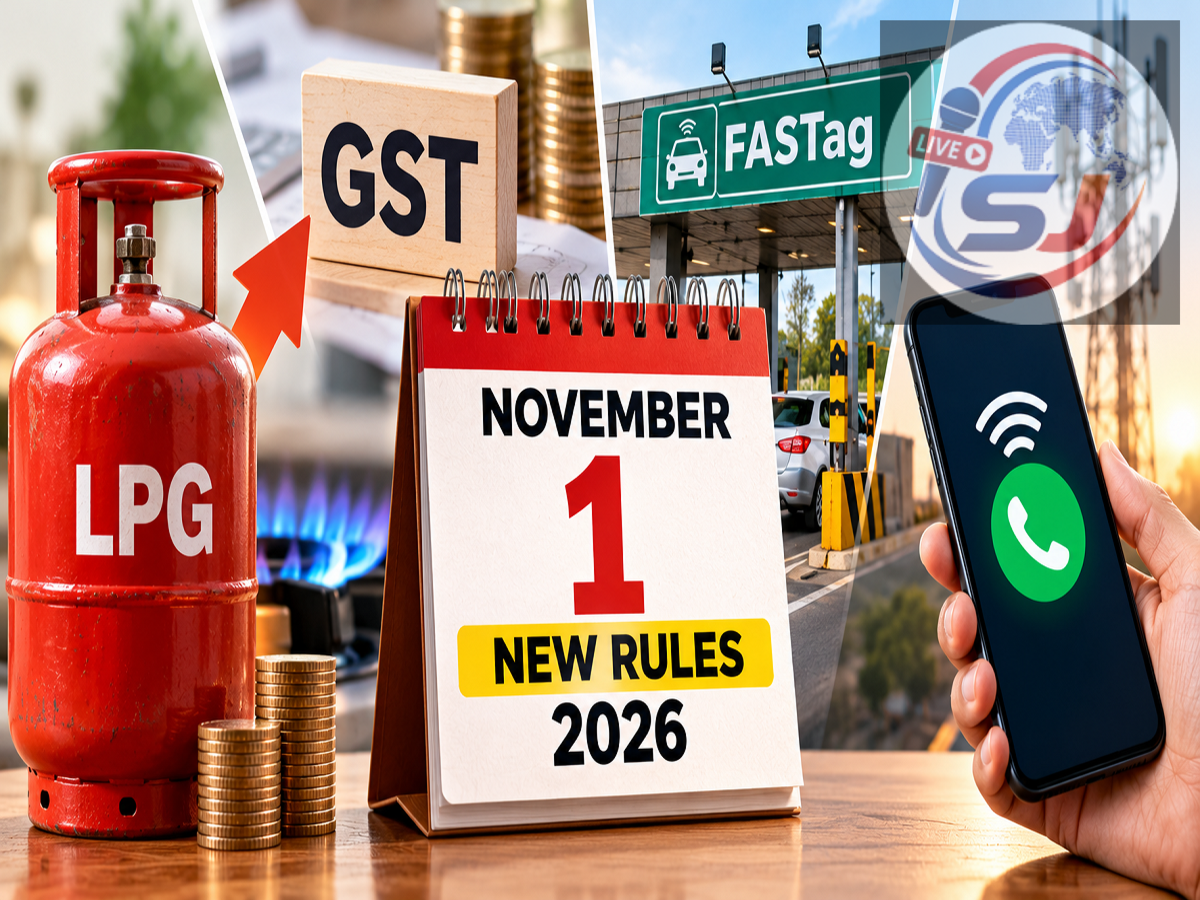
November 2026 New Rules: The beginning of November could bring several important changes affecting household expenses, business operations, highway travel and mobile phone services. From LPG cylinder prices to GST procedures and digital payment requirements, consumers should be aware of the developments expected from November 1, 2026.
Some changes relate to nationwide services, while others are limited to particular states or locations.
Oil marketing companies are expected to review LPG prices at the beginning of the month. Meanwhile, reports suggest changes involving GST compliance, liquor purchases in Tamil Nadu, traffic restrictions on a Mumbai–Pune connecting route and Calling Name Presentation (CNAP) services.
However, not every reported measure has been independently confirmed as fully operational from November 1.
Here are five important developments to watch.
1. LPG Cylinder Prices May Change From November 1
The first major development concerns Liquefied Petroleum Gas (LPG) cylinder prices.
Oil marketing companies periodically review LPG rates, with commercial cylinder prices commonly revised at the beginning of a month.
Consumers will therefore be watching for new prices on November 1.
Earlier, on October 1, 2026, the prices of 19-kg commercial LPG cylinders reportedly increased by up to ₹62.50.
However, domestic LPG cylinder prices remained unchanged during that revision.
Whether domestic or commercial LPG prices increase, decrease or remain unchanged in November will depend on the rates announced by the oil marketing companies.
Who Could Be Affected?
Domestic LPG consumers may see an impact on household cooking expenses if the price of a 14.2-kg cylinder changes.
Restaurants, hotels, food vendors and other commercial establishments could also be affected by changes in 19-kg cylinder prices.
Consumers should check the latest city-specific rates through the official websites of Indian Oil, Bharat Petroleum or Hindustan Petroleum.
The November prices should not be treated as confirmed before the companies announce them.
2. GST Changes May Simplify Refunds and Returns
Another important development concerns the Goods and Services Tax (GST).
Reports suggest that the government is preparing changes intended to make certain GST procedures easier for businesses.
One area under discussion involves simplifying tax refund processing.
Eligible refunds may be processed more quickly through automated procedures, reducing the need for repeated manual intervention.
Another proposal concerns simplified compliance arrangements for certain smaller businesses.
Reports have discussed a possible return framework for eligible businesses with annual turnover below ₹5 crore that sell goods or services directly to consumers.
However, the eligibility conditions, implementation date and final procedures must be checked against official GST notifications.
How Could Businesses Benefit?
If the proposed measures are implemented, eligible businesses could experience faster refund processing and reduced compliance requirements.
This may be particularly useful for small traders and businesses that face cash-flow difficulties because of delayed refunds.
However, business owners should not change their return-filing procedures solely on the basis of media reports.
They should continue following the existing rules until the relevant notifications and portal instructions take effect.
Official updates are available at https://www.gst.gov.in/.
3. Tamil Nadu Liquor Payment Rules May Change
A state-specific payment change has also been reported in Tamil Nadu.
According to reports, the Tamil Nadu State Marketing Corporation (TASMAC) has decided to require digital payments for retail liquor purchases involving bottles priced above ₹1,000.
The measure is reported to take effect from November 1, 2026.
Under the reported arrangement, customers purchasing bottles above the specified price threshold would need to use an accepted digital payment method rather than cash.
The exact scope and implementation conditions should be verified through the applicable TASMAC instructions.
Will This Rule Apply Across India?
No. The reported payment requirement relates to Tamil Nadu.
It should not be confused with a nationwide ban on cash payments for liquor purchases.
Retail liquor regulations vary by state.
Customers in Tamil Nadu should check the payment options available at the relevant authorised outlets.
4. Mumbai–Pune Expressway Connecting Route: New Vehicle Restriction
Drivers travelling between Mumbai and Pune should also pay attention to a reported traffic restriction.
According to reports, Maharashtra Highway Police have decided to prohibit goods-carrying vehicles from using a specified new connecting link associated with the Mumbai–Pune Expressway.
The restriction is reported to take effect from November 1.
It may cover goods vehicles such as pickup vans, small commercial carriers and Tata Ace-type vehicles.
Private cars and passenger buses are reportedly permitted to use the route.
However, this restriction concerns the specified connecting link, not necessarily the entire Mumbai–Pune Expressway.
What Should Commercial Vehicle Drivers Do?
Transport operators should check the applicable traffic notification and identify an authorised alternative route before travelling.
Drivers should also follow road signs and instructions issued by traffic police.
Using an unauthorised route may lead to enforcement action under applicable traffic regulations.
The precise location and vehicle categories covered should be confirmed through Maharashtra Highway Police notices.
5. Mobile Calling Rules: CNAP Service in Focus
A significant telecom development concerns Calling Name Presentation, commonly known as CNAP.
The proposed service is intended to display the caller's registered name when an incoming call is received.
The objective is to help users identify callers and potentially reduce dependence on third-party caller-identification applications.
Reports suggest that telecom operators have been directed to prepare for CNAP implementation from November 1, 2026.
However, a reported implementation deadline does not necessarily mean that every mobile user will receive the feature simultaneously.
How Could CNAP Work?
Under the proposed system, the receiving phone may display a name associated with the caller's registered telecom identity.
The availability of the service can depend on network readiness, technical compatibility and regulatory implementation arrangements.
The feature could make it easier to identify certain unfamiliar callers.
However, a displayed name should not be treated as proof that a call is genuine.
Fraudsters may still use deceptive methods to impersonate banks, government departments or other organisations.
Mobile users should continue avoiding suspicious links and never share OTPs, banking passwords or UPI PINs.
November 1, 2026: Important Changes at a Glance
| Change | Reported Development | Who May Be Affected? |
|---|---|---|
| LPG prices | Monthly price review; change not yet confirmed | Households and commercial LPG users |
| GST procedures | Proposed refund and compliance simplifications | Eligible businesses and taxpayers |
| Liquor payments | Digital payment requirement reported for bottles above ₹1,000 | Customers at affected Tamil Nadu outlets |
| Highway traffic | Goods-vehicle restriction on a specified connecting link | Mumbai–Pune transport operators |
| CNAP | Caller-name identification rollout reported | Mobile subscribers, subject to availability |
Other Important November Deadlines to Remember
Apart from the five developments above, November is also important for pensioners and certain taxpayers.
Pension Life Certificate Submission
Eligible government pensioners generally submit their annual life certificates during November.
For many pensioners, the regular submission window runs from November 1 to November 30.
Pensioners aged 80 years and above are generally permitted to submit their life certificates from October 1.
The certificate can be submitted through eligible physical or digital channels, depending on the pension-disbursing authority.
Pensioners should check the requirements applicable to their pension.
Income Tax Return Deadline
Certain taxpayers covered by audit-related filing requirements should also review their income-tax deadlines.
Reports indicate that the deadline for specified Income Tax Returns for Assessment Year 2026–27 has been extended from October 31 to November 21, 2026.
However, this extension does not apply automatically to every taxpayer or every filing obligation.
Taxpayers should verify the relevant CBDT notification and their applicable category before relying on the revised date.
What Should Consumers Do Before November 1?
Households should check the latest LPG cylinder prices before booking a refill.
Business owners should monitor official GST notifications and avoid assuming that proposed compliance changes are already effective.
Transport operators travelling through the Mumbai–Pune corridor should review traffic restrictions.
Mobile users should check telecom operator announcements for information about CNAP availability.
Pensioners and taxpayers should also review their applicable November deadlines to avoid unnecessary delays.
Final Update
November 1, 2026, is expected to bring several developments involving LPG prices, GST procedures, regional payment rules, highway traffic and mobile calling services.
However, the scope of these changes differs.
Some are state-specific, some depend on company announcements, and others require final regulatory or operational confirmation.
Consumers should verify the rules relevant to them through official notifications rather than assuming that every reported change will apply nationwide from November 1.
Disclaimer: This article is based on information available as of October 28, 2026. Reported implementation dates and conditions may change. Readers should consult the relevant government departments, regulators and service providers for confirmed updates.
Source: Aaj Tak's October 27 report on five November rule changes. Additional reporting:
The Sootr+1