
NHAI Tightens Highway Ambulance Rules: Contractors Face Penalties for Every Minute of Delay
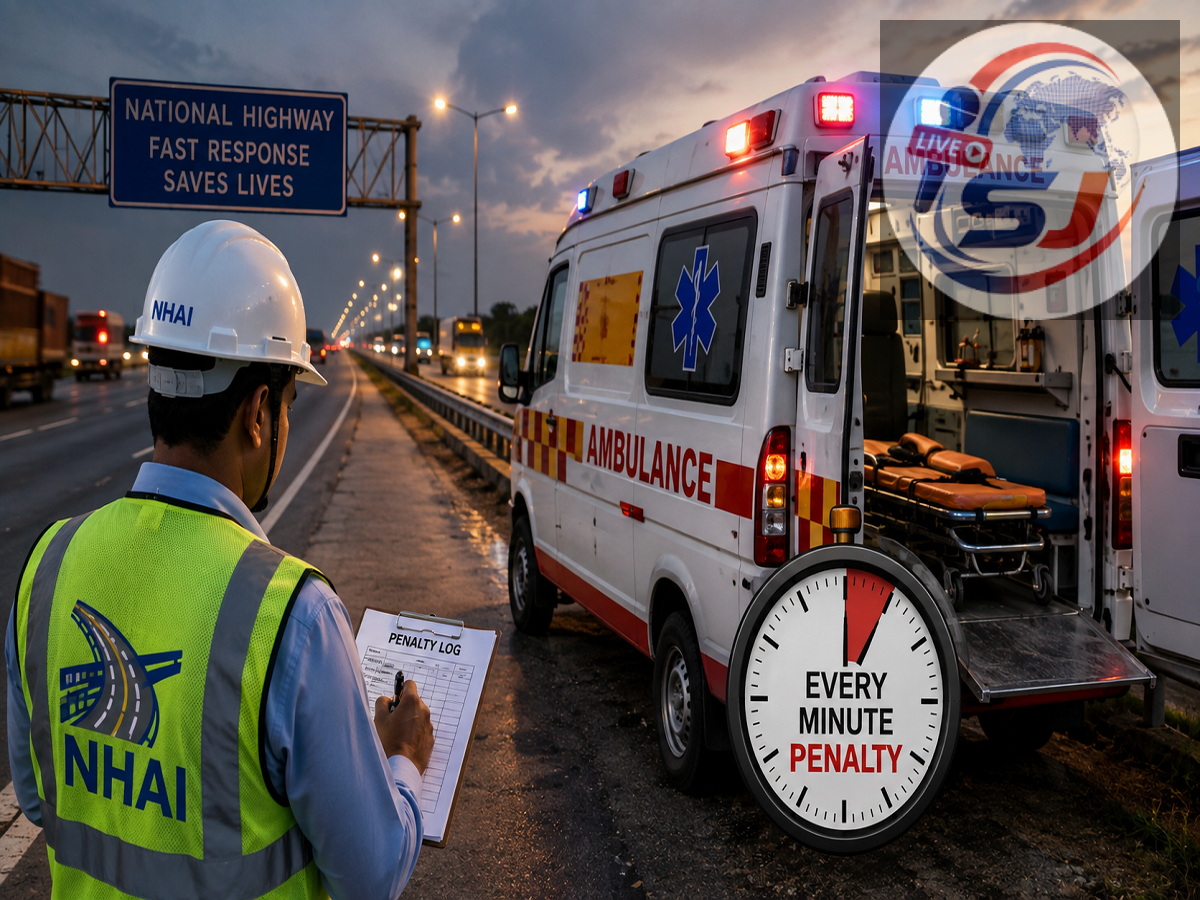
NHAI Ambulance Rules: Emergency response on India's national highways is set to face stricter monitoring, with the National Highways Authority of India introducing penalties for delays and service failures. Contractors could face fines for late acceptance of emergency requests, delayed ambulance dispatch, failure to reach accident sites on time and problems involving GPS, medical equipment or staffing.
Getting medical assistance quickly after a road accident can make a crucial difference for injured passengers. To strengthen emergency response across national highways, the National Highways Authority of India (NHAI) has tightened performance requirements for ambulance services managed under highway contracts.
The new framework establishes specific timelines covering different stages of an emergency—from accepting an accident alert and dispatching an ambulance to reaching the crash site and taking the injured person to a hospital.
Failure to meet these requirements can result in financial penalties for the responsible contractor.
Emergency Request Must Be Accepted Within One Minute
One of the strictest requirements concerns the initial emergency alert or "ticket."
According to the reported NHAI circular, an emergency request must be acknowledged within one minute. If the response takes longer, a penalty of ₹5,000 for every additional minute of delay can be imposed.
The provision is intended to ensure that valuable time is not lost at the very beginning of an emergency response.
Ambulance Must Leave Within Two Minutes
Accepting the request alone will not be sufficient.
Once an emergency call has been received, the ambulance is required to start its journey within two minutes.
Any delay beyond the prescribed dispatch period can attract a penalty of ₹5,000 for each additional minute.
This means contractors will need to ensure that ambulances remain operationally ready and that drivers and emergency medical personnel are available when an accident alert arrives.
Accident Within 10 Km? Ambulance Gets 10 Minutes to Reach
NHAI has also established a response benchmark based on the distance between the ambulance base and accident location.
If a crash occurs within 10 kilometres of the ambulance base, the emergency vehicle is expected to reach the site within 10 minutes.
Failure to meet this timeline can result in a ₹10,000 penalty for the incident.
For accident locations more than 10 kilometres away, the permitted response time can increase according to the distance involved.
The distance-based framework recognises that ambulances cannot reach every location within the same period while still setting measurable response standards.
Injured Person Must Reach Hospital Within an Hour
Another significant provision concerns the time taken to transport accident victims to medical care.
Under the reported rules, an injured person must be taken to the nearest appropriate hospital within one hour of the accident.
Failure to meet the stipulated requirement may lead to a ₹10,000 penalty.
The measure is aimed at reducing avoidable delays between an accident and hospital treatment, particularly in serious highway crashes where immediate medical attention may be critical.
Refusing an Emergency Ticket Can Cost ₹10,000
Ambulance operators will also face action if they simply refuse to accept an emergency assignment.
According to the circular, refusal to take an emergency ticket can attract a ₹10,000 penalty for each instance.
The provision is intended to prevent emergency vehicles from remaining unavailable without a valid operational reason when they are required at an accident site.
GPS and Online Tracking Will Be Closely Monitored
The new enforcement mechanism goes beyond response times.
NHAI has also tightened requirements related to digital monitoring of highway ambulances. GPS tracking and the relevant ambulance application are expected to remain operational so that the location and status of emergency vehicles can be monitored.
If the GPS is switched off, an ambulance is not shown as online on the application, or its details are unavailable on the monitoring dashboard, the contractor may face a penalty of ₹2,500 per day.
Reliable GPS tracking can help control rooms identify the nearest available ambulance and coordinate emergency responses more effectively.
Missing Medicines, Equipment or Staff Can Trigger Penalty
Ambulances must also remain properly equipped and staffed.
If an inspection identifies deficiencies involving required medicines, medical equipment, the driver or an Emergency Medical Technician (EMT), a penalty of ₹10,000 per inspection may be imposed.
This requirement seeks to ensure that an ambulance reaching an accident scene is actually capable of providing the intended emergency support rather than merely transporting patients.
Daily Mock Run Required for Highway Ambulances
Operational readiness will also be checked through regular movement.
Each ambulance is required to undertake at least one dry run or mock drill within every 24-hour period, covering a minimum distance of 5 kilometres.
However, the separate dry-run requirement will not apply if the ambulance has already responded to an accident during the same day and its total movement for that emergency exceeds 5 kilometres.
The rule is designed to help confirm that the vehicle remains functional and ready for deployment.
Ambulances May Have to Cross Their Assigned Highway Section
Another important change concerns jurisdiction.
An ambulance may be required to travel outside its usual highway section when the emergency vehicle assigned to a neighbouring stretch is unavailable.
In practical terms, contractors cannot necessarily refuse assistance simply because an accident occurred beyond their normal operating boundary. Available resources may have to be deployed across sections when needed to ensure faster emergency support.
How Will NHAI Recover the Penalties?
The penalties are expected to be calculated through NHAI's CARE system.
Depending on the type of highway contract, the amount can be deducted from payments due to the responsible service provider. This could include monthly ambulance-service payments, quarterly maintenance payments for EPC projects or half-yearly payments under HAM projects.
However, according to the reported framework, the total penalty in a month will be capped at ₹2.5 lakh.
Why Has NHAI Tightened Ambulance Monitoring?
The measures follow concerns over weaknesses in highway emergency-response systems, including ambulances not appearing online, GPS-related issues and inadequate use of monitoring applications.
Such failures can make it more difficult to identify and dispatch an available ambulance quickly after an accident.
Delays in highway ambulance response have also reportedly been raised by the Supreme Court Committee on Road Safety and through performance-audit observations by the Comptroller and Auditor General (CAG).
By linking response standards directly with financial penalties, NHAI is seeking to make contractors more accountable for ambulance readiness and emergency response.
For highway users, the objective is straightforward: when a serious accident occurs, an ambulance should accept the request quickly, leave without unnecessary delay, reach the victim as soon as possible and help ensure timely access to hospital care.