
New Rules From October 1: LPG, FD, SBI, NPS, PUC and Other Changes You Should Know
October 2026 is set to begin with several changes that could affect household expenses, banking, taxation, LPG users, vehicle owners and public transport passengers. Some changes described in the supplied information are nationwide financial or compliance measures, while others apply only to particular banks, customer categories or locations.
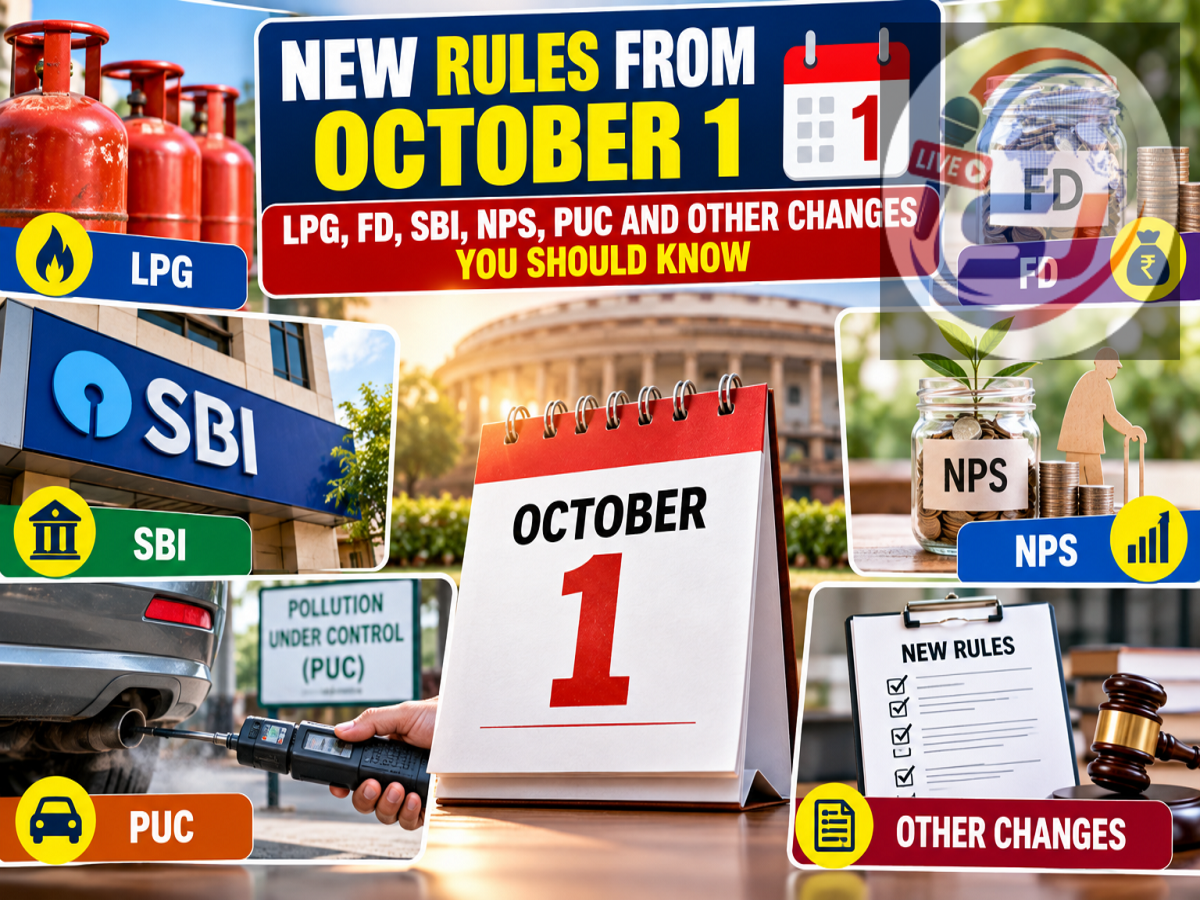
The changes highlighted in the source include LPG biometric Aadhaar authentication, new Fixed Deposit (FD) requirements, SBI cash-withdrawal charges, birth and death registration procedures, an expected NPS healthcare initiative, property TDS compliance, appliance prices and stricter PUC enforcement in Delhi.
Delhi's free bus travel system for women is also stated to be changing from October 1.
Consumers should pay attention to the scope of each change because not every rule applies to everyone.
October 1 Rule Changes: What Is Changing?
Here is a quick overview based on the supplied information:
| Area | Change Mentioned From October 1 |
|---|---|
| LPG | Biometric Aadhaar authentication linked with subsidised refills |
| Fixed Deposits | Uniform-rate requirements for same-date, same-amount deposits; SFB disclosure changes |
| SBI | Four free cash withdrawals for specified Basic Savings Bank Deposit Accounts, then charges |
| Birth/Death Registration | Different procedure based on delay period |
| NPS | ‘NPS Swasthya’ scheme expected to launch |
| Property Purchase From NRI | PAN-based TDS compliance for specified resident/HUF buyers |
| Home Appliances | Some manufacturers expected to raise prices by 5%–8% |
| Delhi PUC | Enforcement drive against vehicles without valid PUCC |
| Delhi Women's Bus Travel | Saheli Pink Smart Card stated to replace paper pink tickets |
The exact eligibility, geographic coverage and implementation conditions vary considerably across these changes.
LPG Subsidy: Biometric Aadhaar Authentication Becomes Important
LPG consumers receiving subsidised refills should pay particular attention to their biometric Aadhaar authentication status.
According to the supplied information, customers who have not completed the required biometric Aadhaar authentication should do so before October 1.
The important point is that failure to complete authentication is not described as automatically cancelling the LPG connection.
The customer may continue to receive cylinders, but the source states that the subsidy benefit could be affected and the refill may have to be purchased at the applicable market price.
The authentication process is stated to be available through applicable oil marketing company mobile apps, at the LPG distributor's showroom or during cylinder delivery.
Consumers should use authorised channels and should never share an OTP, UPI PIN or banking password with someone claiming to complete LPG e-KYC.
FD Rules Are Also Set to Change
Fixed Deposit customers may also see changes from October 1.
According to the supplied information, RBI directions require banks to offer the same interest rate across branches and customers for deposits of the same amount placed on the same date under the applicable conditions.
The source presents this as a move aimed at increasing transparency and reducing differences in rates offered for comparable deposits.
It also states that Small Finance Banks will have to update their FD interest-rate lists on their official websites every day by 10 AM.
This should make it easier for depositors to see the applicable rates before placing their money in an FD.
However, depositors should still examine the applicable tenure, deposit category, customer category and other terms instead of assuming that every FD will carry one uniform interest rate.
SBI Cash Withdrawal Charges Changing
State Bank of India customers with a particular type of basic savings account also need to pay attention.
The supplied information specifically refers to Basic Savings Bank Deposit Accounts opened through SBI branches.
From October 1, these account holders will reportedly receive four free cash withdrawals per month.
After the free limit is exhausted, the source states that a charge of:
₹15 plus applicable GST per withdrawal
will apply.
This should not be interpreted as a ₹15 charge on every SBI customer's fifth cash withdrawal without checking the type of account involved.
The supplied information specifically identifies the affected Basic Savings Bank Deposit Account category.
Birth and Death Registration: 21-Day Window Matters
The source also describes changes concerning delayed birth and death registration.
A birth or death registered within 21 days is described as falling under the normal registration process and being free of charge.
The certificate can be obtained through the relevant hospital or local authority, such as the municipal body or panchayat, depending on the applicable process.
If registration is delayed beyond 21 days, additional formalities can apply, including a late fee and affidavit according to the supplied information.
The requirements become more stringent as the delay increases.
What Happens When Registration Is Delayed?
According to the supplied article, the approval requirement depends on how long registration has been delayed.
For a delay extending beyond one year but remaining within two years, approval from a competent Executive Magistrate is stated to be required.
Where more than two years have passed without registration, the source states that approval from a Judicial Magistrate First Class would be required.
Because delayed-registration procedures can involve documentation and competent-authority approval, applicants should check the exact applicable process before submitting their request.
‘NPS Swasthya’ Scheme Expected From October 1
NPS subscribers may also see a new initiative called NPS Swasthya, according to the supplied report.
The scheme is described as combining retirement savings with healthcare-related benefits.
Under the proposed arrangement, subscribers would receive a separate super top-up health insurance policy associated with their NPS Swasthya account.
The source says the initiative is expected to begin from October 1, 2026 and could potentially benefit around 2.17 crore NPS subscribers.
The word “expected” is important here.
The supplied information does not establish that every existing NPS subscriber will automatically receive the benefit from October 1 or provide the complete eligibility, premium, coverage and enrolment rules.
Therefore, it should not be presented as an automatically available benefit until its final operational terms are known.
Buying Property From an NRI Could Become Simpler
The supplied report also describes an income-tax compliance change affecting certain property transactions involving an NRI seller.
From October 1, 2026, resident individual buyers and Hindu Undivided Families (HUFs) purchasing property from an NRI seller are stated to no longer require a separate Tax Deduction and Collection Account Number (TAN) for the specified TDS compliance.
Instead, they would be able to use their PAN to deduct and report TDS.
The purpose of the change is to simplify the compliance process for the specified buyers.
This does not mean that TDS itself disappears. The change described concerns the compliance mechanism and the requirement to obtain TAN.
TVs, ACs and Washing Machines Could Become More Expensive
Households planning to purchase appliances during the festive season may also face higher prices.
According to the supplied information, major manufacturers of products such as LED televisions, air conditioners and washing machines are preparing price increases of around 5% to 8% from October 1.
The source attributes the expected increase to higher input costs, including copper, steel and crude-oil-linked materials.
Currency volatility amid geopolitical tensions in West Asia is also cited as a contributing factor.
However, this should not be interpreted as a government-mandated 5%–8% price increase on every appliance sold in India.
These are described as manufacturer-led pricing decisions, and the actual increase can differ by company, product, model and retailer.
How Much Difference Could a 5%–8% Price Increase Make?
A simple illustration shows why appliance buyers may notice the change.
Suppose an appliance currently costs ₹40,000.
A 5% increase would add:
₹40,000 × 5% = ₹2,000
This would take the price to ₹42,000.
An 8% increase would add ₹3,200, taking the same product to ₹43,200.
These are only mathematical examples. They do not mean that every ₹40,000 appliance will necessarily become ₹42,000–₹43,200 from October 1.
Actual prices will depend on individual manufacturers and retailers.
Delhi PUC Enforcement to Become Stricter
Vehicle owners in Delhi need to pay particular attention to their Pollution Under Control Certificate (PUCC).
According to the supplied report, Delhi will launch an enforcement drive from October 1, 2026, aimed at vehicles being operated without a valid pollution certificate.
Transport Department and traffic-police teams are expected to conduct checks on Delhi roads and around Delhi-NCR borders.
The source states that driving without a valid PUCC can attract a penalty of ₹10,000 under the applicable motor-vehicle provisions.
It also refers to the possibility of imprisonment of three to six months or both under the relevant legal provisions.
The enforcement drive is linked to efforts to control air pollution as Delhi approaches the winter season.
Is the ₹10,000 PUC Rule New From October 1?
An important distinction is necessary.
The supplied information describes October 1 as the start of a stricter enforcement drive in Delhi.
Therefore, readers should not automatically interpret the ₹10,000 amount as a completely new penalty created for the first time on October 1.
The focus of the reported change is increased enforcement and checking.
Vehicle owners should ensure that their PUCC is valid before driving.
Delhi Women’s Free Bus Travel: Smart Card Change
Women using free bus travel in Delhi are also stated to face an important change from October 1.
According to the supplied information, women travelling free on DTC and cluster buses will need to use the Saheli Pink Smart Card.
The existing pink paper-ticket arrangement is stated to end after September 30.
From October 1, a passenger using the free-travel facility would need to tap the smart card on the bus's Electronic Ticketing Machine (ETM).
The source says that a woman without the required card would not receive the free-travel benefit under the new arrangement and would have to purchase a regular ticket like other passengers.
This change is Delhi-specific and should not be interpreted as a nationwide public-transport rule.
Which Changes Apply Across India and Which Are Limited?
Consumers should avoid treating every item in the October 1 list as one nationwide package.
For example, the SBI change applies to the specified SBI account category.
The Delhi PUC enforcement drive and Saheli Pink Smart Card arrangement are specific to Delhi.
The appliance-price increase is described as a commercial decision by manufacturers rather than a statutory government rule.
NPS Swasthya, meanwhile, is described in the supplied source as expected to launch, meaning its final implementation details need to be distinguished from confirmed operational rules.
What Should You Do Before October 1?
Consumers affected by these changes can take a few practical steps.
LPG subsidy beneficiaries should check whether their required Aadhaar authentication has been completed through an authorised channel.
SBI customers should identify their account type before assuming that the new withdrawal limit applies to them.
Vehicle owners driving in Delhi should check the validity date of their PUCC.
Women relying on Delhi's free bus-travel facility should verify the requirements for the Saheli Pink Smart Card.
Businesses and individuals involved in property purchases from NRI sellers should understand the revised tax-compliance process applicable to their transaction.
And anyone planning to purchase a major home appliance should compare actual retailer prices rather than assuming that every model will automatically become 5%–8% more expensive.
October 1 Changes: Key Takeaway
A number of financial, utility and compliance changes are expected or stated to take effect from October 1, 2026, but their scope differs significantly.
LPG subsidy beneficiaries need to pay attention to biometric Aadhaar authentication. FD customers may see greater transparency in deposit rates, while specified SBI basic savings account holders should watch the revised cash-withdrawal rules.
Property buyers dealing with NRI sellers could see simpler TDS compliance, while appliance manufacturers are reportedly considering price increases of 5%–8%.
In Delhi, vehicle owners face stricter PUCC enforcement, while women using free DTC and cluster-bus travel are stated to be moving from paper pink tickets to the Saheli Pink Smart Card.
At the same time, claims such as the launch of NPS Swasthya should be described as expected where the supplied information itself does not establish final implementation.
The most important step for consumers is to identify which change actually applies to them instead of assuming that every October 1 update affects every household, bank account or city in the same way.
Note: This article is based on the supplied source. Some items are presented there as confirmed changes, while others—particularly NPS Swasthya and manufacturer-led appliance price increases—are described as expected or planned. Readers should distinguish these from universally applicable nationwide rules.